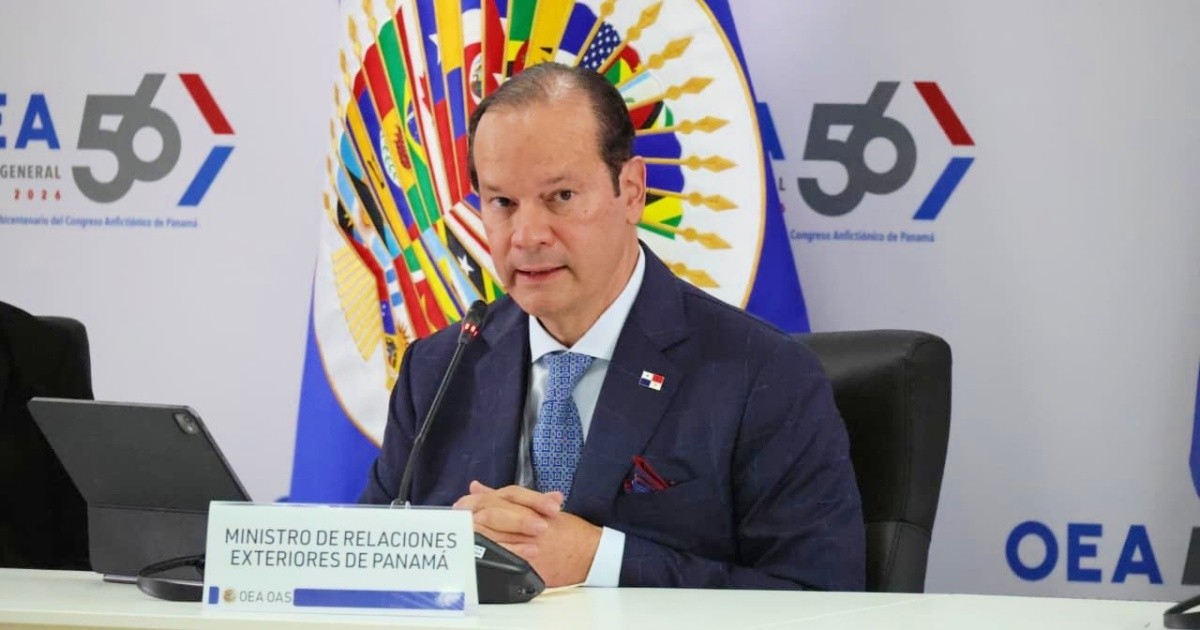
Panama's Foreign Minister Javier Martínez-Acha Vásquez has announced that his country is prepared to host discussions aimed at bridging the gap between the United States and Cuba. This announcement came as the 56th General Assembly of the Organization of American States (OAS) commenced in Panama City.
"Panama has volunteered to host dialogue between Cuba and the United States, emphasizing mutual respect and equality," the minister stated during a press briefing held before the hemispheric forum began at the Bolivar Palace, running from June 22 to June 24.
Political Impact of an Unspecified Agenda
While the foreign minister did not confirm whether Havana or Washington had responded to this proposal, nor did he provide details of any formal discussion agenda, the declaration opens the door for Panama to serve as a neutral ground in one of the hemisphere's most contentious bilateral relationships.
Martínez-Acha emphasized a diplomatic approach focused on "promoting understanding and fostering gradual solutions" to enhance regional stability. He encapsulated his vision with a straightforward message: "Let's advance on common ground."
Background of Geopolitical Tensions
The context is significant. In January 2026, President Donald Trump signed an executive order declaring the situation with Cuba an "unusual and extraordinary threat" to U.S. national security. On May 1, he enacted Executive Order 14404, imposing new sanctions against entities and officials of the Cuban regime, including the Ministry of the Armed Forces.
Despite these measures, in March 2026, Cuban leader Miguel Díaz-Canel acknowledged that initial contacts were underway between Cuban and American officials to explore potential solutions. Trump also suggested that an agreement with Cuba could be reached "very soon."
Ongoing Diplomatic Crisis Involving Panama
Panama's offer to mediate cannot be detached from a diplomatic crisis that has persisted since February 28, 2026, when ten Panamanian citizens were arrested in Havana under charges of spreading propaganda against the constitutional order. These charges carry potential prison sentences of up to eight years.
The Cuban authorities linked them to political graffiti with messages such as "Down with tyranny," "Communism: enemy of the community," and "We trust Donald Trump, Marco Rubio, and Mike Hammer."
The foreign minister traveled to Cuba on March 25, meeting with Díaz-Canel and his counterpart Bruno Rodríguez Parrilla. As a result, three Panamanian women—Evelyn Castro, Cinthia del Carmen Camarena, and Abigail Sthefany Gudiño—were released on April 25.
However, seven men remain detained at Villa Marista, the headquarters of Cuba's State Security: Víctor Manuel Pinzón Cedeño, Anthony Williams Jules Pérez, Omar Gilberto Urriola Vergara, Maykol Jesús Pérez Almendra, Adalberto Antonio Navarro Asprilla, Patrochiny Jerodady Joseph Arisarena, and José Luis Aguirre Baruco.
Regional Dynamics and Venezuela
During the same forum, Martínez-Acha reaffirmed Panama's recognition of Edmundo González as the elected president of Venezuela, calling for conditions that would allow Venezuela's reintegration into the regional community.
"For Venezuela to be integrated into the Latin American community, it must have a government supported by the ballot box," he asserted.
The 56th OAS Assembly in Panama gathers 34 ministers and vice-ministers, six secretaries-general of international organizations, and 55 special envoys, along with the presidents of Guatemala and Honduras and the vice president of El Salvador.
Whether Panama's proposal leads to actual discussions will depend on whether Havana and Washington agree to meet at the negotiation table, a step neither government has confirmed as of Monday.
Key Questions on Panama's Mediation Offer
What role is Panama offering in the U.S.-Cuba relations?
Panama is offering to host and facilitate dialogues between the United States and Cuba, promoting discussions based on mutual respect and equality.
What are the potential outcomes of Panama's mediation offer?
The potential outcomes include opening a neutral platform for dialogue, which could lead to easing tensions and exploring solutions to longstanding conflicts between the two nations.
How does the current geopolitical context affect the U.S.-Cuba relations?
The geopolitical context, marked by U.S. sanctions and Cuba's response, presents a challenging environment for diplomacy. However, initial contacts suggest there may be room for negotiation.
What impact does the arrest of Panamanian citizens in Cuba have on diplomatic relations?
The arrest of Panamanian citizens has strained diplomatic relations between Panama and Cuba, adding complexity to Panama's mediation efforts.