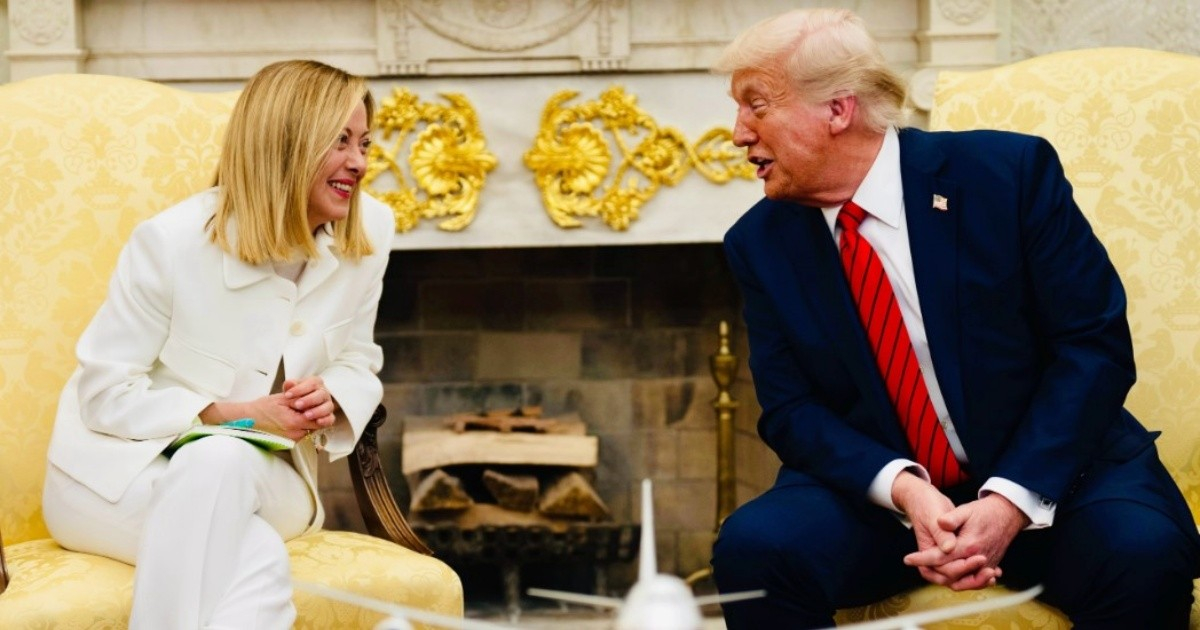
On Sunday, Donald Trump once again criticized Italy and its Prime Minister, Giorgia Meloni, accusing them of staying on the sidelines in the conflict with Iran despite decades of military support from the United States through NATO.
In a post on his Truth Social platform, Trump lambasted Meloni and the Italian government with a direct rebuke: "After spending trillions on NATO, Italy—and its prime minister—won't even consider engaging with the Islamic Republic of Iran and its severe nuclear threat. We've defended them for decades, but when push comes to shove, they're not there to defend us or the rest of the world."
This renewed attack follows a week of mounting tension between the two leaders, who were once seen as close allies within the Western conservative political sphere.
The crisis was sparked by an interview Trump gave to the Italian network La7, aired on Thursday, in which he claimed that Meloni had "begged" him for a photo during the G7 summit in Évian-les-Bains, France, from June 16 to 18, and that he obliged "out of pity."
Trump also linked this request to the alleged popularity issues faced by the Prime Minister, suggesting that a photo with him would help boost her image.
Meloni vehemently denied this account, calling the story "completely fabricated" and stating she was "frankly shocked": "Neither I nor Italy ever begged," she publicly retorted.
The Prime Minister also sent a direct message to the former U.S. President: "My popularity is none of your business."
The diplomatic fallout escalated when Italian Foreign Minister Antonio Tajani canceled a planned official visit to Washington for this Sunday and Monday, which included a meeting with Secretary of State Marco Rubio.
Tajani described Trump's remarks as "serious and offensive," emphasizing that they "insult all of Italy."
The backdrop of the conflict is the war initiated by the United States and Israel against Iran on February 28 with Operation Epic Fury, a coordinated assault involving nearly 900 strikes in the first 12 hours, resulting in the death of Iran's Supreme Leader Ali Khamenei.
Since the beginning of the conflict, Italy—along with France and Spain—has adopted a stance of non-direct involvement, refusing to fully offer their bases to the United States for offensive operations.
Meloni has defended that the use of Italian bases is governed by bilateral agreements that cannot be unilaterally violated, a position that already drew Trump's ire in April.
Trump's criticism on Sunday extended beyond Rome, also targeting NATO as a whole, which he has previously labeled a "paper tiger" and about which he has claimed to be "seriously" considering the U.S. withdrawal—a decision that would require congressional approval.
The cancellation of Tajani's visit to Washington leaves a key meeting between the two governments without a scheduled date, as tensions between Rome and the White House reach their highest point since the conflict began.
Frequently Asked Questions About Trump and Meloni's Conflict
Why did Trump criticize Giorgia Meloni?
Trump criticized Meloni for her lack of involvement in the conflict against Iran, despite Italy's long-standing military ties with the U.S. through NATO.
What was the response from Giorgia Meloni to Trump's claims?
Meloni denied Trump's claims, stating they were completely fabricated and asserted that neither she nor Italy ever begged for anything.
What impact did Trump's statements have on Italy-US relations?
Trump's statements led to a diplomatic fallout, with Italy's Foreign Minister canceling a planned visit to Washington, illustrating heightened tensions between the two countries.