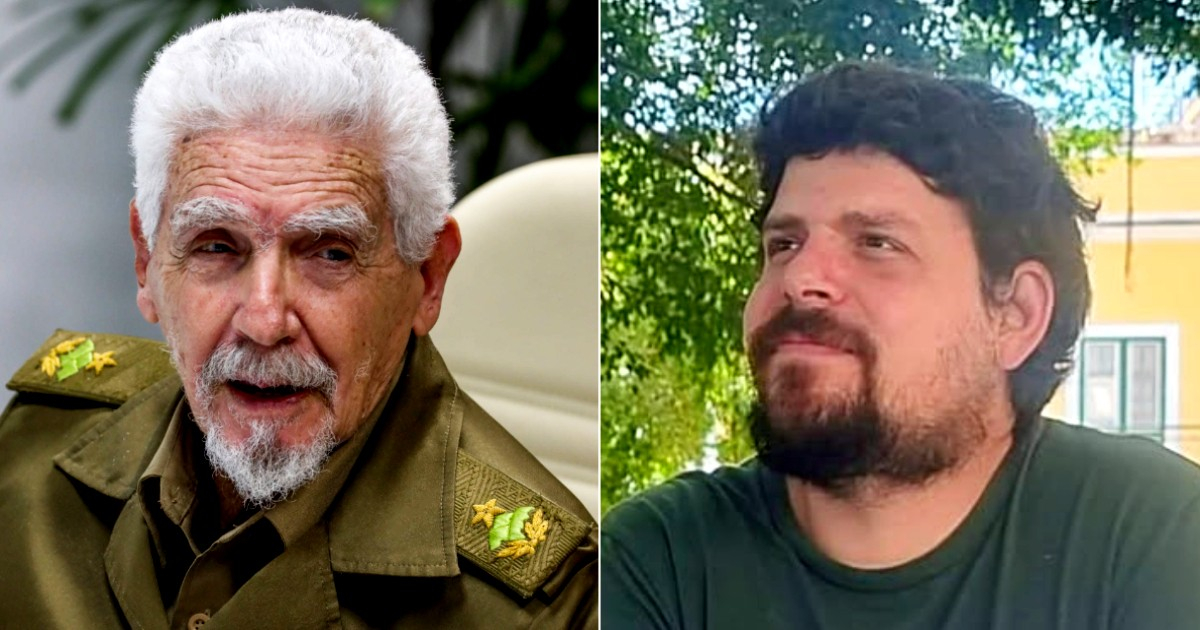
Michel Torres Corona, the host of the state-run TV show 'Con Filo,' took to Facebook this past Sunday to voice a subtle complaint about the Cuban state television's handling of the death of Ramiro Valdés Menéndez. The official news channel announced the passing only after celebrating Father's Day and reporting on the electrical dispatch.
"One tries not to see in such gestures a sign of changing times," Torres Corona wrote, expressing a persistent suspicion shared by many, including himself. Torres Corona is known as an active spokesperson for the regime on social media.
The Noticiero Nacional de Televisión (NTV) drew criticism for its decision to prioritize a Father's Day greeting and an electric report over the announcement of the death of one of the last surviving members of the historic generation, causing discomfort even among those within the system.
Government Reforms Stir Controversy
Torres Corona's discontent is not merely a matter of protocol. His remarks come on the heels of the Cuban government's announcement of 176 economic measures by Miguel Díaz-Canel, including private banking, private exchange houses, conversion of state enterprises into joint-stock companies, and opening up to foreign investment by Cuban expatriates.
For hardline supporters of Cuban communism, these reforms are seen as a betrayal of the vision that Ramiro Valdés and his cohort built. Although Torres Corona doesn't state it outright, he hints at these sentiments: "Ramiro was there at the beginning, and now he won't live to see if this process will finally come to an end."
A Legacy of Revolutionary Contributions
Born in Artemisa on April 28, 1932, Ramiro Valdés was 94 years old. His revolutionary path included participating in the 1953 Moncada Barracks assault, imprisonment on what was known as the Isle of Pines, and returning to Cuba as one of the 82 members aboard the Granma yacht.
He served directly under Che Guevara as the second in command of the 8th Column "Ciro Redondo" and fought at the Battle of Santa Clara. Following the 1959 triumph, he held top positions in security and government, including head of State Security, Minister of the Interior, Vice President of the Councils of State and Ministers, and Deputy Prime Minister.
Since September 2025, Valdés had vanished from the public eye without any official explanation. Reports in February 2026 indicated he was hospitalized in Havana in critical condition, yet the regime remained silent about his absence from several Council of Ministers sessions.
Reflections on a Revolutionary Life
In a conversation with Arleen Rodríguez Derivet, Valdés admitted that his sole regret was not being able to accompany Che to Bolivia—a sentiment equating to a desire to have died alongside his leader. Torres Corona referenced this in his post.
In closing his post, Torres Corona issued what seemed more like an internal warning than a tribute: "Those of us still breathing must defend the Homeland, the Revolution, and Socialism until our last breath... even if it means confronting powerful forces both inside and outside the social and national sphere."
Thus, with the passing of one of the last remaining pillars of the founding generation, the regime's supposed successors announce reforms that, as acknowledged by Prime Minister Manuel Marrero Cruz, will create "contradictions" that the government must address on the fly.
Key Questions About Ramiro Valdés and Cuban Reforms
Who was Ramiro Valdés?
Ramiro Valdés was a prominent Cuban revolutionary figure, known for his participation in the Moncada Barracks assault, his close work with Che Guevara, and his leadership roles in the Cuban government.
What are the recent economic reforms in Cuba?
The Cuban government recently announced 176 economic measures including the introduction of private banking, private exchange houses, the transformation of state enterprises into joint-stock companies, and allowing investment from Cuban expatriates.