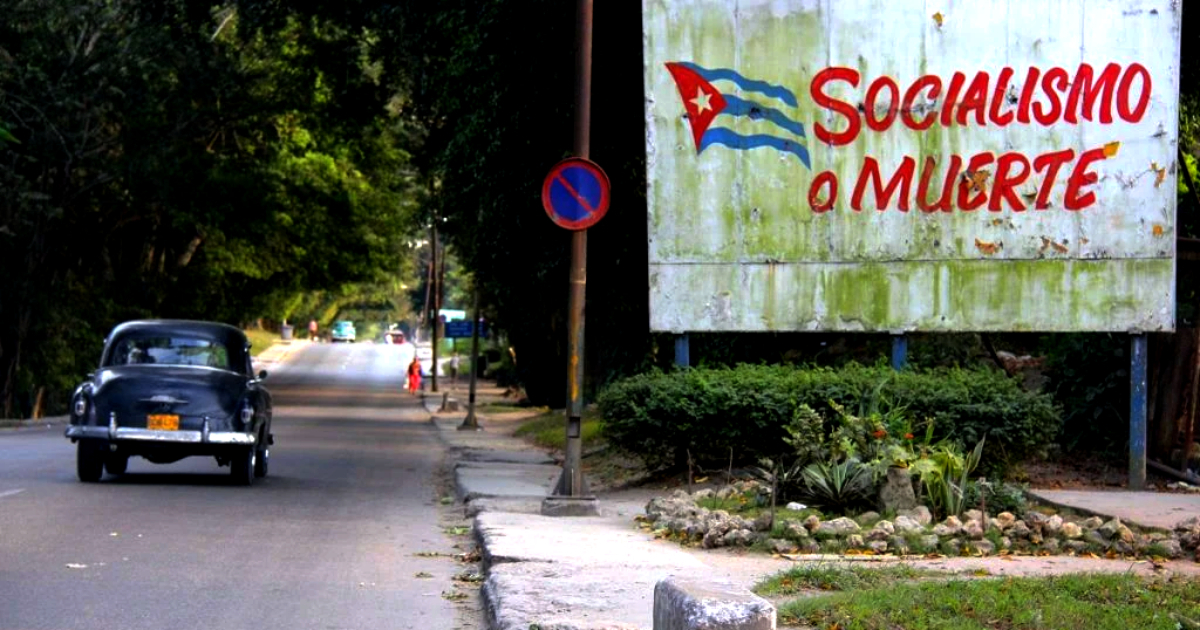
In the past, no Cuban leader could discuss the economy without denouncing capitalism. It was almost an ideological requirement.
Official speeches painted capitalism as a system of exploitation, while textbooks linked it to inequality, unemployment, racism, poverty, and economic crises.
State media regularly highlighted its "insurmountable contradictions," and political education proclaimed socialism as a higher stage of human development.
For decades, this perspective was portrayed as an unquestionable truth.
It is striking, then, to note that recent statements by a key figure in Cuban power circles make no mention of capitalism's faults or socialism's virtues.
Instead, in his first public interview, Raúl Guillermo Rodríguez Castro, known as El Cangrejo, focused on investments, business opportunities, economic growth, production diversification, and new trade partners.
"Our country must seek economic development by diversifying our economy, business methods, trade partners, and investment strategies," he stated.
Such words would have shocked many Cubans educated during the regime's most ideologically rigid years.
The Ideological Enemy: Capitalism
From the early days of the so-called "Cuban revolution," capitalism was not only seen as an alternative economic system but as the moral adversary of the revolutionary project.
Fidel Castro repeatedly condemned the inequalities fostered by capitalism. Ernesto Che Guevara criticized material incentives and advocated for the creation of the socialist "new man."
Communist Party documents — the only legal political force in the country and "superior guiding force of society and the State" according to the regime's Constitution — emphasized the incompatibility between revolutionary values and market logic.
The criticism extended beyond economics. Capitalism was linked to individualism, consumerism, moral corruption, selfishness, and exploitation.
The official narrative drew a stark opposition: socialism was depicted as solidarity-based, promoting social justice and equality, while capitalism was characterized as prioritizing private profit over collective welfare.
Lessons in Cuban Education
The critique of capitalism was not limited to political speeches; it was deeply embedded in the educational system.
Cuban students learned about capitalism's cyclical crises, structural unemployment, labor exploitation, surplus value appropriation, and wealth concentration.
Subjects like History, Political Economy, and Political Culture presented capitalism as a system destined to generate inequality and social conflict.
State media consistently reinforced this message, using international financial crises, social issues in the West, and labor disputes as examples of capitalism's inherent flaws.
For years, the message was clear: capitalism produced inequality, while socialism ensured social justice. The market led to exclusion, while central planning protected the people. Private companies pursued profits, while the revolutionary — and socialist to the core — State defended collective interests.
The Return of Market Dynamics
However, economic realities forced changes that could not be ignored. The collapse of the Soviet Union necessitated partial reforms during the Special Period.
Subsequent market openings came with the "Guidelines of the Economic and Social Policy of the Party and the Revolution" and its implementation through "economic and monetary restructuring" and the "Government Program to correct distortions and revitalize the economy."
Self-employment expanded, the buying and selling of homes and cars was authorized, foreign investment space was widened, and micro, small, and medium enterprises (MIPYMES) emerged under Decree-Law 46 of August 2021. Market mechanisms proliferated within an economy still officially defined as socialist and claiming to adhere to the "inviolable principle of leaving no one behind."
Gradually, concepts once viewed with suspicion began entering institutional language.
The word "enterprise" ceased to arouse distrust. Foreign investment shifted from being a rare concession to a strategic necessity. Private entrepreneurs — the well-known "cuentapropistas" — transitioned from being seen as a temporary anomaly to significant players in the national economy.
This transformation was gradual but profound.
The Silence of Criticism
Perhaps the most revealing change is not the emergence of new concepts but the disappearance of others.
In today's official discourse, lengthy condemnations of capitalism as a system are increasingly rare.
References to class struggle have receded. Criticisms of capitalist exploitation are less prominent than concerns about productivity, exports, or currency acquisition. Economics is beginning to overshadow ideology.
The result is a new lexicon. Words like investment, competitiveness, efficiency, business, development, exports, and entrepreneurship now frequently appear — terms that would have once been viewed with deep suspicion by much of the revolutionary ideological apparatus.
The Inescapable Contradiction
This shift poses a challenging question.
How does a political system that built much of its legitimacy on denouncing capitalism's ills and embracing Marxist-Leninist doctrine end up incorporating practices historically associated with that very system?
The official response often emphasizes that Cuba continues to build socialism and that economic reforms are tools to strengthen it.
However, this explanation does not resolve the contradiction perceived by many citizens. Especially those raised on the belief that market mechanisms were a threat to the revolutionary project.
For these generations, the new economic language can be disconcerting. Not because the regime has formally embraced capitalism, but because many practices now deemed necessary were once systematically criticized.
The statements by El Cangrejo highlight this transformation.
His discourse is filled with references to investments, business, and economic diversification, but lacks any condemnation of capitalism. There are no mentions of exploitation, class struggle, or the market as a source of inequality.
The absence is as telling as the words spoken. For over sixty years, the regime taught Cubans that capitalism was an economically and morally inferior model.
Now, without officially abandoning socialism, many of its leaders seem more focused on attracting investments than denouncing market dangers.
The question is no longer whether Cuba still officially defines itself as socialist.
The question is what happens when a regime that based much of its legitimacy on denouncing capitalism's ills begins speaking the language of investments, business, and the market.
Generations of Cubans were taught that socialism was not merely a political option among others. It was a historical achievement, a moral superiority, and an irreplaceable path.
Many of the hardships, sacrifices, and restrictions endured by the country were justified in defending this project against a system deemed unjust, exploitative, and morally inferior.
Yet, today, it is the very heirs of that "Cuban revolution" who talk about diversifying businesses, attracting capital, expanding investments, and learning from the economic experiences of their former "enemies."
The problem is not only the rhetorical contradiction. The problem is the question of legitimacy that this inevitable contradiction raises.
If, after 67 years in power, educating generations in constant critique of capitalism, and a long history of abuses and sacrifices made in the name of socialism, the regime itself finds it necessary to adopt practices and languages it once condemned, it is legitimate to question why it remains in control of the country it destroyed.
Understanding Cuba's Economic and Ideological Shift
Why is the Cuban regime shifting its stance on capitalism?
The Cuban regime is shifting its stance on capitalism due to economic challenges and the need for reforms to stimulate growth and attract foreign investments.
How has Cuban education historically portrayed capitalism?
Cuban education has historically portrayed capitalism as a system that inherently produces inequality, exploitation, and social conflict, reinforcing these ideas through subjects like History and Political Economy.
What economic changes has Cuba introduced in recent years?
Cuba has introduced economic changes such as expanding self-employment, allowing the buying and selling of homes and cars, widening foreign investment, and establishing micro, small, and medium enterprises (MIPYMES).
What does the shift in language indicate about Cuba's economic priorities?
The shift in language indicates a prioritization of economic development, investment, and competitiveness over ideological adherence to socialism, reflecting a pragmatic approach to Cuba's economic challenges.