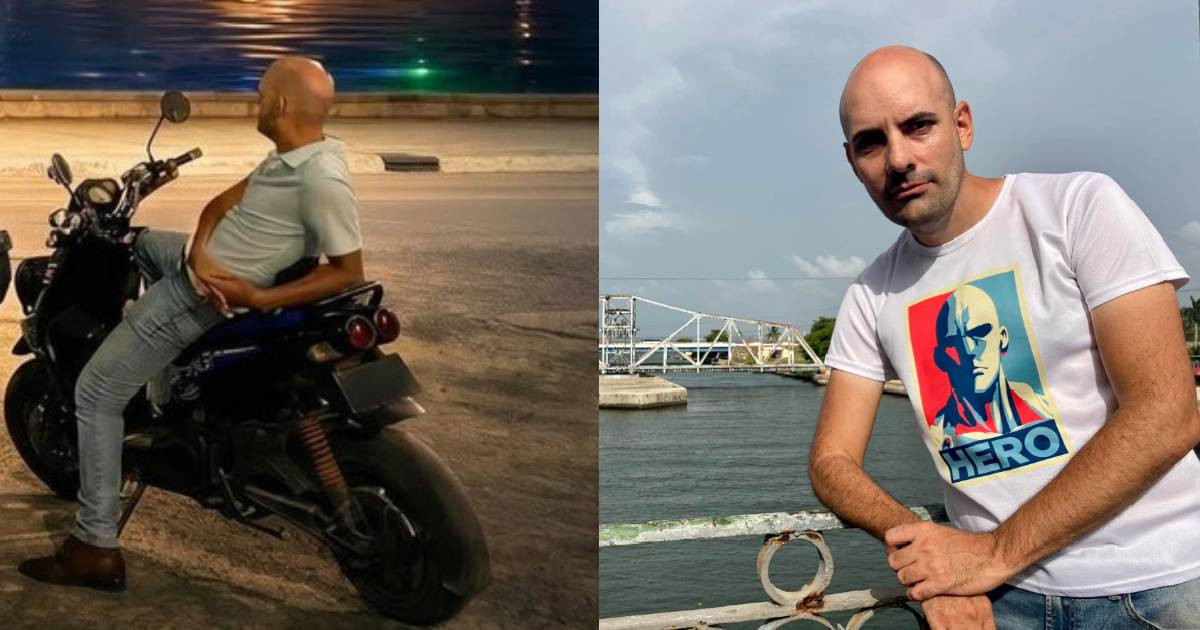
This past Saturday, singer Liliam Ojeda proposed a public fundraising effort to aid Cuban cybernetic expert and activist Javier Bobadilla, whose motorbike was stolen from the garage where he stored it. The loss of his bike has left him without his primary source of income as a courier.
Ojeda shared the incident on her Facebook profile, making a plea for solidarity: "My friend Javier Bobadilla had his motorbike stolen. It was safe in the garage, yet one day it was gone. No one knows what happened."
The stolen motorbike was not just an item of convenience; it was crucial for his family's livelihood.
"The bike they took was his job; Javier's household relies on his courier work," Ojeda explained, highlighting that despite Bobadilla's well-known presence on social media as a writer of incisive commentary on Cuban realities, he needs to work to make a living.
The fundraising goal is to collect an additional $300 needed by Bobadilla to purchase an electric bike, which a contact has arranged to send from abroad.
"I don't know much about crowdfunding, but I know my friend Javier deserves our support. This is about helping someone regain the means to keep food on the table," Ojeda stated, also sharing the card number for donations.
Javier Alejandro Bobadilla Díaz, born in Havana in 1979, is a licensed cybernetic expert and writer with a long-standing history of activism on social media, where he insightfully discusses political and social issues in Cuba.
Rising Crime and Public Response
The theft is part of a growing trend of motorbike robberies on the island, fueled by the economic crisis and the breakdown of public transportation.
The Cuban Citizen Audit Observatory documented 2,833 verified crimes in 2025, marking a 115% increase from 2024 and a 337% rise compared to 2023, with thefts being the most prevalent crime, accounting for 1,536 reported cases.
Due to the sluggish police response, Cubans have developed two parallel responses: direct citizen action and solidarity on social networks.
Recently, residents of Vedado apprehended a man who assaulted a young woman to steal her electric motorbike and handed him over to the National Revolutionary Police.
In April, a disabled young man from Central Havana publicly reported the theft of his motorbike adapted for those with limited mobility, which was his sole means of transportation.
Moreover, in May, another Cuban reported on social media the theft of his motorbike shortly after purchasing it with significant effort, a pattern that is increasingly common on the island.
Electric motorbikes have become one of the most sought-after items by criminals in Cuba due to their high value on the informal market, in a context where they serve as critical tools for work and survival for thousands of families.
Understanding the Motorbike Theft Crisis in Cuba
Why are electric motorbikes targeted by thieves in Cuba?
Electric motorbikes are targeted because of their high value on the informal market and their importance as tools for work and transportation amidst the economic crisis in Cuba.
What has been the community's response to motorbike thefts?
Communities have responded with direct citizen action, such as apprehending thieves, and through solidarity efforts on social media to support victims.
How has the crime rate changed in recent years in Cuba?
The crime rate has significantly increased, with a 115% rise from 2024 to 2025 and a 337% increase compared to 2023, highlighting a surge in thefts.