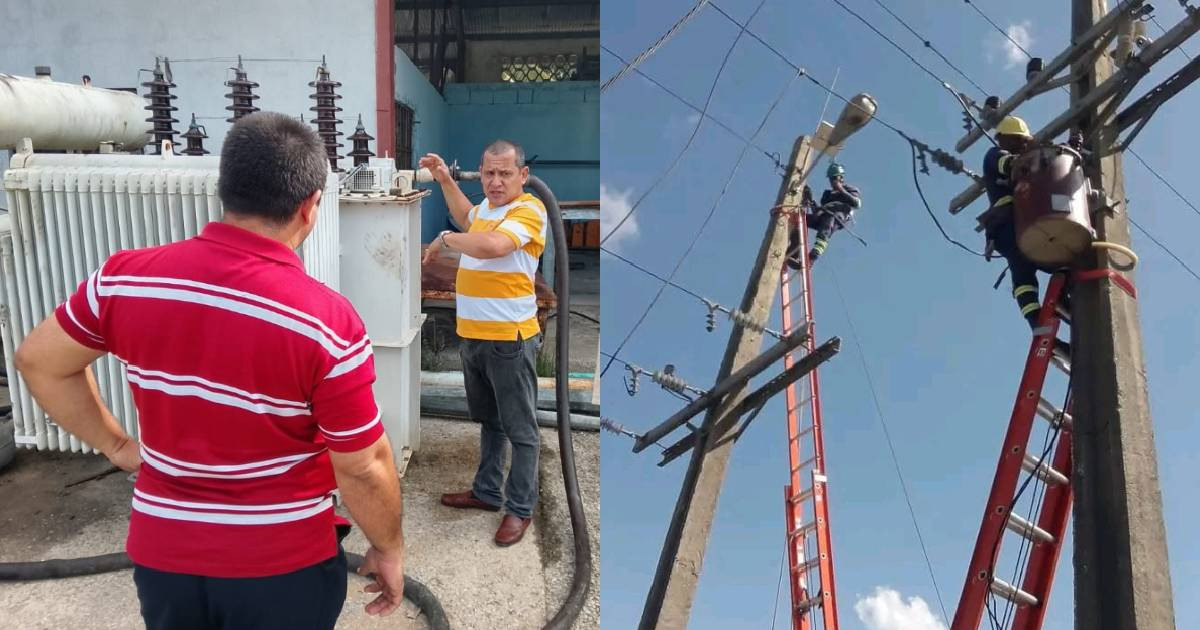
On Saturday, the Provincial Government of Las Tunas dismissed a circulating rumor allegedly attributed to Governor Yelenis Tornet Menéndez. The rumor, spreading through social media, referred to a shortage of electrical transformers in the province.
The viral message claimed the official said: "Neighborhoods with burned-out transformers will have no power until 2027, so take care of those units. The embargo prevents us from purchasing new ones."
Official channels labeled the publication as fake news, affirming that the governor never made such a statement.
A Persistent Transformer Shortage
Despite the denial, the underlying issue remains unresolved, as the transformer shortage in Las Tunas is a well-documented problem within various levels of the electrical system.
As of mid-May, the province reported at least 11 instances of dielectric oil and transformer component thefts, according to the official newspaper 26.
The most severe incident occurred on April 19 in Amancio, where the theft of 600 liters of oil from two transformers left 40% of the area without power. This affected 4,947 customers, including essential services like a polyclinic, telecommunications, and a water pumping station.
Impacts Beyond Las Tunas
The transformer crisis is not limited to Las Tunas. In Santiago de Cuba, the removal of transformers from several neighborhoods without replacement dates led to protests and public outcries.
Meanwhile, on June 7, Guantánamo's Electric Company admitted the lack of physical equipment to replace at least eight broken transformers. In Sancti Spíritus, authorities cited user consumption spikes as a cause for the damage.
The situation is compounded by structural limitations. Cuba has only three specialized workshops for transformer repairs, located in Havana, Villa Clara, and Manzanillo, making each breakdown a slow, centralized process.
Government Measures and Persistent Challenges
The national energy context exacerbates pressure on the grid, with the National Electric System (SEN) operating with deficits of around 2,000 MW daily.
In response, the provincial government announced measures to tackle infrastructure deterioration and thefts, including reinforcing perimeter fences at substations, installing solar lighting, and employing control devices with the Interior Ministry's support.
While the official narrative focuses on debunking a non-existent statement, the reality persists: entire neighborhoods in Las Tunas continue to endure weeks without electricity, with no clear timeline for service restoration.
Understanding the Transformer Crisis in Cuba
What triggered the transformer crisis in Las Tunas?
The crisis was fueled by a combination of transformer shortages, thefts, and structural limitations within the repair system, as well as a strained national energy grid.
How are government authorities addressing the crisis?
Authorities have announced measures such as reinforcing substation security, installing solar lighting, and utilizing control devices supported by the Interior Ministry.
Are other provinces in Cuba facing similar transformer issues?
Yes, similar issues have been reported in Santiago de Cuba, Guantánamo, and Sancti Spíritus, where transformer shortages and breakdowns have led to public protests and service disruptions.