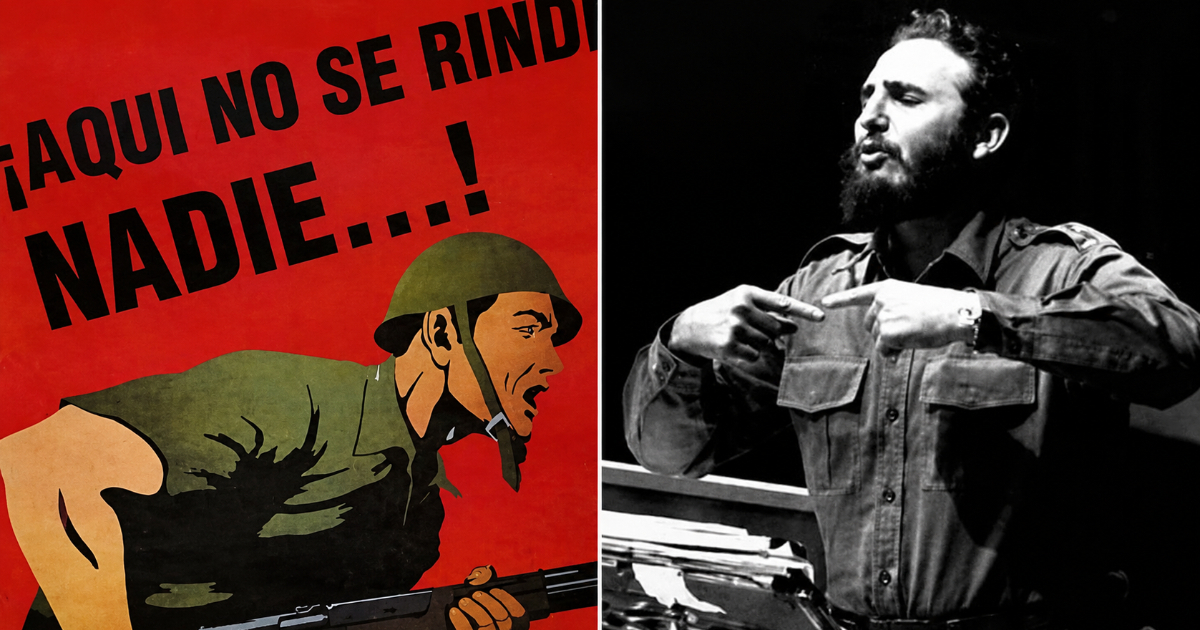
For over six decades, many Cubans were raised with the belief that the United States was the foremost adversary of the Cuban Revolution.
This notion was ingrained in them through education, reinforced by the media, and echoed in political speeches, slogans, and events. The term "Yankee imperialism" was not just a passing phrase but a cornerstone of the political narrative crafted by the regime since 1959.
Thus, it was startling when Raúl Guillermo Rodríguez Castro, known as El Cangrejo, stated in his first public interview that the historical leaders of the so-called "Cuban Revolution" always aimed for a cordial, respectful, and civilized relationship with Washington.
"From that moment on, the historical leaders of the Revolution have always projected, and made it known to the world and the various U.S. governments, that Cuba and its revolutionary government have always been willing to maintain a cordial, respectful, and civilized relationship," declared Raúl Castro's grandson.
This assertion is significant for several reasons. Not only does it come from someone considered to be part of the inner circle of power in Cuba, but it also seems to be part of an emerging narrative aimed at redefining the historical relationship between Havana and Washington.
A History of Conflict
Since the early years following the revolutionary triumph, the confrontation with the United States took center stage in the political identity of the new regime.
Events like the Bay of Pigs invasion, the October Crisis, covert operations against Cuba, and assassination attempts on dictator Fidel Castro (often exaggerated in the official narrative), along with the economic embargo, cemented a deeply contentious relationship between the two nations.
Beyond these historical events, the conflict with Washington became a structural element of Cuban political discourse.
The Role of Propaganda
The First Declaration of Havana, announced in September 1960, explicitly condemned American imperialism. From then on, Fidel Castro dedicated numerous speeches to warning against alleged threats from the United States, a theme that continued even into his later years.
Decades later, anti-imperialist rhetoric remained prevalent in official media, Communist Party documents, and public education.
Generations grew up familiar with terms like "Yankee imperialism," "historical enemy," "imperialist aggression," "genocidal blockade," or "besieged fortress." The narrative was clear: Cuba was resisting under siege.
Educational Indoctrination
The confrontation with the United States wasn’t solely a foreign policy issue; it became a tool for political indoctrination.
Textbooks, youth organizations, educational programs, and state media perpetuated a worldview where the conflict with the U.S. was central.
National history was often portrayed as a continual struggle against foreign domination, with anti-imperialism becoming a key component of revolutionary identity.
In political rallies, Granma editorials, and official speeches, the message was consistent: the Revolution's survival depended on resisting Washington's pressures.
The existence of an external enemy served an evident political function. A constant threat required perpetual mobilization, and a permanent danger necessitated unity around revolutionary leadership.
For decades, many of the country’s economic and political difficulties were framed within this narrative.
A Shift in Discourse
El Cangrejo's words are noteworthy not for suggesting Cuba's willingness to dialogue with the United States—it’s a stance previously expressed by Fidel and Raúl Castro, and even Miguel Díaz-Canel.
The striking aspect is the use of the word "always." By claiming revolutionary leaders always sought a respectful relationship with Washington, Rodríguez Castro suggests this was the historical essence of Cuba's stance.
However, this interpretation clashes with six decades of speeches, political campaigns, educational programs, and institutional propaganda that made confrontation with the United States a pillar of the revolutionary narrative.
While moments of opportunistic dialogue or rapprochement existed, confrontation was far more prominent in the official narrative than cooperation.
Thus, the pertinent question isn’t whether Cuba was ever willing to engage in dialogue. It's why, today, there's an emphasis on this relatively marginal part of history while downplaying the narrative that dominated the official discourse for over sixty years.
Rewriting the Official Narrative
El Cangrejo's statements don't exist in a vacuum. In recent months, signs of a broader shift in Cuban official rhetoric have emerged.
Some diplomatic communications have significantly toned down the use of historically ubiquitous terms like "imperialism," "enemy," or even "blockade."
Simultaneously, leaders and officials increasingly discuss investments, economic development, market diversification, trade partners, and international cooperation. The Cold War vocabulary is giving way to a more pragmatic language.
Clearly, this is a tactical adaptation to current circumstances, but words matter, and the regime understands this. When the words change, so too does the way the dictatorship rewrites history.
Adapting to a New Narrative
Perhaps the most crucial issue isn't what the regime thinks of the United States today.
The real question is what happens when a generation raised on one version of history finds that narrative being retold.
For millions of Cubans, official anti-Americanism was not a mere footnote or a transient episode. It was part of their political and emotional education, their understanding of the world, and the moral justification for many collective sacrifices.
For decades, they were told the Revolution stood firm against a powerful enemy intent on its destruction. Today, some representatives of that same system seem to suggest that a cordial relationship with the United States was always the goal.
For those who grew up with the classic narrative and the epic of the "Cuban Revolution," the contrast is hard to ignore.
Because if a respectful relationship with Washington was always the fundamental aspiration, what place do six decades of speeches about the imperialist enemy hold? How was it impossible to build a normal relationship, and now, suddenly, there's an attempt to erase the memory of the "external enemy," the "threat to sovereignty," and the "lurking empire"?
The question is no longer what the Revolution thought of the United States in 1961. The question is why, in 2026, some of its heirs seem determined to tell that story in a completely different way.
Understanding Cuba's Changing Narrative
How has Cuba's narrative about the U.S. relationship changed?
Cuba's narrative is shifting from portraying the U.S. as a primary enemy to suggesting a historical aspiration for a respectful relationship, reflecting a broader change in rhetoric and strategy.
What role did the U.S. play in Cuban political identity?
The U.S. was depicted as a central adversary in Cuban political identity, used to justify resistance and unity under the revolutionary leadership, forming a significant part of educational and political narratives.
Why is the term "always" significant in Rodríguez Castro's statement?
The use of "always" suggests a historical continuity in seeking peaceful relations with the U.S., contradicting decades of confrontation-focused propaganda, raising questions about the regime's historical narrative.