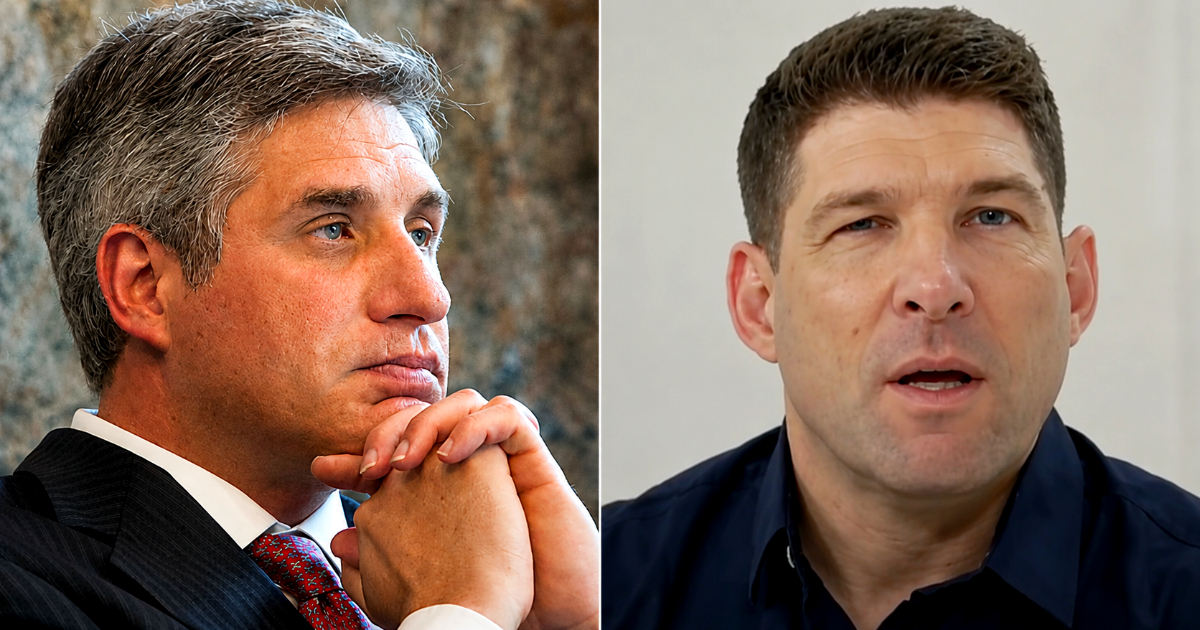
The recent interview given by Raúl Guillermo Rodríguez Castro, known as "El Cangrejo," to the Emirati newspaper The National has sparked a fresh wave of controversy among the Cuban opposition and the exile community.
Interestingly, the backlash has not been solely focused on the interview's content. A significant part of the uproar stems from the public support expressed by Cuban academic Arturo López-Levy, who proudly acknowledged his contribution to the article.
"It was a pleasure to contribute to this work: 'We are not a threat': Raúl Castro's grandson, 'Raulito,' makes the case for Cuba to the United States and the world," López-Levy wrote on the social media platform X.
This statement quickly drew a sharp response from Cuban activist and intellectual Anamely Ramos.
"As if the Cangrejo interview wasn't disgusting enough, now we have this gem from his cousin López-Levy (read López-Calleja)," she posted on Facebook.
"The shamelessness levels of these criminals are truly indescribable," she added.
The Controversial Role of López-Levy
The response underscores a growing sentiment among regime critics: that Rodríguez Castro's increased public profile is part of an effort to present a renewed and more politically palatable image of a new generation linked to Cuba's historical power core.
Adding another layer to the controversy is the background and family ties of Arturo López-Levy.
The academic, whose full last name is López-Calleja Levy, is the cousin of Luis Alberto Rodríguez López-Calleja, the deceased head of GAESA, former son-in-law of Raúl Castro, and father of Raúl Guillermo Rodríguez Castro (El Cangrejo).
Having graduated from the Higher Institute of International Relations (ISRI), López-Levy served as an officer in the Ministry of the Interior (MININT) from 1992 to 1994 before emigrating and pursuing an academic career in the United States.
Over the years, he has been one of the most vocal proponents of closer ties between Washington and Havana. He founded the organization Cuban Americans for Engagement (CAFE), advocated for the normalization of bilateral relations, and consistently opposed U.S. economic sanctions against the Cuban regime.
From Unknown to International Figure
Critics argue that his analyses often emphasize the need for dialogue with Havana while giving less attention to issues such as the lack of political freedoms, the presence of political prisoners, or GAESA's economic and political clout within the Cuban system.
For many observers, López-Levy's involvement in this episode is significant not just for his political views but because he appears simultaneously as an academic, media commentator, collaborator, and a member of a family closely linked to the main power structures built around the Castros.
The interview with The National is not the first time "El Cangrejo" has been thrust into the spotlight.
In recent months, various reports have connected Raúl Castro's grandson with talks and contacts between U.S. representatives and the power circle surrounding the former Cuban leader.
His name began appearing in discussions related to discreet negotiations and high-level political contacts, raising questions both within and outside Cuba.
The Political Weight of a Name
This attention is particularly noteworthy because Rodríguez Castro holds no known significant position within the Council of State, the Council of Ministers, or the visible structure of the Communist Party.
Despite this, his involvement in political discussions and international contacts has started to cast him as a figure capable of engaging in strategic matters concerning the island's future.
This situation has led to a recurring question among opponents, academics, and political observers: What true representation does "El Cangrejo" have, and on whose behalf is he speaking?
Raúl Guillermo Rodríguez Castro's political significance does not stem from an independent institutional career.
He is the grandson of Raúl Castro and the son of Luis Alberto Rodríguez López-Calleja, who was considered for years one of Cuba's most powerful men due to his control over GAESA, the military-business conglomerate that dominates significant sectors of the national economy.
For much of his public life, he was primarily identified as part of his grandfather's inner circle and responsible for his personal security.
For many regime critics, his emergence as an interlocutor with international actors is a sign that real power continues to operate through familial and informal structures that transcend the official institutions headed by Miguel Díaz-Canel.
Beyond a Single Interview
The controversy surrounding López-Levy's endorsement of the interview extends beyond the scope of a single journalistic publication.
Many opponents perceive this as an attempt to transfer political legitimacy from the old guard of Castroism to their familial successors by leveraging international media, academics, analysts, and public figures who present these heirs as valid interlocutors to Washington and the international community.
In this context, The National's interview and López-Levy's promotion are seen by detractors as part of an image operation aimed at normalizing the public presence of a Castro family member whose main political asset remains his proximity to the historical power core.
The lingering question is whether "El Cangrejo's" increasing media exposure is solely due to journalistic interest in a previously unknown figure or part of a broader strategy to construct a new narrative around the heirs of Castroism at a time of uncertainty about Cuba's political future.
Understanding the Impact of Rodríguez Castro's Interview
Who is Raúl Guillermo Rodríguez Castro?
Raúl Guillermo Rodríguez Castro, also known as "El Cangrejo," is the grandson of Raúl Castro. He has been increasingly involved in political discussions and international contacts, despite not holding a formal position in Cuba's government.
What role does Arturo López-Levy play in the controversy?
Arturo López-Levy, a Cuban academic and relative of Rodríguez Castro, publicly supported "El Cangrejo's" interview, which has been seen as part of an effort to legitimize the next generation of Castro family members.
Why is the interview considered controversial?
The interview is controversial because it is viewed as an attempt to project a politically acceptable image of a new generation tied to Cuba's historic power centers, sparking criticism from opponents of the regime.