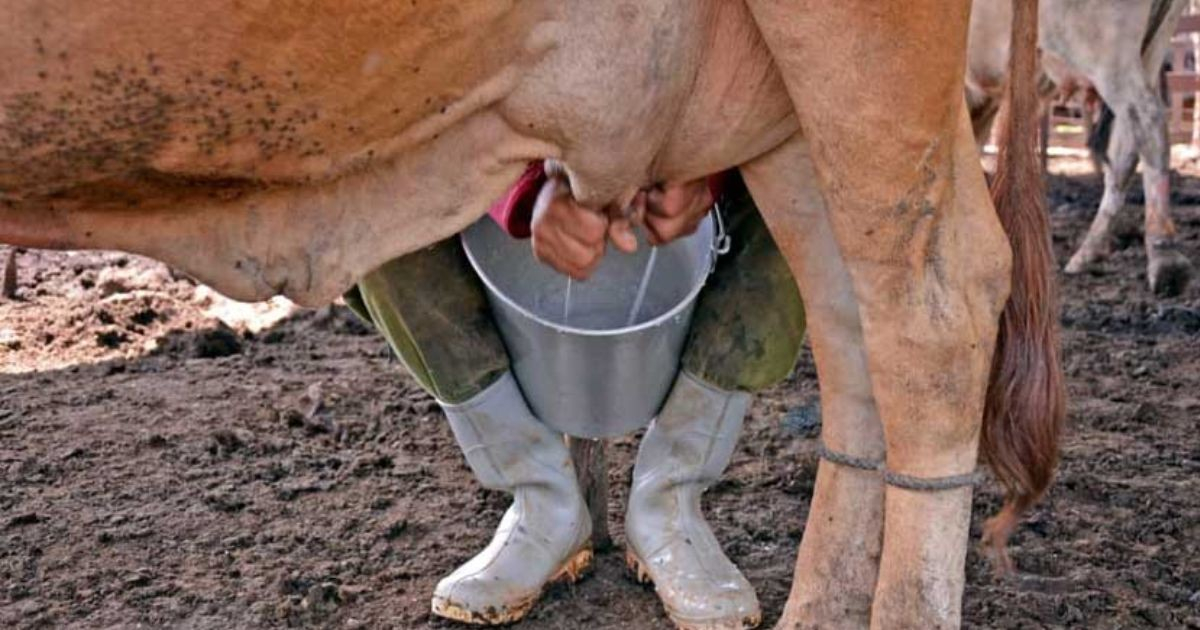
The state-run newspaper Invasor from Ciego de Ávila has pointed fingers at the United States embargo as the main culprit for the lack of milk in Cuba. In a report published on Friday, the paper earnestly attributed the shortage to the "tightening of the economic, financial, and commercial blockade by the current U.S. administration." This, it claimed, is why the Dairy Products Company of Ciego de Ávila receives only 15% of the cow's milk needed for its daily processing plans.
To put it into perspective, the company receives between 4,800 and 5,000 liters daily, far below the planned 33,700 liters, as acknowledged by Daniel Moll Espinosa, the company's Business Director, in a statement to the same state media.
However, nestled within the article are hints of the actual issues at play: fuel shortages, extended power outages, a lack of spare parts for transport vehicles, refrigeration failures that spoil the milk before it reaches stores, and an outstanding debt of 13 million pesos owed to cooperative farmers who haven't been paid for months. Yet, blame is cast on Trump.
The Distribution Dilemma
Milk distribution in Ciego de Ávila and Morón municipalities is scheduled every three days, but residents often wait over six days to receive their share. The allocation itself is meager: children aged one to two are given a bottle that, as clarified by Moll Espinosa, doesn't quite equal a full liter, measuring 0.917 milliliters. Those aged two to six, pregnant women, and individuals on medical diets receive half a bottle, contingent upon fuel availability and other frequently disruptive factors.
For babies under one year, imported powdered milk is the answer. In May, they were allotted three 600-gram packets. The Cuban regime has struggled for decades to produce sufficient milk and had to seek UN assistance in 2024 to secure this minimal supply.
A Historical Irony
On June 5, during the Round Table, Food Industry Minister Alberto López Díaz confessed that over 100,000 Cuban children do not receive their daily milk ration, and the official plan — powdered milk for 331,000 children and fluid milk for 200,000 — is not being fulfilled. The sector has reported losses exceeding $450 million by 2025.
The historical irony is striking. On July 26, 2007, in Camagüey, Raúl Castro declared that Cuba should produce enough milk for "anyone who wants a glass." Nearly 19 years later, this pledge remains the most enduring symbol of governmental failure. A netizen succinctly captured the sentiment upon hearing the new official promise of "electrical sovereignty by 2050": "We've been waiting 20 years for the glass of milk Raúl promised."
Meanwhile, in 2025, the official press documented that in Camagüey, the nation's main dairy region, hundreds of producers hadn't delivered a single glass of milk that year, and 36% of contracted producers failed to meet their targets. Reasons cited by Granma included poor livestock management, cattle theft and illegal slaughter, nonpayment, and a loss of dairy farming culture. None of these issues bear Trump's name.
An Unlikely Solution
In light of the collapse, the Ciego de Ávila dairy company devised a creative solution: selling croquettes, bread, pastries, and pizzas to generate revenue. A dairy factory turned into a bakery-pizzeria is perhaps the most fitting metaphor for the state of Cuba's economy.
Just a day before Invasor's article was published, Prime Minister Manuel Marrero Cruz presented a package of 176 economic measures to the National Assembly, including opening agriculture to private capital — an implicit acknowledgment that the 67-year-old centralized state model, with its empty promises of milk, has failed. In Ciego de Ávila's informal market, half a kilo of powdered milk reached 2,333 pesos in April 2026. According to Invasor, the blame lies with Washington.
Understanding Cuba's Milk Crisis
What factors contribute to the milk shortage in Cuba?
The milk shortage in Cuba is attributed to fuel shortages, prolonged power outages, lack of spare parts for transport vehicles, and refrigeration issues that spoil milk. Additionally, there is a significant debt to cooperative farmers and a loss of dairy farming culture.
How does the U.S. embargo affect Cuba's milk supply?
The Cuban government often blames the U.S. embargo for its economic challenges, including the milk shortage. However, internal issues such as mismanagement and inefficiencies also play a significant role.