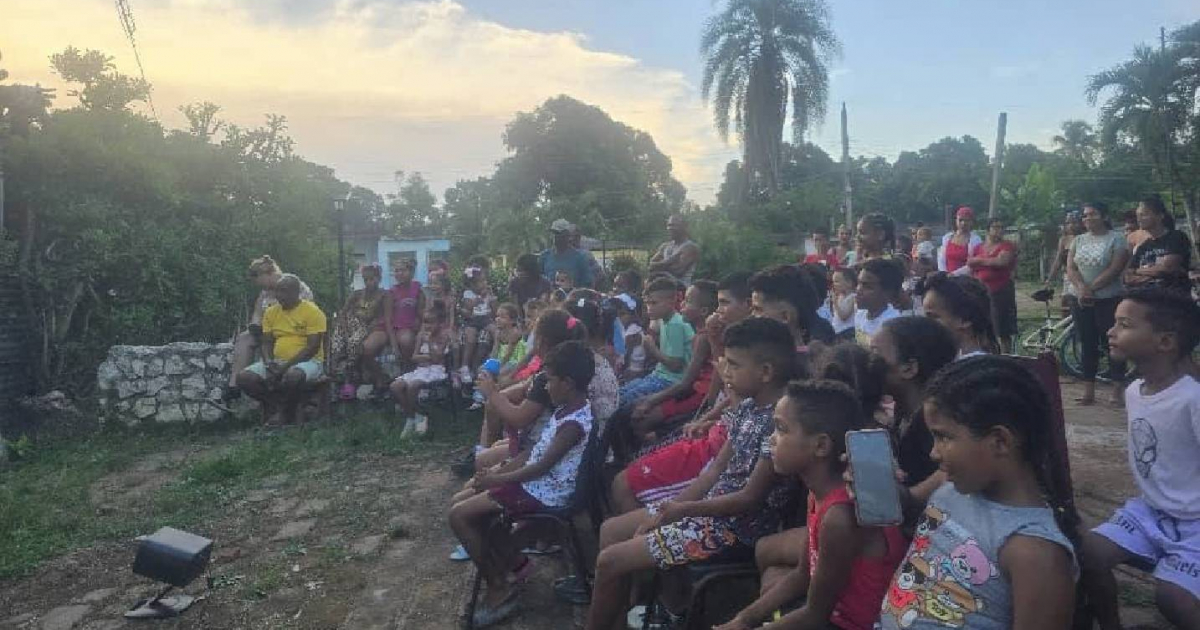
While the province of Granma endures power outages lasting up to 48 consecutive hours, Yudelkis Ortiz, the top official of the Communist Party in the region, took to Facebook this week. She posted about the arrival of a mobile cinema to the community of El Dátil in Bayamo, framing it as a solution to the energy crisis that weighs heavily on its residents.
The post, tagged with the official hashtags #GranmaWithMe and #ProvinceGranma, described the two-hour outdoor screening as "a simple yet powerful relief, a different kind of light," candidly acknowledging that "it's not the solution our people deserve." Ortiz herself admitted that "the lack of electricity is burdensome, painful, and draining," but she portrayed the cultural event as a beacon of hope.
The public's response was swift and unequivocal: Cubans directly demanded that what they truly need is not a projector in a park, but electricity. This demand is encapsulated in a phrase circulating among the province's inhabitants: "We want at least three hours of light."
This modest-sounding request underscores the severe energy collapse in eastern Cuba. In Granma, some circuits have been left powerless for 45 to 48 hours straight. In Santiago de Cuba, the power company reorganized outages into nine blocks, leaving each area with merely one or two hours of electricity daily.
Nationwide, the situation fares no better. The Electric Union reported a deficit exceeding 2,000 MW against a demand of 3,050 MW this Thursday, impacting 65% of the country with blackouts.
In Havana, outages stretched to 22 hours a day, with residents of the Diez de Octubre municipality reporting only 20 minutes of electrical service on Wednesday.
The regime's handling of the crisis in Granma has sparked sustained criticism. On June 5, the Bayamo government mobilized members of the Association of Combatants of the Cuban Revolution to "explain" the outages to the populace under the program "Neighborhood for the Homeland." Days later, Ortiz herself touted as "humanism" the fact that neighbors were forced to cook on the streets due to the lack of power.
Four solar parks installed in the province have also failed to ease the situation: a report highlighted ongoing issues with intermittency and failures in thermoelectric plants, keeping blackouts above 30 hours in several circuits.
On Friday, Cubans across the island took to social media, expressing their frustration with pot-banging protests in various neighborhoods, marking a day filled with desperation over the endless power cuts.
The scene of the mobile cinema in El Dátil—dozens of children sitting on folding chairs staring at a screen in the dark neighborhood—unintentionally captures the paradox of the moment: a province receiving projectors instead of electrical power, while its leaders celebrate "turning on a projector in a park" as "a way to illuminate."
Understanding the Energy Crisis in Granma, Cuba
What are the main causes of the power outages in Granma?
The power outages in Granma are primarily due to a combination of failing infrastructure, including intermittent solar park performance and issues with thermoelectric plants, along with a national energy deficit exceeding 2,000 MW.
How has the government responded to the energy crisis?
The government's response has included mobilizing combatants to explain the outages and organizing cultural events, like mobile cinemas, to provide temporary relief. However, these measures have been criticized for not addressing the root causes of the energy collapse.
What are the impacts of the power outages on daily life in Cuba?
The power outages significantly disrupt daily life, affecting everything from food preparation to healthcare services. In some areas, residents have reported having only a few minutes of electricity per day, leading to widespread frustration and protests.