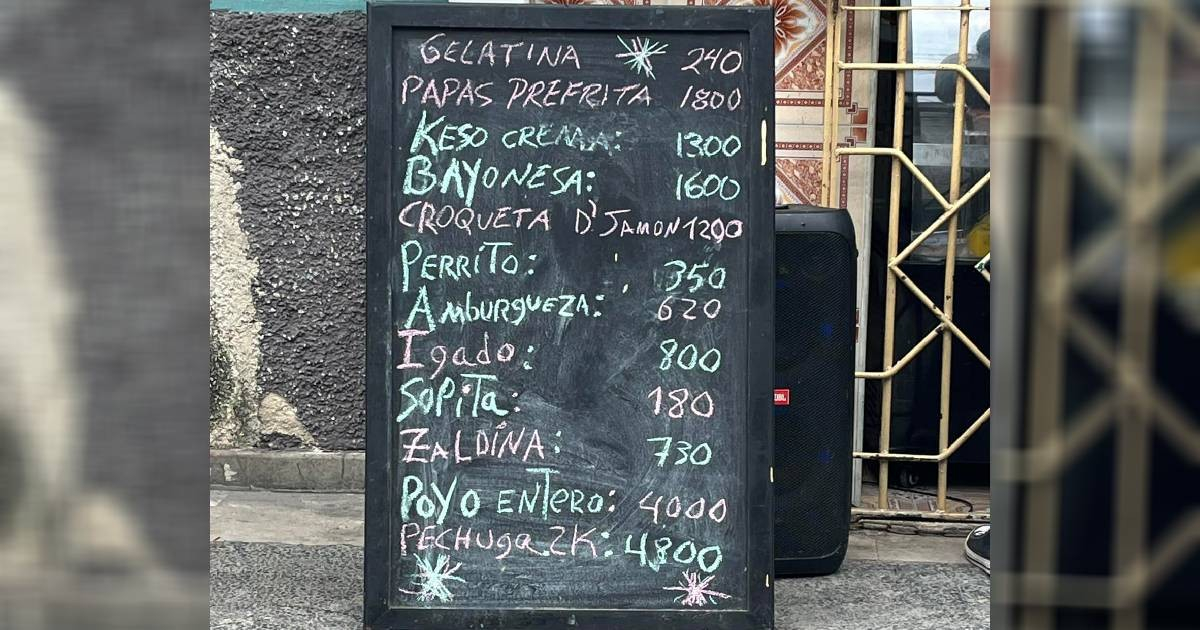
The Cuban government has unveiled a sweeping reform to its pricing policies, effectively abandoning a cornerstone of its historically centralized economy: the administrative setting of prices based on production costs and state-imposed price controls.
This change is part of a broader economic transformation package introduced by Prime Minister Manuel Marrero Cruz to the National Assembly of People's Power (ANPP) amid what the regime itself acknowledges as the most severe economic crisis since the Special Period.
Decentralization of Pricing Authority
A notable aspect of the announced changes is the shift in authority to approve prices and rates, which will now be transferred to individual enterprises and local administrations. This move marks a significant departure from the traditional method of pricing solely based on expenses. Instead, the authorities plan to incorporate market references and consider each product's position within the value chain.
This shift serves as an implicit admission of the failure of decades of state interventionism and, particularly, the price cap policies implemented in recent years to curb inflation, which continues to severely impact the Cuban population.
Admission of Policy Failures
On Wednesday, Miguel Díaz-Canel publicly acknowledged what independent economists and experts have been warning for years: price controls failed to curb inflation and, instead, contributed to shortages, the growth of the black market, and the rising cost of many goods.
“Price caps did not contain inflation in practice. They often led to product shortages, diversion into illegality, higher prices, and reduced tax revenue,” the leader admitted during the Extraordinary Plenum of the Central Committee of the Communist Party.
This rare instance of self-criticism comes from a political system that for years attributed economic deterioration almost solely to U.S. sanctions while dismissing warnings about the negative effects of state regulations. The acknowledgment follows numerous failed attempts to administratively control prices.
Historical Context and Market Adaptation
One of the most notable examples was Resolution 225 of 2024, which set maximum prices for basic products like chicken, oil, powdered milk, and detergent. The measure was partially suspended even before its implementation due to tensions with importers and private traders. At the time, experts warned that the initiative would exacerbate shortages and stimulate informal markets. Two years later, the government itself has conceded these outcomes.
The reform announced by Marrero also highlights how deeply the economic crisis has forced the regime to accept market mechanisms once deemed incompatible with socialist orthodoxy. Using market reference prices to set tariffs represents a significant departure from the principles that have guided centralized planning since 1959.
However, these changes come at a precarious time. Inflation remains sky-high, wages continue to lose purchasing power, and the rapid devaluation of the Cuban peso has driven the dollar to record levels in the informal market. Although authorities assure that the partial price liberalization will be accompanied by new social protection policies, doubts persist about the state's financial ability to mitigate the impact on an increasingly impoverished population.
Beyond the announcements, the reform stands as one of the most important economic corrections made by the Cuban government in recent years, officially acknowledging that one of its most emblematic tools for intervening in the economy ended up worsening many of the issues it was meant to address.
Insights on Cuba's Economic Reforms
What prompted the Cuban government to reform its pricing policies?
The Cuban government reformed its pricing policies in response to a severe economic crisis, recognizing that decades of price controls and state intervention had failed to curb inflation and worsened shortages.
How will the new pricing policies affect the Cuban economy?
The new policies aim to decentralize pricing authority, incorporating market references, which could lead to more efficient pricing. However, there are concerns about the state's ability to protect the population from the potential adverse effects of these changes.
What was the impact of Resolution 225 of 2024?
Resolution 225 of 2024, which set maximum prices for essential goods, was suspended due to conflicts with private traders and importers. It inadvertently contributed to shortages and the expansion of informal markets.