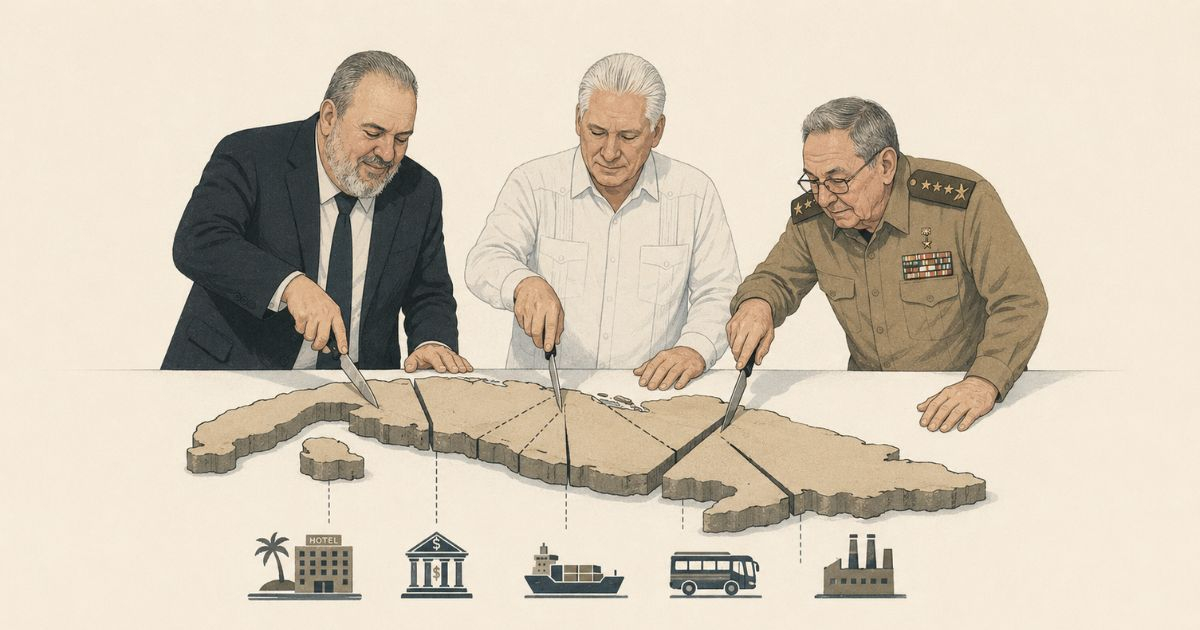
The Cuban regime's announcement on June 18, labeled as "Cuba's major economic transformation," is essentially a repackaged version of the strategy Soviet elites used to seize assets when the USSR collapsed. However, this time they are proceeding with more caution.
On June 18, 2026, the Cuban dictatorship unveiled a set of 176 economic measures to the National Assembly. Official state media hailed it as historic, speaking of liberalization, decentralization, and market recognition. Some analysts even praised it as a step toward economic normalization.
It is anything but that.
A closer examination of these 176 measures reveals a familiar pattern. It mirrors what transpired in Russia from 1992 to 1998, when Soviet Communist Party leaders exploited the chaos from the USSR's fall to claim factories, banks, mines, and lands supposedly owned by "the people." This led to the rise of the Russian oligarchy: a handful of individuals amassing the wealth three hundred million Soviets had built over generations.
In Cuba, this process will unfold more systematically, quietly, and will be harder to reverse, but the ultimate outcome remains the same.
The Soviet Blueprint: A Cautionary Tale
To grasp the implications for Cuba, one must first understand how the Soviets fashioned their oligarchs.
When the USSR disintegrated, the state owned everything: factories, banks, lands, hotels, ports, oil refineries. Yeltsin's government announced plans to distribute this wealth among the people. Each Russian citizen received a "voucher" to purchase shares in the soon-to-be privatized state enterprises.
While this sounded promising, the reality was starkly different.
Those managing these enterprises—long-standing Party members—knew the exact worth of every factory, bank, and oil well. The average citizen, however, was clueless. Many urgently needed money for basic needs. Thus, directors and Party officials bought up these vouchers for a pittance, amassing thousands, and used them to acquire the companies.
Within five years, Party leaders transformed into empire owners, while most Soviets were left impoverished.
The Cuban Document: A Translation
The 176 measures are penned in bureaucratic jargon, but their true intent becomes clear when translated plainly.
“Transform state enterprises into joint-stock companies” is the most crucial measure, though it's scarcely debated. Essentially, it means state-owned companies will issue shares that can be purchased by individuals and private enterprises.
Who will buy these shares? Those currently in charge of these enterprises.
Cuba's "chief executives of state conglomerates"—those overseeing state enterprise groups like sugar, laboratories, tourism, and imports—have insider knowledge of each company's value, debts, assets, contracts, and potential for appreciation. When the shares hit the market, they will buy first and best, armed with insights the common citizen lacks, just like Soviet directors in 1992.
“National Asset Valuation Program” is another key component. Before privatization, assets must be appraised. This program sets out to inventory and value all state-owned properties.
The issue lies in who determines these valuations.
In Cuba, there are no independent judges, no free press to investigate, and no oversight bodies not beholden to the Party. Those appraising assets are appointed by the very system that stands to benefit from these valuations.
In Russia, assets were deliberately undervalued. An oil refinery worth a billion dollars was valued at ten million. The purchaser struck the deal of a lifetime, while the Soviet populace bore the loss.
The document also discusses "leasing underutilized assets long-term." When leases span fifty to ninety-nine years, it's not leasing; it's ownership by another name.
“Long-term, unlimited land usufruct” means that while those receiving state land in Cuba currently must cultivate it to retain usage rights, this new measure removes that requirement. There's also no ceiling on how many hectares one can claim.
Without limits and the obligation to work the land, opportunities abound for insiders to hoard vast tracts, not for farming, but for speculation. They'll wait for land values to rise, then cash in.
Cubans who've long sought land for crops will keep waiting. Those who know the official signing off on applications will secure the prime plots without ever farming them.
The Emergence of Private Banks
The package allows for the establishment of private banks in Cuba.
Whoever controls credit dictates who can thrive and who cannot. If licenses to create private banks end up with the usual suspects—unsurprising in a dictatorship lacking transparency—those banks will lend to their owners to acquire more businesses, while obstructing outsiders.
In Russia, oligarchs established their banks, used public deposits for self-loans, bought state enterprises, and when banks folded, depositors lost everything. The entrepreneurs did not; they had already moved assets.
“Successive devaluations. Nonviable companies will be liquidated” is one of the most damaging phrases for ordinary people.
A sudden devaluation erodes the value of savings in pesos. Those with pesos wake up poorer. Those with savings in dollars or real assets—land, equipment, property—remain unaffected.
Who knows when devaluation will strike? The very ones ordering it. They prepare in advance. Everyone else learns too late.
Firms bankrupted by devaluation will be auctioned off. Their assets will be snapped up by those with capital. Those with capital are the connected ones.
Tourism Assets: Case-by-Case Approval
Cuba's tourism—hotels, keys, marinas—is already under GAESA, the military's business conglomerate. The new measures allow "area concessions and property sales" in tourist zones.
The telling phrase: "case-by-case approval."
No public tenders. No transparent criteria. No open competition. Each hotel, key, and marina is awarded at a functionary's discretion, with no recourse for contestation. Cuba's best key won't go to the best project, but to the one closest to the decision-maker.
The Future Cuban Oligarchs
Predicting who these oligarchs will be isn't challenging. The profile is clear.
State enterprise executives possess insider knowledge to buy smartly. GAESA's military, already dominating tourism, imports, and much retail, will receive legal titles to assets they effectively control. Party cadres with years of foreign currency access and family abroad will invest the wealth accumulated overseas.
The package itself establishes an "Investment Program for Cubans Abroad." While some emigrants have little, others are relatives of officials who have long siphoned money out of the country. For them, this program is a return ticket with benefits.
The Controlled Transition: A Cuban Distinction
One aspect sets Cuba's unfolding scenario apart from the USSR's, and it's unfavorable for Cubans.
In Russia, the process was chaotic. The state collapsed. Amidst the disorder, individuals not directly affiliated with the Party also found opportunities. Violence ensued. Surprises occurred.
In Cuba, the process is orchestrated from above by the same individuals who've held power for sixty years. There will be no chaos, no collapse. There will be a meticulously ordered, silent, and entirely legal—legal under laws they draft themselves—transfer of the Cuban people's assets into the pockets of the elite.
When all is said and done, the new owners will hold deeds, titles, lawyers. Any attempt to reverse it will face the same retort Russian oligarchs used when challenged: "It's all legal. Here are the documents."
The Stakes for Cuba
Cuba may be small, but its assets are significant: agricultural lands, coastal areas, hotel infrastructure, industrial facilities, skilled workforce. Currently, in principle, all are owned by the Cuban people.
The 176 measures serve as a mechanism to transfer this wealth into a few hands. Not into those of an entrepreneur who started a business from scratch, not to a farmer working the land for decades, not to a doctor paid in pesos all their life.
Into the hands of those who already wielded power. Only now, with property titles.
The Soviets took a decade to realize what had occurred. By then, assets were beyond reclaim.
Cuba has the advantage of foresight, with the process just beginning. And the example of Russia serves as a lesson not to repeat that mistake.
Understanding Cuba's Economic Transformation
How does the Cuban economic reform compare to the Soviet Union's collapse?
The Cuban economic reform mirrors the Soviet Union's post-collapse period where elites seized state assets, leading to an oligarchic structure. In both cases, a few individuals gained immense wealth at the expense of the general population.
What are the risks of Cuba's new economic measures?
The risks include the concentration of wealth and assets in the hands of a few, lack of transparency, and the marginalization of ordinary citizens. These measures could lead to a similar oligarchic system as seen in post-Soviet Russia.
Who stands to benefit from Cuba's economic transformation?
The primary beneficiaries will likely be current state enterprise leaders, military officials, and Party members with insider knowledge and connections, similar to the Soviet-era elites who became oligarchs.
What measures are included in the Cuban economic reform?
Key measures include transforming state enterprises into joint-stock companies, the establishment of private banks, land use without cultivation requirements, and asset leasing under long-term contracts.