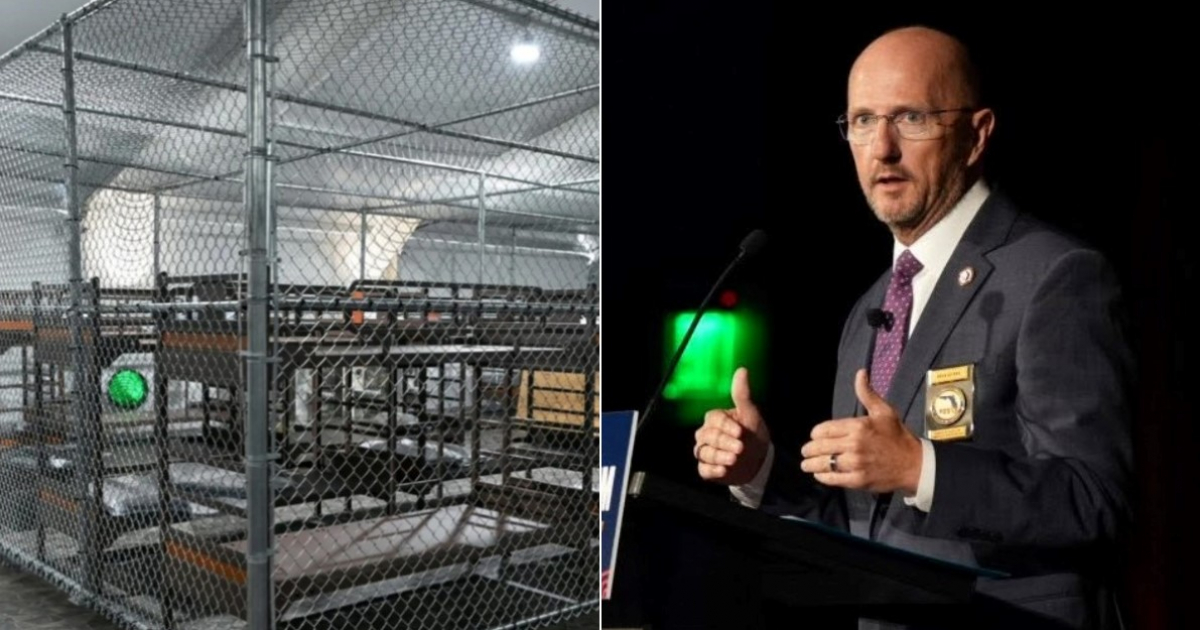
Kevin Guthrie, the head of Florida's Division of Emergency Management, revealed he learned through news outlets about the federal decision to relocate all detainees from the immigration facility known as "Alligator Alcatraz," situated in the southern Florida Everglades.
During a hurricane preparedness roundtable at Florida International University's Biscayne Bay Campus in North Miami, Guthrie directed inquiries to the federal agency, stating, "So you'd have to ask ICE what has changed."
His comments highlight a significant disconnect between state and federal governments regarding the future of this controversial site.
"It was always meant to be temporary. ICE made a decision. They released that statement. I hadn't seen that statement before it hit the media," Guthrie admitted, as reported by Local 10.
The Department of Homeland Security (DHS) confirmed on Tuesday that the facility was cleared out, citing safety concerns at the start of hurricane season, coinciding with the formation of the first tropical storm of the 2026 season off the Texas coast.
DHS spokesperson Lauren Bis explained the action with a brief statement: "For the safety of undocumented detainees, we moved them to other facilities."
Unanswered Questions and Legal Challenges
Authorities did not specify the number of individuals relocated or the exact locations to which they were transferred.
Attorney Katie Blankenship from Sanctuary of the South confirmed that her 50 clients were moved to centers in southern Florida, California, Arizona, Louisiana, and Texas, without formal notification to their legal representatives.
Guthrie defended the structural resilience of the facility, albeit with a toned-down version from earlier claims: "The I-beam and canvas structures can withstand winds up to 74 miles per hour, equivalent to a tropical storm or Category 1 hurricane." Previously, he had asserted it could endure a Category 2 hurricane.
He emphasized that evacuation plans were always in place: "There was never an intention to leave people in that facility, not even during a tropical storm. We were going to evacuate and had evacuation plans."
Future of "Alligator Alcatraz"
The facility remains intact and could reopen. "At this time, we haven't been directed to cease operations, so we remain ready to receive detainees again, if that's what the Department of Homeland Security wants to do," Guthrie stated.
The DHS has not clarified whether the closure is temporary or permanent.
"Alligator Alcatraz" was constructed in just eight days using state emergency powers and was inaugurated by President Donald Trump and Governor Ron DeSantis on July 3, 2025, at the former Dade-Collier Airport within Big Cypress National Preserve.
Since its opening, the facility has faced accusations of inhumane conditions: overcrowding, non-potable water, maggots in food, and non-functioning toilets. Nearly 60% of detainees were classified by ICE as having no prior criminal convictions, contradicting the authorities' initial justification.
The total operational cost exceeded $1.1 billion by June 2026, according to records obtained by Friends of the Everglades, which has an active lawsuit for environmental damage in the Everglades.
Amy Godshall, an attorney with the ACLU of Florida, warned that the relocation does not close the chapter: "Removing people from this cruel facility is an important step, but it does not erase the harm already done. The state and federal government must close this facility permanently and commit to never detaining people there again."
Frequently Asked Questions About 'Alligator Alcatraz' Facility
Why was 'Alligator Alcatraz' evacuated?
The evacuation was executed due to safety concerns at the start of the hurricane season, as confirmed by the Department of Homeland Security.
What are the criticisms against the 'Alligator Alcatraz' facility?
The facility has been criticized for inhumane conditions, including overcrowding, non-potable water, maggots in food, and non-functioning toilets.
Is the closure of 'Alligator Alcatraz' permanent?
The Department of Homeland Security has not clarified if the closure is temporary or permanent.