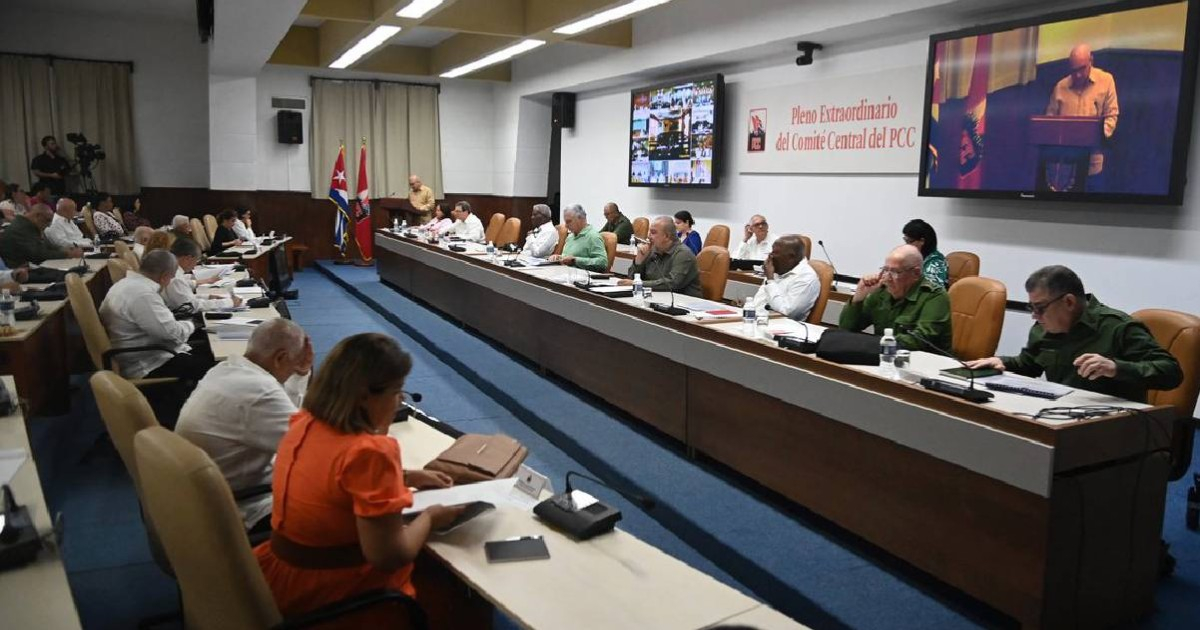
The Cuban Communist Party (PCC) held a Special Plenum of its Central Committee this past Wednesday, led by Miguel Díaz-Canel. The principal aim of this assembly was to endorse a series of economic reforms that, according to its promoters, aim to "safeguard the Revolution and its key achievements."
Roberto Morales Ojeda, a member of the Political Bureau and Secretary of Organization of the Central Committee, set the ideological tone of the meeting with his opening remarks. "The economic and social transformations we are discussing here are to protect the Revolution and its accomplishments," Morales Ojeda declared to the delegates present.
During his speech, Morales Ojeda also paid homage to Generalissimo Máximo Gómez on the 121st anniversary of his death, a gesture intended to evoke historical symbols often used by the regime to rally support when facing internal pressure.
New Reforms Amid Challenges
Following Morales Ojeda’s introduction, Prime Minister Manuel Marrero Cruz presented the proposals, structured around several work axes. He emphasized that these changes "can only be driven by our own efforts," thereby dismissing any expectations of external assistance.
Marrero Cruz further noted that the measures "will impact the enhancement of the Cuban economic management system," but did not provide specifics on timelines or implementation methods.
Commitment to Socialist Model
The session confirmed that the proposals do not deviate from the socialist model. Instead, they are described as "expressions of the inherent logic of development during the historical period of its construction, guided by the ideas of Fidel and Raúl, and under the directives of the First Secretary."
Announced by Díaz-Canel on June 12, the reform package includes reducing ministries from 27 to 21, granting greater autonomy to municipalities and state enterprises, opening investment opportunities to Cubans residing abroad, and promoting small and medium-sized businesses.
The plenum took place under the backdrop of a Reuters ticker displaying news: "U.S. will prevent the arrival of two tankers with Russian fuel." This development occurred amid street protests in Santa Clara and new demonstrations in Havana, compounded by an electricity deficit exceeding 1,900 MW during peak hours and a record 1,311 protests documented in May 2026 by the Cuban Conflict Observatory.
Next Steps in Legislative Process
The next phase in the institutional process is already set: the regime has called for an Extraordinary Session of the National Assembly this Thursday, June 18, where formal legislative approval of the same measures endorsed by the PCC in their plenum is anticipated.
Understanding Cuba's Economic Reforms and Protests
What are the main goals of the Cuban Communist Party's recent economic reforms?
The main goals of the recent economic reforms are to preserve the Revolution and its achievements by restructuring ministries, increasing autonomy for municipalities and state enterprises, and encouraging investment from Cubans abroad.
How is the Cuban government responding to internal pressures and protests?
The government is appealing to historical symbols and conducting meetings to discuss reforms, while emphasizing that changes will be driven by internal efforts without external support. This comes amidst significant public dissatisfaction and protests.
What challenges are currently facing Cuba?
Cuba is experiencing a severe electricity deficit, widespread protests, and economic difficulties exacerbated by external sanctions and internal inefficiencies.