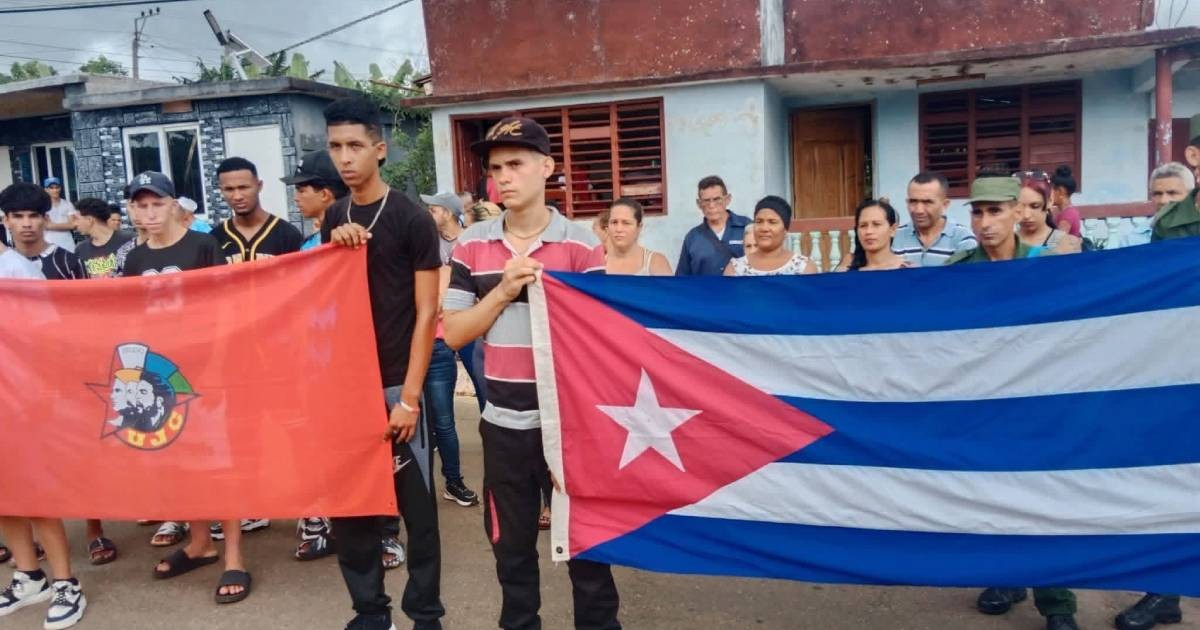
In the midst of escalating tensions between Havana and Washington, a military recruitment ceremony took place on Wednesday in Maisí, the easternmost municipality of Cuba. Official channels linked to local authorities shared the event, highlighting the growing criticisms surrounding the Active Military Service (AMS).
The "Dme Maisí Guantánamo Cuba" Facebook page released images showing a uniformed officer reading documents to a group of young individuals holding Cuban flags and flags of the Union of Young Communists (UJC).
The post described the event as a farewell ceremony for those about to join the military service, citing the Constitution, National Defense Law No. 75, and Decree-Law 224 of 2001 as legal justifications for the process.
"Answering the call of duty, they prepare to fulfill this phase of their lives," the statement from the entity read.
Contrasting Views on Military Service
However, the official narrative starkly contrasts with the complaints from Cuban families over the years, who have challenged the mandatory nature of the recruitment and the conditions under which thousands of young people serve in the AMS.
The ceremony occurred at a particularly sensitive time. Since early 2026, the regime has ramped up its military readiness rhetoric following the deterioration of relations with the United States.
In June, Miguel Díaz-Canel declared that Cuba would respond to any external aggression.
"If the homeland is attacked, we will respond in legitimate defense. Should they attempt to invade, let there be no doubt, there will be a determined and firm fight," the Cuban leader asserted.
Symbolic Significance of Maisí
Maisí's location adds a symbolic layer to the event. Situated in Guantánamo province, home to the U.S. naval base, it remains a major point of tension between the two nations.
Recently, official rhetoric about a potential confrontation has also surfaced in public forums. During official events this year, regime-affiliated figures have made aggressive statements advocating for a potential Cuban military response.
While authorities promote military service as a patriotic duty, independent organizations and families of recruits continue to report accidents, negligence, and fatalities during AMS.
Data gathered by Archivo Cuba and CubaXCuba show at least 67 recruits died from 2018 to early 2026 due to various causes, including suicides, accidents, and alleged negligence. Meanwhile, Cubalex documented at least 19 young deaths during military service in 2025 alone.
Growing Concerns Over Safety and Legal Constraints
Guantánamo province has recently been the scene of some of these incidents. In December 2025, Eldis Leyva Nieves, 19, died after being injured in shooting exercises. A few months later, in February 2026, 17-year-old Abraham Limonta Estrada passed away at the "La Marquesita" Military Unit, causing shock among his family and friends.
Concerns about recruit safety are compounded by the lack of legal mechanisms to refuse military service on conscientious grounds. Cuban law does not recognize this right and imposes penalties on those failing to register or join.
Decree 103 of 2024 imposes fines up to 7,000 pesos for those who fail to appear when summoned, alongside potential criminal consequences for repeat offenders.
Within this context, the ceremony in Maisí underscores the continuation of a recruitment policy that authorities present as a civic duty, yet it continues to worry many Cuban families due to the risks and limited legal options to prevent their children from joining the Active Military Service.
Understanding Cuba's Military Recruitment and Its Implications
Why is military service mandatory in Cuba?
Military service in Cuba is mandated by the government as a civic duty, supported by the Constitution, National Defense Law No. 75, and Decree-Law 224 of 2001. It's portrayed as essential for national defense and patriotism.
What are the main concerns regarding Cuba's military recruitment?
Concerns include the mandatory nature of the service, the conditions recruits face, and the lack of legal avenues to refuse service on moral or conscientious grounds. Reports of accidents and fatalities among recruits exacerbate these worries.
How does the international community view Cuba's military policies?
The international community often views Cuba's military policies critically, particularly the compulsory nature of service and the reported human rights concerns surrounding it. Relations with the U.S. and other nations further complicate these perceptions.