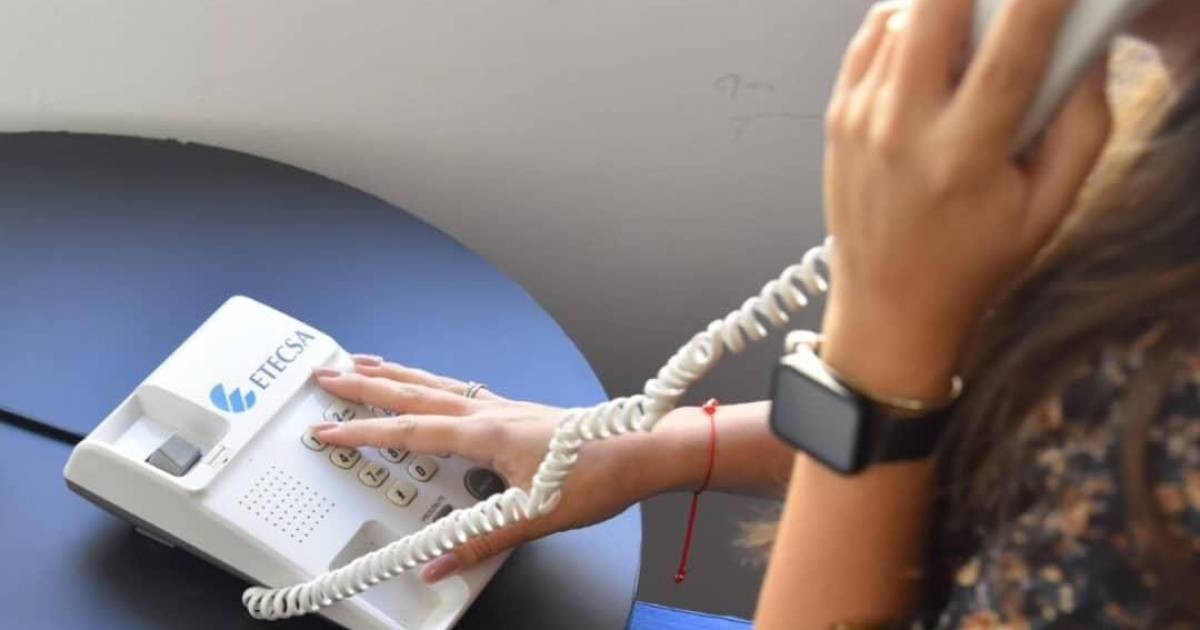
An official from ETECSA has publicly acknowledged that Cuba's telecommunications infrastructure cannot remain operational for more than 24 hours without power, highlighting the severe impact of the ongoing energy crisis on the island's phone and internet services.
Gustavo López Cruz, head of ETECSA's commercial department in Sancti Spíritus, revealed to Radio Vitral that extended blackouts and fuel shortages for generators have placed the company in an increasingly challenging position.
"The reality is that sustaining this technology beyond 24 hours without grid power is impossible," he stated.
This statement comes as many Cuban localities endure power cuts lasting up to 18 hours daily, with some communities experiencing severely limited electrical service for weeks.
López Cruz pointed out that the main cause of disruptions in landline, mobile phone, and internet services today is the frequent power outages.
The Nationwide Impact of Power Outages
In Sancti Spíritus, just 21 out of 70 telephone exchanges and cabinets are equipped with backup generators, leaving over 288,000 mobile lines and about 11,400 Nauta Hogar customers vulnerable.
However, this issue is widespread across the country. According to the company's own data, power cuts disable approximately 47.5% of mobile radiobases and 56.5% of telecommunications cabinets nationwide.
The executive also explained that backup batteries frequently malfunction due to incomplete charging cycles caused by the unstable electrical system. Additionally, reduced solar energy generation during rainy and cloudy months exacerbates the problem.
Adapting to Prolonged Power Outages
"We've made scheduling adjustments because, during such extended periods without electricity, the equipment can't perform optimally. Alarms trigger, shutting them down completely, leading to complaints about the lack of service availability," he admitted.
In response to the worsening situation, ETECSA has accelerated the installation of photovoltaic systems in several municipalities as an emergency measure.
For instance, in Jobabo, Las Tunas, 54 solar panels of 620 watts were installed alongside a battery bank capable of supporting telecommunications infrastructure for seven to eight hours. However, this duration falls short of the more than 24 hours deemed necessary by the company to cope with current blackouts.
These systems are part of a Chinese donation comprising 5,000 photovoltaic systems valued at over $114 million. Of these, 2,671 units were allocated to strategically important centers in 168 municipalities, including 240 for ETECSA facilities.
Challenges and Security Concerns
Despite these efforts, limitations remain. The National Office for Rational Energy Use (ONURE) regulations prevent recharging batteries using the conventional electrical grid, making them solely reliant on solar energy, which is less effective during extended outages.
The crisis has also exposed these infrastructures to new issues. In Santiago de Cuba, at least three solar panel thefts were reported between May and June this year, leaving several telecommunications nodes without backup power and affecting over 560 users.
Meanwhile, the company has had to prioritize protecting certain key points for the national network's operation. In Sancti Spíritus, efforts focus on maintaining the provincial headquarters, Trinidad, and Cabaiguán facilities operational, while many rural communities remain cut off during prolonged blackouts.
The deterioration of infrastructure occurs as Cuba records one of the slowest internet connections in Latin America. According to the Speedtest global index, the island ranks last in the region, with an average speed of just 7.21 Mbps.
The system's vulnerability was further exposed in March 2026, when a massive blackout caused a 65% drop in national internet traffic, and full service restoration took nearly 29 hours.
Understanding the Telecommunications Crisis in Cuba
How long can ETECSA's infrastructure operate without power?
ETECSA's infrastructure cannot maintain operations for more than 24 hours without power.
What is the main cause of telecommunications disruptions in Cuba?
The primary cause of disruptions in telecommunications services is the frequent power outages.
What measures is ETECSA taking to address power outages?
ETECSA is installing photovoltaic systems in various municipalities as an emergency measure to cope with power outages.