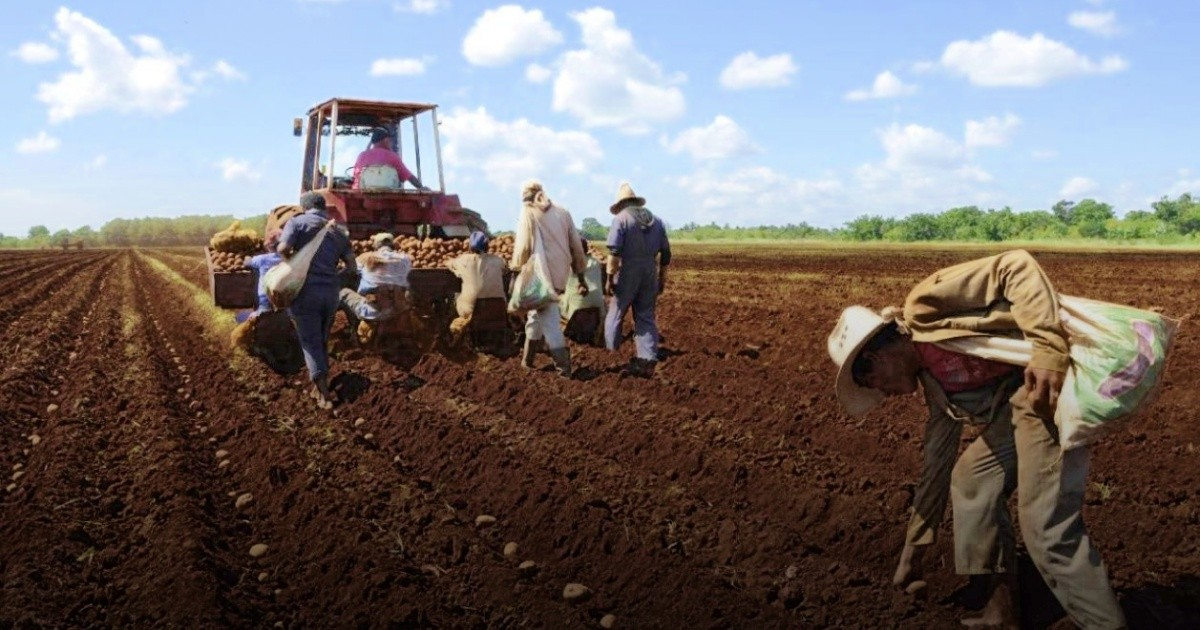
This Wednesday, the Cuban regime unveiled details of the proposed Agricultural and Forestry Land Law, a comprehensive legal framework designed to consolidate over 25 scattered regulations that have governed land ownership, possession, and use on the island for decades. The law is set for approval during the National Assembly's ordinary session on July 16, 2026.
Mayra Cruz Legón, the legal director of the Ministry of Agriculture (MINAG), presented the forthcoming legislation as "a comprehensive update of the legal framework governing agricultural lands and assets." She emphasized that the law maintains continuity with the past: "The law reaffirms the principles and provisions of the Agrarian Reform Laws of 1959 and 1963, highlighting its revolutionary continuity."
This announcement comes at a time when Cuban agriculture is facing its most challenging period in decades: rice production has plummeted from 304,000 tons in 2018 to 111,000 in 2025, and the production of root vegetables, eggs, and milk has decreased by 44%, 43%, and 37.6% respectively. Cuba currently imports between 70% and 80% of the food it consumes, costing approximately $2 billion annually.
A Unified Legal Framework After Years of Disarray
The new legislation repeals Decree-Law 125 of 1991 and Decree-Law 358 of 2018, which previously established a 20-year usufruct limit and capped individual land holdings at 26.84 hectares.
Under the new law, the usufruct period for state lands is extended to 25 years with the possibility of renewal, and the maximum land size increases to 67.10 hectares — equivalent to five caballerías — with potential expansions up to 268 hectares for livestock, forestry, sugarcane, or rice activities.
Recognition of Small and Medium Enterprises (SMEs)
One significant change is the explicit acknowledgment of state-owned, private, and mixed small and medium enterprises (SMEs) as agricultural and forestry producers, a status not previously recognized in existing legislation.
The law also includes productive hubs, local development projects, and foreign investment modalities. Cruz Legón described these entities as "the productive base of the agricultural system," which organizes production processes and agricultural services.
Private SMEs will be able to access land under usufruct as long as their projects contribute to municipal development and local food systems.
Property Rights and Transfer Provisions
For the first time, the legislation recognizes usufructuaries' rights over homes built on granted lands, with the possibility of legalizing them as property after at least five years of effective work on the land.
The law permits transactions between farmer-owners, subject to the approval of the Municipal Commission of Agrarian Affairs, and introduces succession agreements to designate heirs through public deeds. Donations are extended to fourth-degree relatives and those with recognized socio-affective ties.
Existing Restrictions Persist
Despite these innovations, structural restrictions remain: leasing land is still prohibited, the state retains the right of first refusal on any land transfer, and private ownership is capped at 67.10 hectares per owner, unchanged since the Second Agrarian Reform Law of 1963.
The law is part of a broader package of agricultural reforms announced by Díaz-Canel on June 12, which includes access to inputs in both national currency and foreign exchange, as well as openness to foreign investment. The leader stated that these measures aim to enable Cuba to achieve "food sovereignty and become self-sufficient in food production."
Simultaneously, the regime announced the dissolution of the Ministry of Agriculture, to be replaced by a new Ministry of Agro-Food that will integrate agriculture, sugar, fisheries, and the food industry. The law's approval is anticipated for July 16, 2026, during the National Assembly's upcoming ordinary session.
Understanding Cuba's New Agricultural Land Law
What is the purpose of Cuba's new Agricultural Land Law?
The new Agricultural Land Law aims to consolidate over 25 scattered regulations into a single legal framework, enhancing land ownership, possession, and usage rules to boost agricultural production on the island.
How does the new law impact land usufruct in Cuba?
The law extends the usufruct period for state lands to 25 years with the possibility of renewal and increases the maximum land size to 67.10 hectares, with potential expansions for specific agricultural activities.
What changes does the law introduce for SMEs in agriculture?
The law recognizes state-owned, private, and mixed SMEs as legitimate agricultural producers, allowing them to access land under usufruct if their projects support municipal development and local food systems.