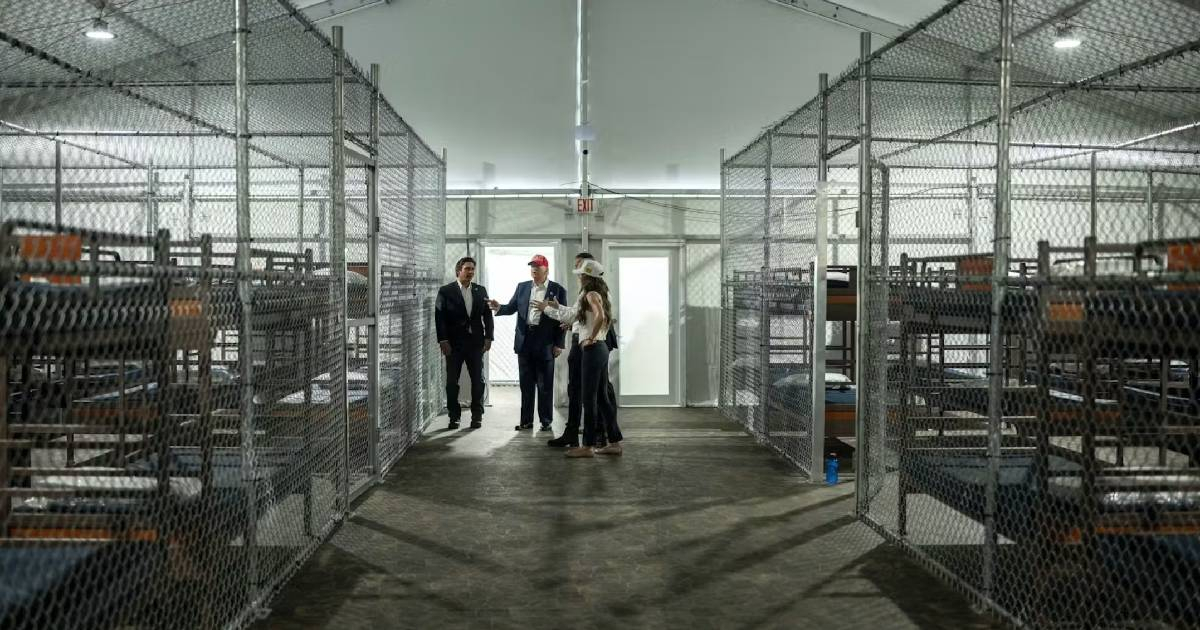
The Immigration and Customs Enforcement (ICE) and the state of Florida have emptied the detention center known as Alligator Alcatraz, situated in the southern Everglades of Florida, by relocating all detainees to different facilities ahead of the hurricane season.
"As the hurricane season begins, ICE and the state of Florida have transferred undocumented immigrants from the flexible-structure facility," the federal agency confirmed, explaining the move as a precaution to ensure the "safety of undocumented detainees."
Officials did not specify the exact number of people relocated or the specific facilities they were sent to.
This closure follows months of complaints regarding the conditions within the center and an operational cost that, according to records obtained by the environmental organization Friends of the Everglades, amounted to about $1.2 million daily, with total expenses exceeding $1.1 billion up to June of this year.
A significant number of those who passed through Alligator Alcatraz were Cubans, many of whom are elderly individuals with decades of residence in the United States. According to a Human Rights Watch report published on May 27, 2026, titled "They Leave Us Here to Die," between January 2025 and March 2026, 4,353 Cubans were deported to Mexico, the largest national group among those deported to that country.
Out of the 53 deportees interviewed by HRW, 41 were Cuban, and 17 were aged 60 or older, with the oldest being 83 years old.
Documented cases include Cuban Rafael Enrique Migolla, 73, who arrived in the United States in 1991 and was deported to Mexico, where he lives irregularly in Villahermosa, Tabasco. Also, Felipe Muñoz, 70, with over thirty years in the country, and Lázaro Romero León, 59, with the same length of residence, who ended up homeless in Tapachula after being deported.
Controversial Facility Built in Eight Days
The facility was constructed in just eight days using state emergency powers and inaugurated by Trump and DeSantis in July 2025, at the site of the former Dade-Collier Training and Transition Airport within the Big Cypress National Preserve. Although its announced capacity was between 3,000 and 5,000 detainees, by April 2026, it housed a daily average population of about 1,400 individuals.
Nearly 60% of the detainees were classified by ICE as "non-threatening," meaning they had no previous criminal convictions, which contradicted the original justification by authorities for constructing the facility.
"When it was built without public input in the heart of the Everglades last summer, authorities claimed it was needed to house the worst of the worst. And it's clear that wasn't the case," stated Eve Samples, executive director of Friends of the Everglades.
Legal and Environmental Concerns
The organization filed a lawsuit claiming the state did not perform the federally required environmental assessment before opening the center and that at least 20 acres of new asphalt were laid in the Everglades without any public process.
Detainees reported inhumane conditions within the facility: overcrowding of 27 to 32 people per cage, non-potable water, insufficient food, and delays of up to 72 hours for medical attention.
Florida anticipated receiving over $600 million in federal reimbursements for the center's operation, but that payment remains stalled without a clear payment schedule.
Friends of the Everglades announced it will continue legal action until the facility is permanently closed. "I believe, when all is said and done, it will be seen as a dark chapter in the history of the Everglades," Samples concluded.
Key Concerns about Alligator Alcatraz Detention Center
Why were detainees moved from Alligator Alcatraz?
Detainees were relocated to ensure their safety as the hurricane season began.
What were the reported conditions inside the facility?
Reports indicated overcrowding, non-potable water, insufficient food, and delays in medical care.
How did the construction of the facility impact the Everglades?
The facility was built without a required environmental assessment, and new asphalt covered 20 acres of the Everglades.