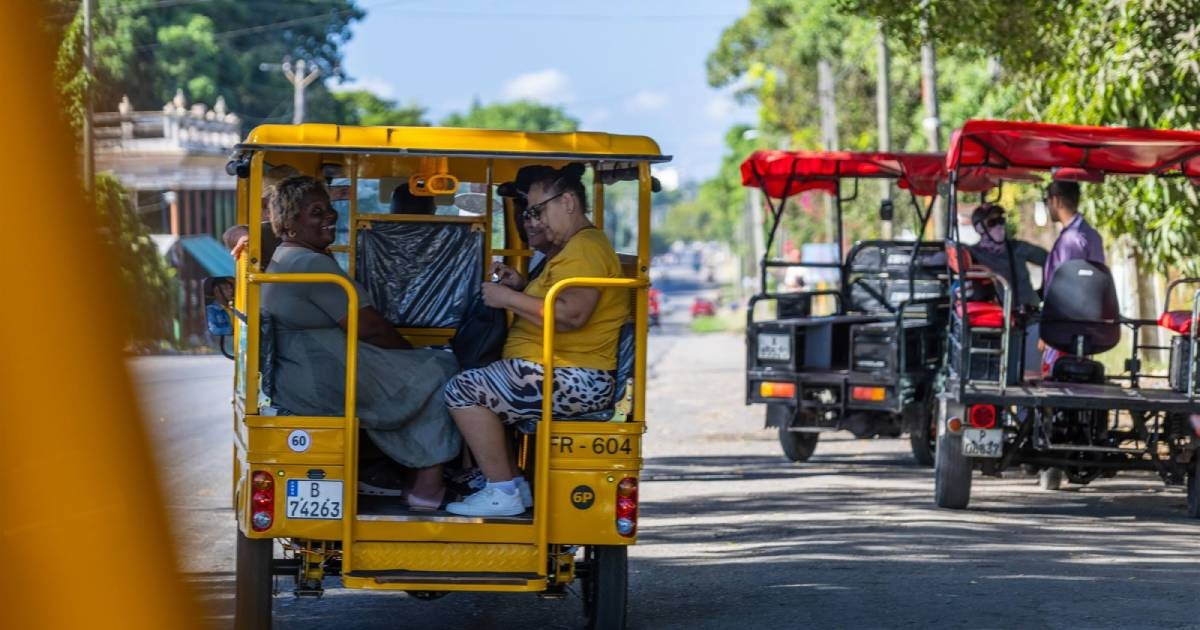
In response to public outcry, private tricycle fares in Matanzas have been lowered following a meeting between local authorities, tricycle owners, and drivers. The discussion aimed to reorganize services and set official prices for several of the city's most frequented routes.
This meeting, held on Tuesday with representatives from the Municipal Government, the Communist Party, and private transport operators, followed just days after users complained about the steep fare increases amid the public transportation crisis.
Until last week, some tricycles charged 300 pesos for trips to Peñas Altas and 150 pesos to the Bus Terminal. With the newly agreed rates, these costs will decrease.
Journalist Yuni Moliner, along with Radio 26, reported that the new fares are set at 250 pesos between the Pre-University and Peñas Altas; 125 pesos from the Pre-University to the Terminal; 125 pesos between the Pre-University or the Cathedral and Versalles; and 150 pesos from the Pre-University to the Faustino Pérez Hospital.
Drivers had justified the recent price hikes due to the rising costs of batteries, spare parts, and other essentials needed to keep the vehicles operational, all within a context of the depreciating Cuban peso and the soaring dollar in the informal market.
Efforts to Legalize and Organize Tricycle Services
Beyond fare adjustments, the meeting addressed the status of a sector that has become a crucial component of urban mobility in Matanzas.
Authorities pledged to expedite the legalization process for both electric and combustion tricycles, taking advantage of a special provision from the Ministry of Transportation that allows operational licenses to be processed using vehicle chassis numbers for those without official registration.
Additionally, there was an announcement about creating representatives for tricycle stands and initiating the unionization process for drivers. This move aims to formalize an activity that has rapidly expanded in recent years.
Tricycles as an Essential Transportation Alternative
Another agreement involves some tricycles participating in prioritized services for Public Health and the Electric Company, as well as keeping drivers informed about the development of electric vehicle charging stations in the province.
The significance of these decisions lies in the current dependence of thousands of Matanzas residents on tricycles for transportation.
The decline in state-run transportation has left these private vehicles as one of the primary mobility options in the city. In recent months, numerous urban and intermunicipal routes have reduced or ceased operations due to a lack of fuel, spare parts, and available buses.
Given this situation, tricycles have shifted from being a supplementary option to an essential service for a large portion of the population.
Both authorities and transport operators agreed on the necessity of maintaining dialogue to find a balance between the economic sustainability of the service and the users' ability to pay, as they are increasingly affected by inflation and the ongoing economic crisis in the country.
FAQs about Matanzas Tricycle Fare Reductions
What prompted the reduction in tricycle fares in Matanzas?
The reduction was prompted by public complaints about fare increases, leading to a meeting between local authorities and tricycle operators to set new official rates.
What are the new tricycle fares in Matanzas?
The new fares are 250 pesos between the Pre-University and Peñas Altas, 125 pesos from the Pre-University to the Terminal, 125 pesos between the Pre-University or the Cathedral and Versalles, and 150 pesos from the Pre-University to the Faustino Pérez Hospital.
How are authorities supporting tricycle operators?
Authorities are working to expedite the legalization of tricycles and have announced plans for unionization and representation of tricycle stands, aiming to formalize and support the sector.