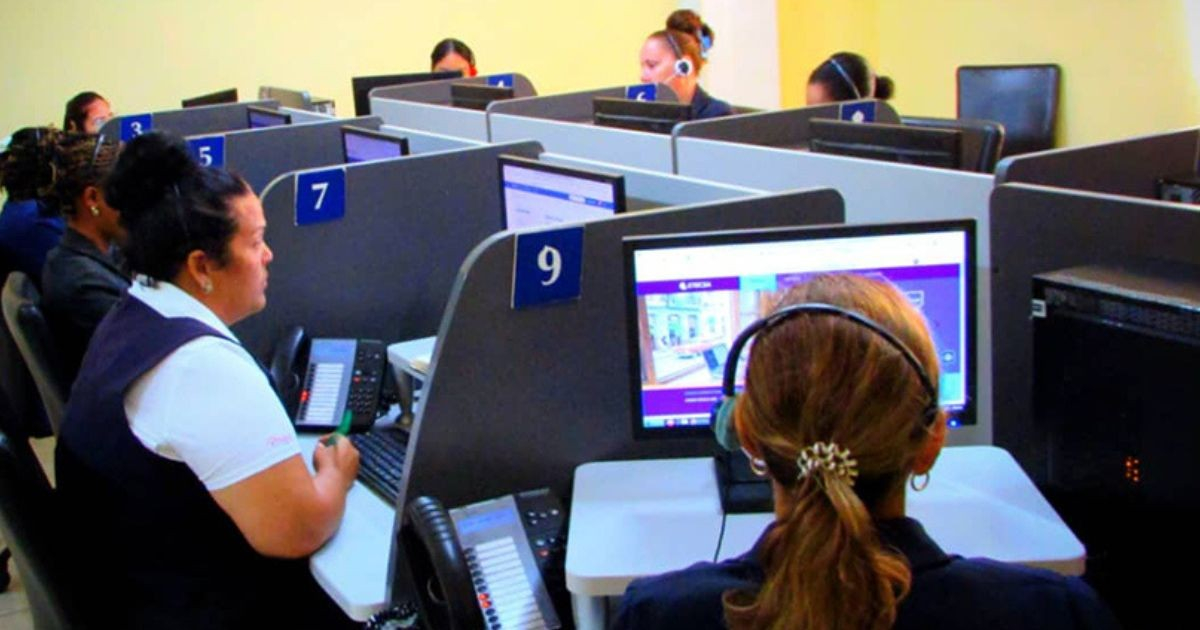
In Ciego de Ávila, three generations of women serve as the primary point of contact between ETECSA and its customers. The Telephone Assistance Center (CAT) within the company's Territorial Division operates under strict protocols, minute-by-minute metrics, and faces the challenging task of remaining composed amid public criticism over the company's inefficiencies.
A report by the state-run newspaper Invasor, published by journalist Alain Martínez Pol, sheds light on this situation.
The telecommunication executives at CAT are not allowed to use colloquial language. Their mandatory greeting is "Etecsa is here to assist you, how can we help?" The system tracks how many calls each operator handles, the duration of each conversation, and even if they exceed their break time for using the restroom.
Alicia María Consuegra Fernández began her career in 1994 when the center was known as Telephone Traffic, working with a plug panel that could handle ten simultaneous connections. This was during the Special Period, a time of economic hardship, with minimal wages and scarce food.
"I come from the era of plugs," recalls Alicia, who is now a supervisor and has dedicated over thirty years to the company without considering leaving.
Back then, public phone calls required distinguishing between the sound of different coins. "If a light went on, you had to respond. You always had to keep an ear out because public coin calls required distinguishing the sound of different coins and notifying customers when their three minutes were up," Alicia explains.
Challenges and Evolution at ETECSA
The era of pagers followed, with operators handling between 600 and 700 messages each, requiring proper spelling and no breaks. Then came Movitel, text messaging, and eventually, the era of Nauta Hogar and data packages. "Now, it's more complex with mobile services, Nauta Hogar, and those offerings. We have to continuously study and read," Alicia admits.
Yanira Cedré Castilla, with five years in the field, recalls one of the most intense nights of her career when a frantic ambulance driver called. His vehicle had broken down while transporting a patient from Sancti Spíritus to Ciego de Ávila, and he couldn't reach his dispatch center. Yanira managed to establish the necessary connection. "The gratitude from a customer after calling in distress is priceless," she says.
Meeting Customer Needs Amidst Modern Challenges
The youngest team member, Anella de la Caridad Montalvo Pérez, at twenty years old, enrolled in the training course as soon as she turned 18. She was the first in her group to do so and graduated before her 19th birthday. "I'm thrilled. I have a fantastic job. Our goal is to always meet customer needs and help them with any concerns," she confesses.
Anella acknowledges that the most demanding aspect isn't the difficult calls but the vast amount of information they must master. "The most stressful part is the sheer volume of information we need to gather, process, and read, as required to be well-prepared. Sometimes it's challenging to explain new services to customers," she notes.
The role of the CAT takes on particular significance in ETECSA's current context. Since May 2025, the company has capped Cuban peso recharges at 360 CUP every 30 days and promoted data plans in dollars, sparking widespread public criticism. These frustrated calls are the ones CAT workers handle daily.
Yanira defends the usefulness of phone services against digitalization: "The internet is complicated for many. Through the phone, we can help set up access points, purchase data packages, and even assist students with access to educational sites."
ETECSA plans to transform the traditional phone service model into a digital contact center where employees will engage in selling and promoting services internationally. However, all three agree that the core of their work will remain unchanged: "We're always helping someone, and that makes you feel useful," Anella concludes.
Understanding ETECSA's Customer Service Dynamics
What challenges do ETECSA's customer service representatives face?
Representatives face the challenge of maintaining composure under strict protocols, dealing with public criticism due to the company's inefficiencies, and handling a vast amount of information to assist customers effectively.
How has ETECSA's customer service evolved over the years?
Customer service at ETECSA has transitioned from handling public phone calls with coin sounds to dealing with pagers, text messages, and now complex mobile and internet services, requiring continuous learning and adaptation.
What changes are planned for ETECSA's customer service model?
ETECSA intends to shift from a traditional phone service model to a digital contact center, aiming to sell and promote services internationally while maintaining the essence of assisting customers.