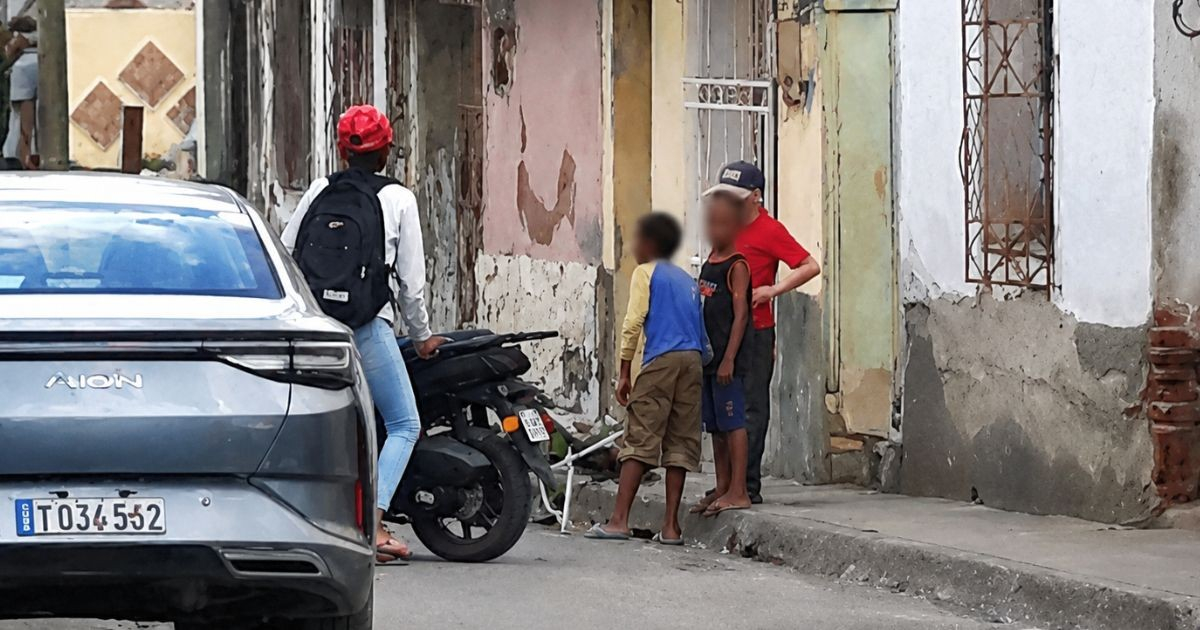
A photograph taken on the streets of Las Tunas sparked a heated online debate this Tuesday. The image depicted two children, aged between eight and ten, pushing a cart loaded with bananas. Their clothes were tattered, and they appeared to be in rough conditions.
This photo was shared in the Facebook group "Lo que necesitas en Las Tunas" by a user named Luis Vargas.
Vargas expressed his outrage over the scene, stating, "Kids between 8 and 10 years old are often seen on the streets of Las Tunas with a cart selling bananas. Dirty and wearing torn clothes."
He also highlighted another case: a child frequently asking for money near the city's Pediatric Hospital, who reportedly does not attend school.
Debate Over Responsibility and Government's Role
The most controversial aspect was Vargas's stance on the situation. He argued that the Cuban regime prioritizes children as "priority 1," blaming families for allowing such circumstances, which he deemed "unthinkable."
Commenters quickly responded, mostly disagreeing with Vargas's view. One user retorted, "You don't understand those children's situation. If you had kids, you'd know the government doesn't prioritize them, let alone care for or support them."
Others pointed out the economic hardships that force children into work. "Sometimes parents work all day just to afford a meal. Kids beg their parents to let them work so they can buy a glass of milk or a pair of shoes," another commenter explained.
Economic Struggles and Social Reality
Many users noted that state-subsidized milk is cut off at age seven, and even the cheapest shoes cost 5,000 Cuban pesos, while second-hand pants are around 2,000 pesos—prices unattainable with state wages.
Another user questioned, "Priority number one? Since when? They take away milk at age seven, and many have nothing for breakfast."
A commenter familiar with the children confirmed they are two brothers and a cousin who walk the neighborhood daily. "They lead a tough life. I've even given them clothes and sandals. It's sad, but they struggle to eat," the commenter said.
Broader Context of Child Labor in Cuba
The controversy erupted just four days after the Union of Young Communists (UJC) publicly denied the existence of child labor in Cuba "thanks to the Revolution," a statement that also faced massive backlash online.
The clash between official rhetoric and the reality in Las Tunas highlights a recurring debate across the island.
This is not an isolated incident. On June 10, a ten-year-old Cuban boy sold coquitos to support his mother and three siblings. In April 2026, another child sold pastries in a Santiago de Cuba park. In May, a 14-year-old sought work to help his family.
Even Miguel Díaz-Canel acknowledged in April 2025 the presence of begging and informal labor involving children in Cuba, while the prime minister admitted that over 310,000 people live in poverty or social vulnerability.
Las Tunas, among the provinces hardest hit by the crisis, has lost 11.5% of its population over eight years, with 53,510 fewer residents between 2022 and 2024 alone.
Since 2025, Cuba has had a law explicitly prohibiting child labor and child begging, yet the reality on its streets tells a different story.
Understanding Child Labor in Cuba
What sparked the controversy in Las Tunas?
The controversy was ignited by a photograph showing two young children in ragged clothing selling bananas on the streets, highlighting issues of child labor and poverty.
How did the public react to the situation?
The public largely disagreed with the idea that the government prioritizes children, highlighting economic hardships and criticizing the state's lack of support for families.
What did the Union of Young Communists claim about child labor?
The Union of Young Communists claimed that child labor does not exist in Cuba due to the Revolution, a statement that was met with widespread criticism.