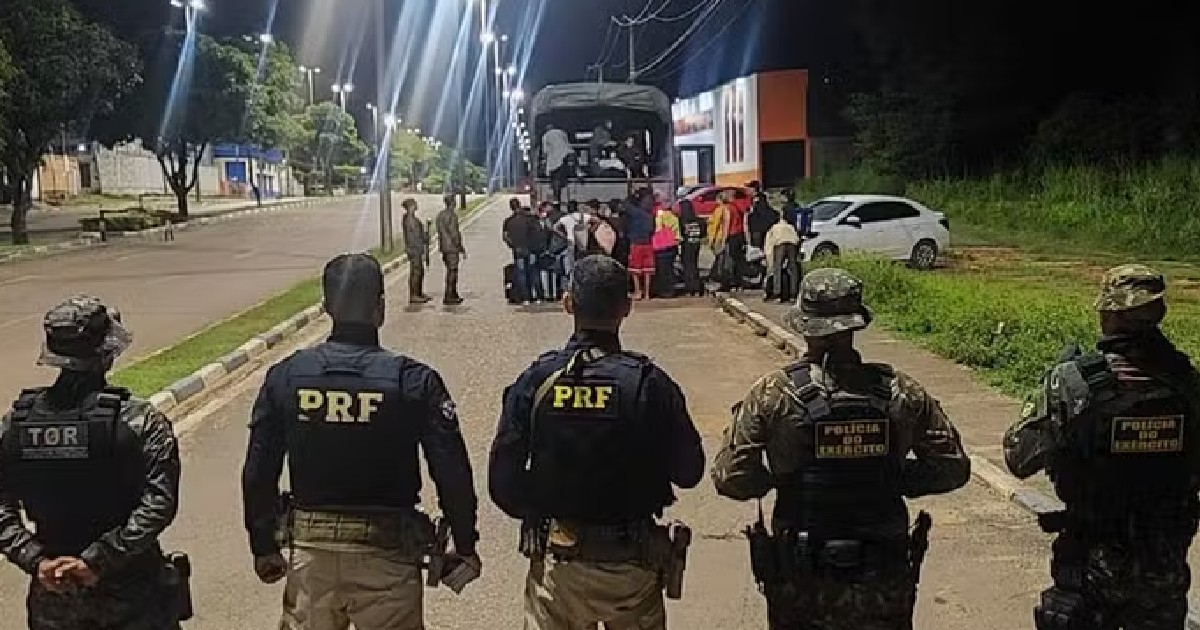
Brazilian law enforcement successfully rescued 189 Cuban migrants in the northern state of Roraima over the span of a single week. Authorities also detained at least seven alleged human traffickers, often referred to as "coyotes," who were accused of facilitating the illegal entry of these migrants from Guyana, according to reports from the Federal Police.
The rescues took place between June 8 and June 14 along the BR-401 highway, which links Bonfim—a border town adjacent to Guyana—with Boa Vista, the state capital. Additionally, operations were conducted at the Macuxis bridge, connecting the municipality of Cantá with Boa Vista.
A Record Rescue Operation
On June 8, the Federal Highway Police executed the largest single-day rescue operation recorded in Roraima, saving 108 Cuban migrants on the BR-401. Among those rescued were elderly individuals, a pregnant woman, and over ten children under the age of ten, some suffering from respiratory issues. Many of these migrants had endured days without adequate food.
The June 8 operation, part of the "Safe Route" initiative, unfolded in three distinct phases. Initially, three overcrowded vehicles carrying 39 Cubans were intercepted. Subsequently, a driver transporting eight additional migrants was stopped. Finally, following a suspicious vehicle led officers to a residence in Cantá where 61 Cubans were found crammed together. Five human traffickers were arrested during the operation.
The Cost of a Dangerous Journey
According to the Federal Highway Police, the migrants paid up to $2,800 to traffickers for their journey into Brazil. Officer Isaías Magalhães elaborated on the criminal network's operations, stating, "For many, Boa Vista is not the final destination. The capital serves merely as a transit point. This criminal network charges for a complete package, from departure in Cuba to the final destination within Brazil."
In the early hours of June 11, the Military Police rescued an additional 35 Cubans at the Macuxis bridge. Hours later, the Federal Highway Police discovered eight more in the same area. Authorities report that these migrants were intercepted while crossing the bridge on foot, displaying signs of vulnerability and suspected of being targeted by traffickers.
A Cuban migrant, interviewed by the television network O Globo after a rescue, recounted, "I went five days without sleep and without eating anything, just a little water and some cookies, to make it here, walking, crossing puddles, rivers, wherever possible to get here."
Crackdown on Human Trafficking Networks
On June 11, the Federal Police launched "Operation Northern Connection," executing four search and seizure warrants—three in Boa Vista and one in Bonfim—against a group facilitating the illegal entry of Cubans for payment. Authorities described the suspects as operating "in a structured and recurring manner, contrary to Brazilian migration laws."
The most common route for Cuban migrants heading to Brazil begins with a flight from the island to Georgetown, Guyana's capital—the only country in the region that does not require a visa for Cubans. From there, migrants travel overland to Lethem, then make a clandestine crossing of the Tacutu River into Roraima, continuing by road to southern Brazilian cities such as Curitiba.
This migration trend is escalating: in the first four months of 2026, over 13,000 Cubans sought asylum in Brazil, accounting for 58% of all applications in the country during that period, with Roraima receiving 57% of those requests. In 2025, Cuban asylum applications in Brazil reached 41,900, an increase of 88% from the previous year, driven by economic collapse on the island and the closure of migration routes to the United States. Brazil currently hosts around 84,000 Cubans, although for many, it serves as a transit country: more than 11,000 crossed into Uruguay between January and October 2025, averaging thirty per day.
Frequently Asked Questions About Cuban Migration to Brazil
What is the primary route for Cuban migrants entering Brazil?
Cuban migrants primarily enter Brazil via a flight to Georgetown, Guyana, followed by an overland journey to Lethem and a clandestine crossing of the Tacutu River into Roraima.
Why are so many Cubans seeking asylum in Brazil?
The spike in Cuban asylum seekers in Brazil is largely due to economic collapse in Cuba and the closure of migration routes to the United States, prompting many to seek refuge in Brazil.
How much are Cuban migrants paying to enter Brazil?
Migrants are reportedly paying up to $2,800 to human traffickers for their journey into Brazil.