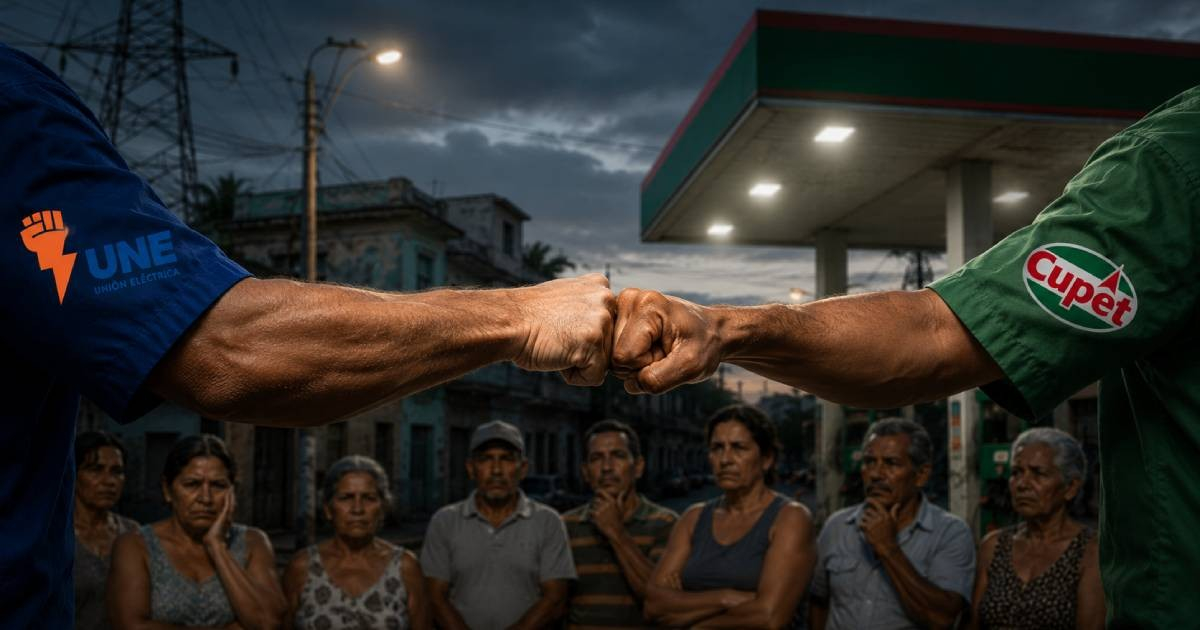
Last Thursday, Cuba's Electric Union (UNE) released an official letter addressed to CUPET, referring to oil workers as "brothers in arms" and expressing solidarity amid U.S. sanctions against the state-owned company. However, the Cuban public reacted with widespread mockery and indignation on social media.
The letter, signed by Rubén Campos Olmo, UNE's Director General, was shared on the social media accounts of both state entities a day after Secretary of State Marco Rubio announced CUPET's addition to the Office of Foreign Assets Control's (OFAC) Specially Designated Nationals (SDN) list, under Executive Order 14404, signed by President Donald Trump on May 1, 2026.
Campos Olmo stated in the letter, "Without you, there is no electricity; without electricity, there is no industry, no hospitals, no schools, and the harm to the population is substantial. Therefore, this aggression is not just against CUPET: it is against every Cuban household, against our children, every workplace, and the very life of the nation."
The document concluded with a revolutionary tone: "The people's energy cannot be sanctioned. The Revolution will not surrender. Onward to victory, always!"
Public Outcry Over Disparity Between Words and Reality
The discrepancy between the lofty rhetoric and the stark reality faced by Cubans did not go unnoticed. On Tuesday, the National Electrical System reported a projected shortfall of up to 2,000 MW during the evening peak, with only 1,030 MW available against a demand of 3,000 MW.
Additionally, since February 2025, CUPET has been selling special gasoline exclusively in U.S. dollars, and by June 2026, liquefied gas canisters cost up to $50 on the black market.
Comments on the posts by both entities harshly reflected this frustration. "Cubans don't need speeches to light a bulb. They need fuel, stable generation, modernized networks, and a functioning electrical system," one user commented, further noting that, "when a company spends more time issuing political slogans than explaining production indicators, it's normal for citizens to have questions."
Others were more blunt: "Let me know when you stop selling gas canisters in dollars." Another Cuban remarked, "Meanwhile, we'll keep selling gas in dollars, and those who can't afford it... well, too bad. You are the hunger and the calamity."
One user summed it up succinctly: "And the people are left in the dark, fed up." Another quipped with irony, "Future, sustainable, and Cuba cannot coexist in the same sentence."
Immediate Impact of Sanctions on CUPET
The sanctions against CUPET had swift repercussions. Vanguard Energy, based in Coral Gables, Florida, halted the shipment of 250,000 barrels of fuel to Cuba, and Miami-Dade County revoked its business license.
For Paul Kaye, Vice President of the U.S.-Cuba Trade and Economic Council, the signs of failure were evident from the outset. The critical question now is whether other companies considering business with Cuba will heed a story that, in his analysis, concluded exactly as anticipated.
Understanding the Impact of U.S. Sanctions on Cuba
Why did the UNE express solidarity with CUPET?
The UNE expressed solidarity with CUPET as they both face challenges due to U.S. sanctions, highlighting the interconnectedness of energy and fuel supply in Cuba.
What were the consequences of the sanctions on CUPET?
The sanctions led to immediate actions like Vanguard Energy suspending fuel shipments to Cuba and Miami-Dade County revoking CUPET's business license.
How did Cubans react to the UNE's message?
Cubans reacted with mockery and indignation, criticizing the disconnect between official rhetoric and the harsh realities of fuel and electricity shortages.