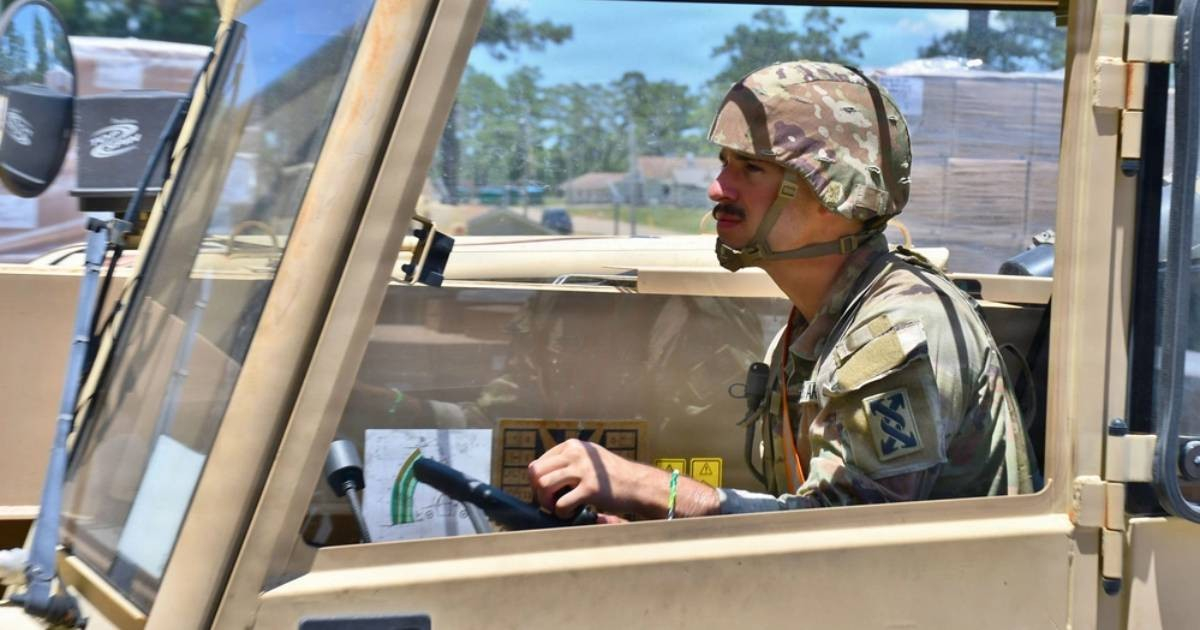
Andy Soto, who left Havana at the age of seven, is now a logistics specialist in the United States Army Reserve and is pursuing his second bachelor's degree in Miami. He attributes his journey to his father's unwavering decision to leave Cuba at all costs.
Soto's story was recently highlighted by the Department of Defense on their official information platform, DVIDS, during the military exercise Sentinel Justice held at Camp Shelby, Mississippi.
Currently, Soto serves in the 873rd Quartermaster Company, 332nd Transportation Battalion, 143rd Sustainment Command (Expeditionary) as an automated logistics specialist. Simultaneously, he is a full-time student at Florida International University in Miami, pursuing a degree in anthropology, having already obtained one in history.
The Struggles and Sacrifices of Soto's Family
Behind Soto's success lies a history marked by the Cuban regime's oppression. His father, once a major in the Cuban army, was dismissed and jailed for months for maintaining contact with Andy’s grandfather, who was already residing in the United States.
"He chose to refuse and was marginalized. He spent several months in prison as a result. After his release, he was assigned a job at the bakery," Soto shared about his father's ordeal.
After serving his sentence, Soto's father was relegated to managing a bakery. Aware of the harsh living conditions and persecution for having family abroad, he resolved to leave the country.
"He secured a visa through a lottery, allowing us to visit the U.S. Through the 'wet foot, dry foot' policy that enabled Cubans to apply for permanent residency, we were able to stay," Soto explained.
A New Beginning in the United States
Soto recalls his childhood in Havana with hazy but vivid memories: "Life could be tough—most stores were closed, we had no air conditioning, but I spent most of my time playing outside with my friends, just being a normal kid."
Upon arriving in Miami, Soto's path was influenced by his older brother, who, eight years his senior, is now a retired first-class sergeant in the U.S. Army. "I used to wear his uniform and pretend to salute. I didn’t know what I was doing, but I knew I wanted to be like my brother," Soto reminisced.
His brother ultimately recruited him from the Royal Palm Recruiting Station in Palm Beach, guiding him to specialize in automated logistics. Soto graduated from Felix Varela Senior High School in Miami and enlisted at 18, choosing the Reserve over active duty to forge his own path.
Serving in Operation Sentinel Justice
Today, Soto is part of Operation Sentinel Justice, one of the largest training exercises in U.S. Army Reserve history, with between 12,000 and 15,000 soldiers deployed in Mississippi. "I feel like I’m a good soldier; the unit trusts me with a lot of responsibility as a specialist, and I look forward to the deployment next year," he expressed.
Cubans serving in the U.S. Army often express their gratitude toward their adopted country. In April, soldier Lea Nieves shared her military experience, and in February, another Cuban expressed his emotions when thanked for his service. In December 2025, a Cuban-origin soldier sent a message to the Venezuelan people from his position in the U.S. Army.
Soto is scheduled for deployment in 2027, which will require him to pause his studies for a year. "I’ll have to take a year off for deployment, but I’ll complete it when I return," he stated regarding his anthropology degree.
"If I were still in Cuba, I don't know what I would be doing. I am eternally grateful to the United States and the Army for everything they have given me," Soto concluded.
Understanding the Cuban-American Military Experience
What influenced Andy Soto to join the U.S. Army Reserve?
Andy Soto was influenced by his older brother, a retired first-class sergeant in the U.S. Army, who guided him to specialize in automated logistics and recruited him from the Royal Palm Recruiting Station in Palm Beach.
How did Soto's family manage to immigrate to the United States?
Soto's family managed to immigrate to the U.S. through a visa lottery, which allowed them to visit. They were able to stay under the 'wet foot, dry foot' policy that enabled Cubans to apply for permanent residency.
What are Soto's future plans in the U.S. Army?
Soto is scheduled for deployment in 2027, during which he will pause his studies for a year. He plans to complete his anthropology degree upon returning from deployment.