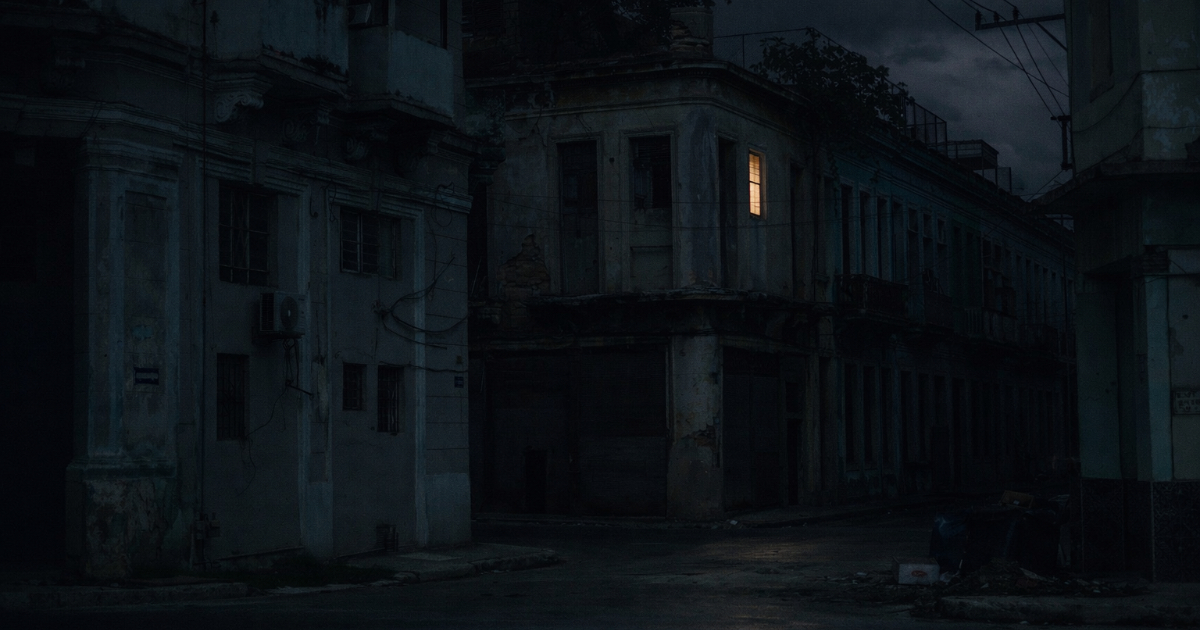
On Tuesday, Cuba's National Electrical System (SEN) experienced one of its most critical days of the year. According to the daily report from the Unión Eléctrica, at 6:00 AM, the available power was a mere 970 MW, while the demand reached 2,525 MW, leaving 1,555 MW already affected since the early morning hours.
The evening rush hour forecast paints an even grimmer picture. The electricity provider predicts an availability of just 1,030 MW against a peak demand of 3,000 MW, resulting in a shortfall of 1,970 MW. "If the anticipated conditions persist, a 2,000 MW disruption is expected during this period," the official report warns.
The Persistent Power Struggles
The situation was equally dire the day before. The Unión Eléctrica confirmed that "the maximum shortfall due to generation capacity deficit yesterday reached 2,018 MW at 8:50 PM," with service interruptions lasting all day and night.
In Havana, the capital's Electric Company reported that Monday saw continuous service disruptions, with a peak impact of 422 MW at 8:00 PM. Emergency circuits were shut down, adding another 128 MW to the blackout. By the end of the report, five blocks and emergency circuits remained down, accounting for 372 MW. "Restoring service was not possible," the company admitted in a Facebook post.
Fuel Shortages and Mechanical Failures
The most crippling factor for the system remains the lack of fuel. According to the Unión Eléctrica, 106 distributed generation plants are offline due to this issue, representing 890 MW. Additionally, the Regla Barge, Melones Barge, Mariel Central Fuel, and Moa Central Fuel plants are all out of service, culminating in a total of 1,203 MW unavailable due to fuel shortages.
Mechanical failures further exacerbate the problem. The Máximo Gómez Unit 6, an Antonio Guiteras plant unit, the Lidio Ramón Pérez Unit 2, and the Antonio Maceo Unit 6 are all offline due to breakdowns. Thermal generation limitations have resulted in another 289 MW being out of commission.
The nation's largest thermoelectric plant, the Antonio Guiteras, was disconnected again on Monday due to a new leak in the boiler, marking its 15th breakdown or outage of the year. It had briefly returned to service last Thursday after repairs but failed again in less than 72 hours.
Solar Power: A Modest Relief
Offering some reprieve, the 54 photovoltaic solar parks contributed 3,877 MWh on Monday, reaching a peak output of 547 MW at midday. However, solar generation does not address the nighttime deficit when demand peaks.
The only slight improvement expected this evening is the activation of the Energás Boca de Jaruco unit 3, providing 30 MW, along with the completion of its Combined Cycle with another 30 MW. This addition is marginal compared to the nearly 2,000 MW shortfall projected.
The crisis in June is part of a sustained decline: SEN experienced a total disconnection on March 16, 2026, which took 29 hours and 29 minutes to resolve, and record deficits of 2,153 MW and 2,174 MW were logged on consecutive days in May.
Cuba's Power Crisis: Key Questions and Answers
What are the main causes of the power outages in Cuba?
The primary causes of power outages in Cuba include fuel shortages and mechanical failures in power plants, as well as limitations in thermal generation capacity.
How is solar power contributing to Cuba's energy needs?
Solar power provides some relief by contributing to the overall energy supply, with 54 photovoltaic solar parks generating significant daytime power. However, it does not alleviate the nighttime demand peak.
What steps are being taken to address the power deficit?
Efforts to address the power deficit include the addition of new power units like the Energás Boca de Jaruco unit, although these measures are currently insufficient to cover the substantial shortfall.