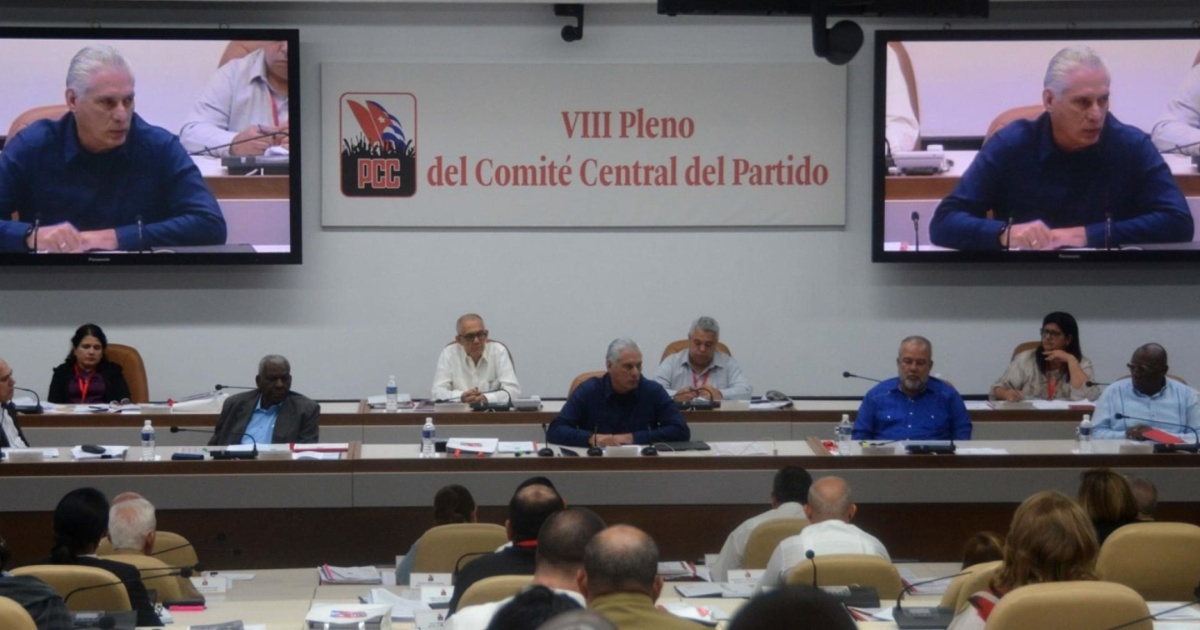
The Political Bureau of the Cuban Communist Party has decided to convene an extraordinary session of its Central Committee this Wednesday, June 17. The primary aim is to assess proposed economic and social reforms announced by Miguel Díaz-Canel in recent press statements.
Díaz-Canel confirmed this gathering on his Facebook page, stating, "On June 17, the Political Bureau has convened an extraordinary session of the Central Committee of the Communist Party of Cuba to evaluate the transformation proposals we recently outlined in press declarations."
The catalyst for this meeting was the announcement of a sweeping economic reform package presented by Díaz-Canel on June 12 during the television program Buenos Días. The regime has described this package as the most comprehensive in years.
Key Aspects of the Reform Package
The reform package is structured around six main pillars: restructuring the economic management system, promoting municipal and business autonomy, revitalizing agriculture, easing foreign trade restrictions, and attracting foreign investment.
Among the proposed measures are enabling municipalities to manage foreign currency and conduct direct imports and exports, alongside granting state enterprises greater leeway in setting wages and retaining their own foreign currency earnings.
Additionally, the plan suggests opening investment opportunities to Cubans living abroad under the same conditions as other economic players, and gradually replacing universal product subsidies with targeted assistance for vulnerable individuals.
Urgency and Political Support
Díaz-Canel emphasized that these measures would be processed "very swiftly" by both the Political Bureau and the National Assembly, which is scheduled to meet in July 2026.
An extraordinary meeting of the Central Committee is a rare occurrence on a national scale and is intended to provide formal political backing for the proposals before they undergo legislative processing.
The most recent precedent was the 11th Plenary of the Central Committee, which took place on December 13, 2025, via videoconference in a single day due to the severity of the crisis. During this session, Díaz-Canel acknowledged a dire economic outlook, with GDP declining and inflation soaring.
Internal Party Challenges and External Criticism
Since that time, the Communist Party has held a series of extraordinary provincial plenaries, where internal unity issues were acknowledged, and leadership changes were executed. In January 2026, Díaz-Canel admitted at provincial plenaries in Santiago de Cuba and Guantánamo that "a true unity within the Party does not exist."
The reforms announced on June 12 have failed to persuade analysts or opposition figures. Cuban economists have labeled them as "too late, too flawed, too limited," and a Cuban-American businessperson stated on June 15 that the announced changes are insufficient, pointing out that the regime still maintains the Communist Party's dominant role over the economy and society.
Key Questions About Cuba's Economic Reforms
What are the main goals of the proposed economic reforms in Cuba?
The primary objectives are to restructure the economic management system, enhance municipal and business autonomy, revive agriculture, relax foreign trade restrictions, and increase foreign investment opportunities.
How will the proposed reforms affect Cuban municipalities and businesses?
The reforms aim to allow municipalities to manage foreign currency and conduct direct trade without intermediaries, while giving state enterprises more freedom to set wages and retain earnings.
What criticisms have been raised against the proposed reforms?
Critics argue that the reforms are insufficient, as they maintain the Communist Party's control over the economy and society, and come too late to address Cuba's pressing economic challenges.