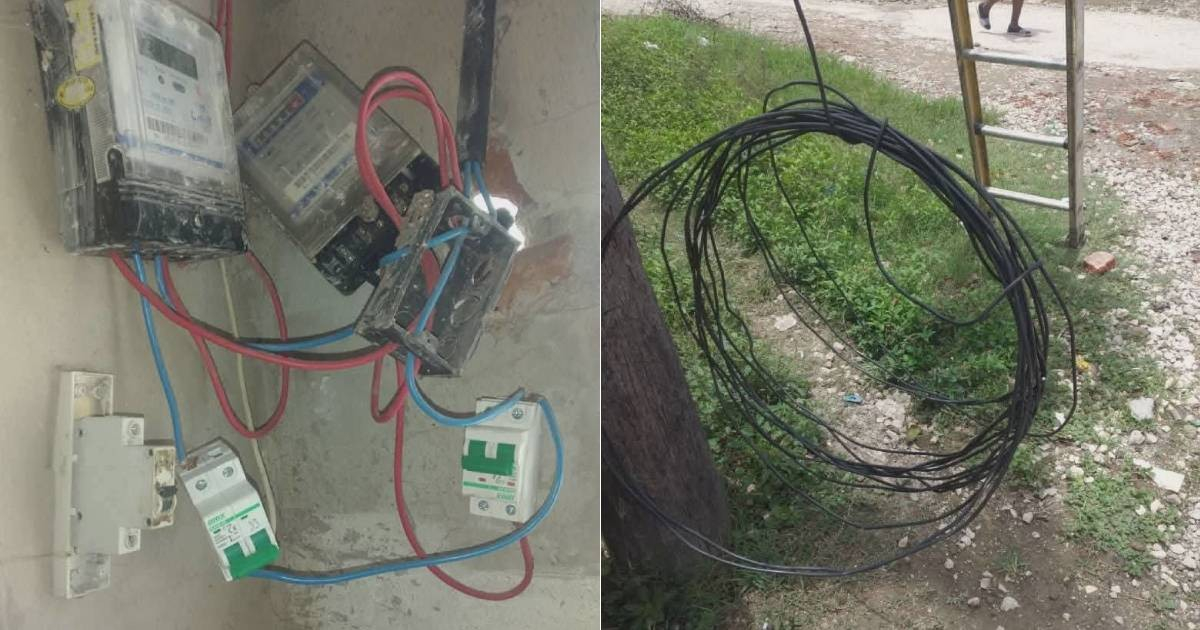
The Guantánamo Electric Company announced on Monday the identification of several homes in the central and southern parts of the city that had illegally tapped into the power grid to access prioritized circuits.
According to the company via the Electric Union (UNE), these residences had been fraudulently connected to a double circuit near areas shielded from blackouts, enabling occupants to access electricity without permission while much of the province endures extended service interruptions.
Those responsible have been handed over to authorities as investigations and inspections continue across the region.
The company stated that such connections lead to network overloads, potentially causing damage to transformers and other electrical equipment.
"These practices, besides being illegal, result in overloads, transformer damage, and directly disrupt the electrical service for entire communities, including vital centers," the company highlighted.
This report follows a similar operation in Santiago de Cuba, where approximately 30 homes had illegally connected to circuit 10, a line supplying major hospital centers in the province.
Santiago authorities reported that the clandestine connections caused irreversible damage to transformers located in the Trocha and Cristina areas. During the operation, about 1,000 meters of illegally installed electrical wiring were recovered.
Worsening Energy Crisis Across Cuba
These operations occur during one of the most critical phases of Cuba's energy crisis.
In Guantánamo, the situation has been particularly dire over the past weeks. On June 7, the UNE admitted that eight transformers remained out of service in various municipalities, with no replacement equipment available for repairs. Residents in areas like Baracoa, Maisí, El Salvador, and Manuel Tames reported power cuts lasting up to 20 consecutive hours.
Four days later, a fault in the 110-kilovolt line connecting Guantánamo to Santiago de Cuba resulted in a total blackout for the province, with some areas experiencing outages exceeding 24 hours.
The crisis keeps escalating. On Monday, the UNE reported an availability of only 995 megawatts against a national demand of 3,050 MW, with a forecasted deficit exceeding 2,000 MW during peak hours.
Additionally, the Antonio Guiteras thermoelectric plant, the country's main generator, experienced a new shutdown due to a boiler leak. This marks the fifteenth failure in the plant this year.
In this context, crackdowns on illegal connections also highlight a growing reality: as blackouts increase and the electrical infrastructure deteriorates, some Cubans seek alternatives to evade the outages that define the daily lives of millions on the island.
Independent journalist Yosmany Mayeta Labrada questioned the background of these interventions, pointing out that many official responses often come only when social unrest becomes undeniable.
"The lingering question is why these solutions so often activate only when silence is no longer an option," he wrote.
Understanding the Illegal Electrical Connections in Cuba
What illegal activity was discovered in Guantánamo's power grid?
Several homes were found to have illegally connected to prioritized circuits in the power grid, allowing them unauthorized access to electricity.
How do these illegal connections impact the electrical infrastructure?
Illegal connections can cause overloads, leading to damage in transformers and other critical electrical equipment, disrupting service for entire communities.
Why is the energy crisis in Cuba worsening?
Cuba faces a severe energy crisis due to a lack of replacement parts for transformers, frequent breakdowns in major power plants, and a mismatch between energy supply and demand.