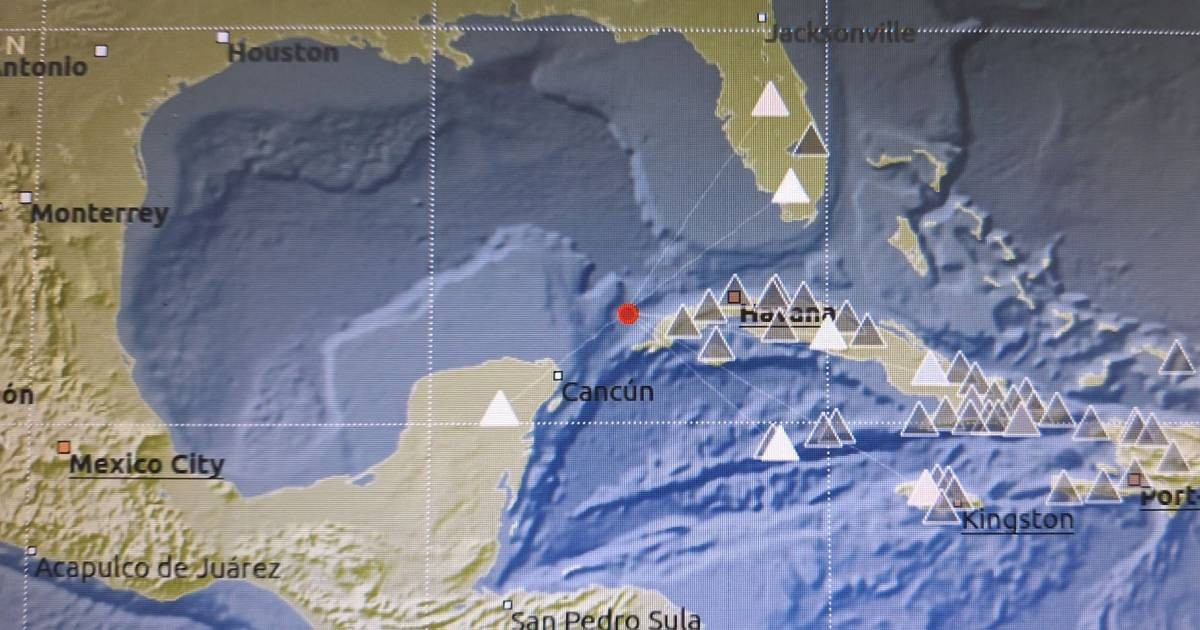
A 5.3 magnitude earthquake rattled western Cuba at 1:37 PM local time this Monday, as reported by the National Center for Seismological Research (CENAIS). The quake's epicenter was pinpointed 98 km northwest of Mantua, in Pinar del Río province, at a depth of 10 km.
Seismologist Enrique Diego Arango Arias took to social media to announce the tremor, identifying it as an aftershock of the 6.2 magnitude earthquake that shook western Cuba on June 8. "A perceptible tremor occurred in the west of the country at 1:37 PM with a magnitude of 5.3, an aftershock of the 6.2 magnitude quake from last Monday, June 8, located 98 km northwest of Mantua, Pinar del Río," he stated.
The main event on June 8, with its epicenter 142 km northwest of Minas de Matahambre in the waters of the Yucatán Channel, caught even the Cuban scientific community by surprise.
Unexpected Seismic Activity
Arango Arias, head of the National Seismological Service, admitted that the 6.2 magnitude earthquake was unexpected: "We would never have anticipated an earthquake of this magnitude in that location," he explained, noting that the area is considered a stable carbonate platform with no known faults or history of significant seismic activity.
The June 8 earthquake was particularly intense in Pinar del Río and Havana, and its effects were also felt in southern Florida and southeastern Mexico. Residents in Havana recounted moments of panic, while those in Pinar del Río described it as "the biggest scare of my life."
U.S. authorities ruled out the threat of a tsunami following the June 8 quake, and no casualties or significant property damage were reported in either Cuba or Florida.
Ongoing Seismic Sequence
This Monday's aftershock confirms that the seismic sequence in western Cuba remains active exactly one week after the main event.
Historically, western Cuba experiences less seismic activity compared to the eastern regions, where the majority of the archipelago's seismicity is concentrated. The most notable historical earthquake in that area dates back to 1880, with an estimated magnitude of 6.0. The year 2026 has been seismically intense across Cuba: a 6.0 magnitude quake struck Guantánamo on March 17, resulting in over 900 aftershocks within 24 hours, and a 5.6 magnitude tremor in February caused cracks in 14 homes and the clinic in Imías.
American meteorologist Matt Devitt described the June 8 earthquake as "the second-largest earthquake ever recorded in the Gulf of Mexico," highlighting the exceptional nature of the ongoing seismic sequence, now extended by this latest aftershock.
Understanding Seismic Activity in Cuba
Why was the June 8 earthquake surprising to scientists?
The June 8 earthquake was surprising because it occurred in a region considered to be a stable carbonate platform with no known faults or significant seismic history, making such a large magnitude event unexpected.
Have there been significant earthquakes in western Cuba before?
Western Cuba has historically experienced less seismic activity than the eastern regions. The most notable historical earthquake in this area occurred in 1880 with an estimated magnitude of 6.0.
What was the impact of the June 8 earthquake on nearby regions?
The June 8 earthquake was felt intensely in Pinar del Río and Havana, and it also reached southern Florida and southeastern Mexico. Despite the intensity, it did not result in significant property damage or casualties.