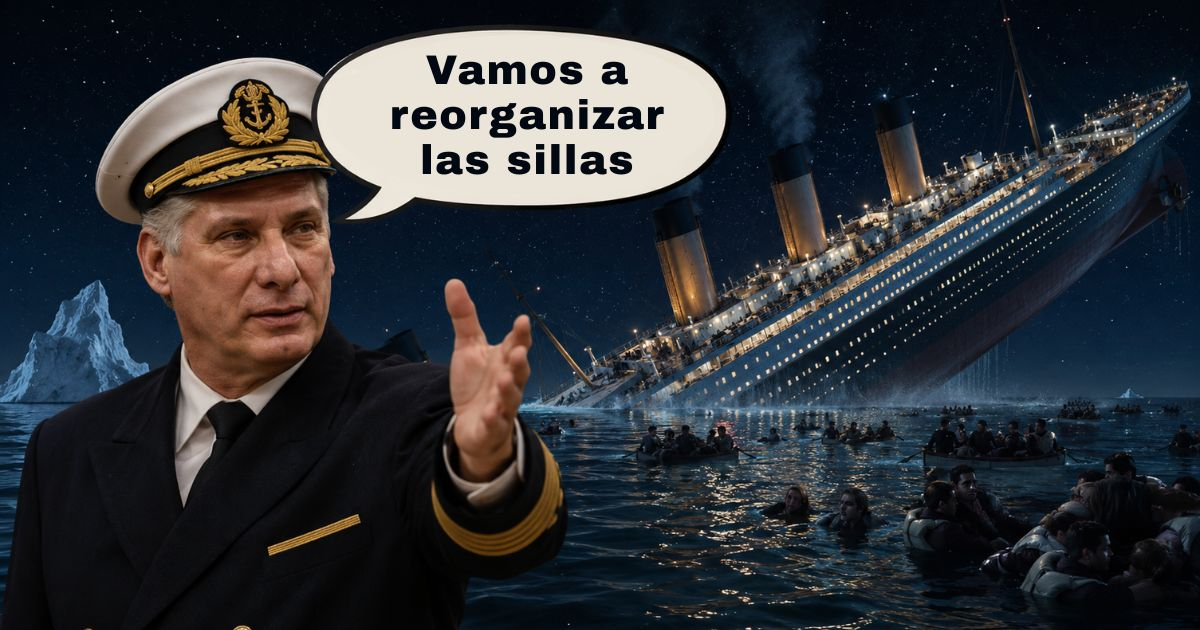
There's a saying in English often used to describe making trivial adjustments in the face of an unavoidable disaster: "rearranging the deck chairs on the Titanic." It's about tending to the superficial while the ship is going down, oblivious to the imminent danger.
This is precisely what Díaz-Canel did on June 12.
The Illusion of an Economy
The Cuban regime never truly built an economy. Instead, it constructed a system reliant on external income sources: oil from allies, tourists' spending, the wages of exploited doctors, and the sacrifices of exiled families. These were the financial lifelines that the regime neither generated nor deserved, yet they have been the foundation of its survival for decades.
Today, all these sources have dried up. Beneath them, there is no damaged productive framework to restore. There's simply the emptiness created by the regime over sixty years, during which it systematically dismantled private initiative, property rights, and the Cuban people's ability to create value independently.
The Illusion of "Reforms"
Every measure announced comes with an explicit limitation that Díaz-Canel openly stated: reforms must align with preserving the current political system.
Yet, the existing political system is the root of the economic problem. It's not merely a factor; it's the core cause.
A market requiring Party permission isn't a true market. A business that can be shut down by arbitrary decree doesn't attract investment. A revocable opening at any moment doesn't build trust. Economic actors understand this, which is why remaining Cuban capital continues to flee rather than invest in these so-called reforms.
What the regime labels as transformation is actually a negotiation with itself: conceding the bare minimum necessary to survive without relinquishing the one thing that truly matters—power.
The Theater of Reform
Díaz-Canel isn't governing. He's managing the facade of governance. Each crisis spawns a new set of measures. Each set of measures creates headlines. Those headlines foster an illusion of progress. Yet, nothing fundamental changes because altering anything substantial would mean giving up power, something the dictatorship will never do voluntarily.
Rearranging deck chairs on the Titanic is ultimately an act of deliberate denial: someone aware that the ship is sinking but chooses to focus on the chairs, as facing reality would mean surrendering.
The issue isn't that Díaz-Canel is unaware of the situation. It's that his incentives point in only one direction: buy time. Remain in power as long as possible by announcing reforms that never materialize, promising changes that never happen, all while the water continues to rise.
The most critical deck chair they're rearranging isn't economic—it's time itself. And they're doing it at the expense of the Cuban people, who have long borne the cost of a sinking ship their leaders refuse to acknowledge.
Understanding Cuba's Economic Crisis
What is the main cause of Cuba's economic problems?
The main cause of Cuba's economic issues is its political system, which stifles market freedom and discourages investment by requiring permission from the ruling Party and allowing for arbitrary business closures.
Why do Cuban reforms fail to bring about real change?
Cuban reforms fail because they are designed to preserve the existing political system rather than facilitate genuine economic transformation. They serve more as a cosmetic maneuver to maintain power than as a catalyst for real change.