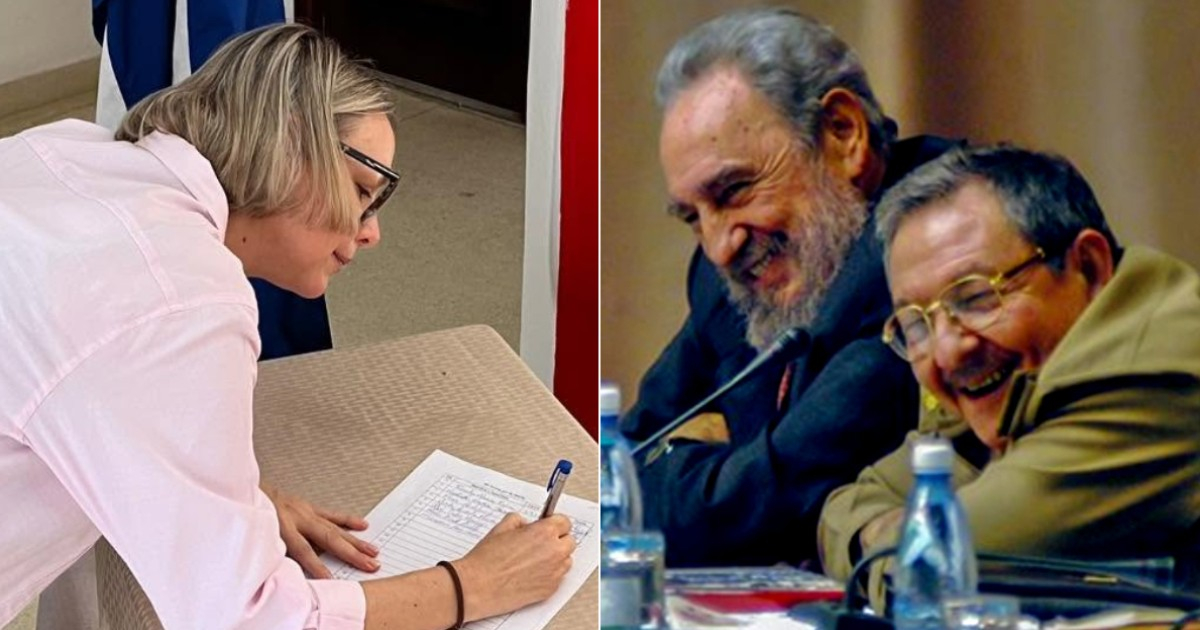
Marxlenin Pérez Valdés, host of the state-run program 'Cuadrando la Caja' and wife of Fidel Castro Smirnov, grandson of the late dictator Fidel Castro, took to Facebook this Sunday to defend Miguel Díaz-Canel's purported economic reforms.
In a post titled "Expectations," the regime's spokesperson referred to yet another maneuver by Díaz-Canel on state television last Friday. The broadcast featured him appearing troubled while rehashing old political strategies: economic management, municipal and business autonomy, agricultural recovery, foreign trade, and investment.
Despite adopting a disdainful tone, Pérez Valdés conceded the diversity of Cuban opinions in her post, only to immediately negate them with the official mantra of unity.
The post inadvertently reveals a truth: Pérez Valdés acknowledged the existence of "many expectations, expressed in various languages and from different ideological, class, political, and economic perspectives" within Cuban society. Yet, she quoted the appointed leader to close the debate: "our response must be one of unity."
This approach—acknowledging diversity only to subordinate it under the Party's command—is emblematic of the Cuban regime's totalitarian nature, where "unity" serves not as a democratic value but as a tool for social control.
Pérez Valdés also admitted that Díaz-Canel's announcement was merely a "glimpse of what we should soon know in more detail," which didn't stop her from criticizing those who reacted with skepticism.
In her post, she categorized critics into derogatory groups: "mercenaries," "theorists without achievement," promoters of "neoliberal and subservient agendas through counter-revolutionary media," and those "using this crossroads to discredit the president."
According to Pérez Valdés, only those concerned about socialism's future, who "won't stand idly by at the prospect of losing our project of social justice originally designed for the humble," deserve to be called "legitimate."
Ironically, she acknowledged that "in real life, people have more urgent matters to attend to," referring to Cubans who don't engage in Facebook debates.
This "real life" is set in a nation where 89% of families live in extreme poverty, blackouts last between 20 and 40 hours daily in some areas, inflation reached 13.42% in March 2026, and more than 1.5 million Cubans emigrated between 2020 and 2024.
The reforms Pérez Valdés supports—greater autonomy for state companies, easing restrictions on small and medium-sized private enterprises, and eliminating middlemen in foreign trade—have been dubbed "an outdated ploy" by economist Pedro Monreal and "too little, too late" by other analysts. They still await approval from the Politburo and the National Assembly, scheduled for July.
This isn't Pérez Valdés's first controversial episode. In December 2025, she called critics of a suggestion on her program to forgo rice and potatoes "worms."
In March 2026, during a tour of 18 Spanish cities, she declared that private businesses in Cuba "will be created to be dismantled," succinctly capturing the regime's stance on true economic openness.
The 2019 Cuban Constitution enshrines this logic in Article 5, declaring the Communist Party of Cuba the "supreme leading force" and banning any political alternative, making the unity doctrine law.
Comments on Pérez Valdés's post weren't exactly enthusiastic: "Develop awareness? At this point and with an empty stomach?" wrote one user; another was more succinct: "I'll read it when I want to fall asleep and there's no light"; a third concluded: "No text using the word 'agglutinate' has ever said anything serious."
Understanding Cuba's Political Climate and Economic Reforms
What economic reforms are being proposed in Cuba?
The proposed economic reforms include granting greater autonomy to state enterprises, easing restrictions on private small and medium-sized businesses, and eliminating intermediaries in foreign trade.
Why is the concept of "unity" emphasized by the Cuban regime?
The emphasis on "unity" is used by the regime as a means of social control, portraying it not as a democratic principle but as a tool to maintain the Communist Party's dominance and suppress political diversity.
What challenges are facing Cuba's population currently?
Cuba faces significant challenges, including extreme poverty affecting 89% of families, prolonged power outages, high inflation, and a significant emigration rate, with over 1.5 million people leaving the country between 2020 and 2024.