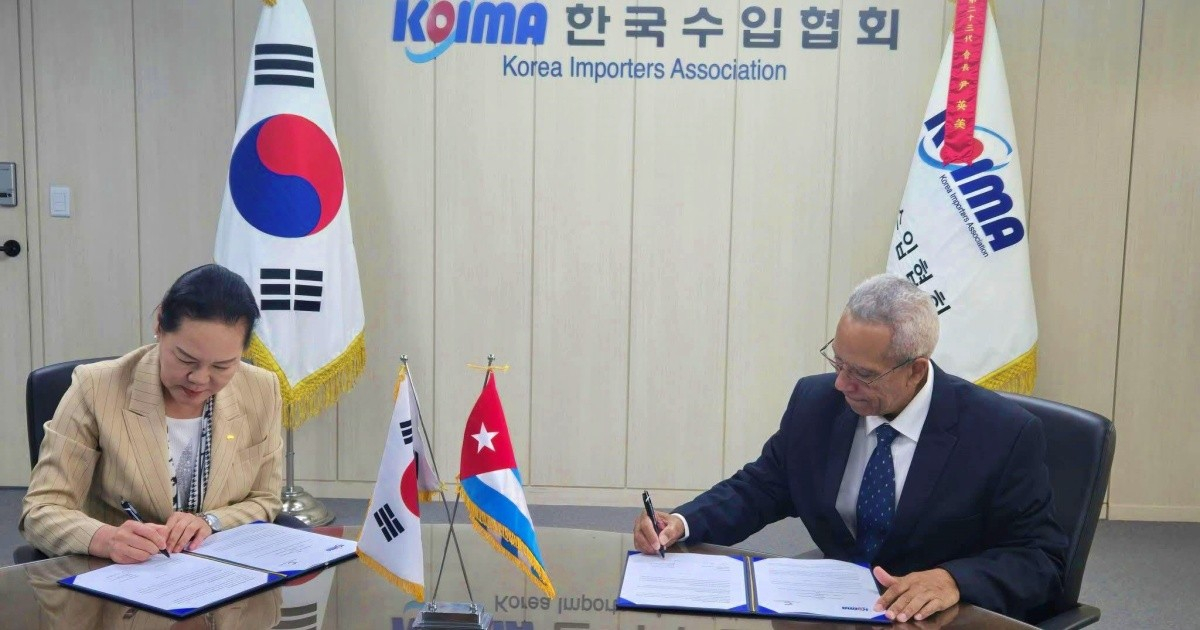
In a significant move, the Chamber of Commerce of the Republic of Cuba and the Korea Importers Association (KOIMA) have entered into a commercial collaboration agreement in Seoul. This development was announced by the Cuban Chamber of Commerce through their official Facebook page.
The Cuban institution lauded the agreement as "a crucial step in bilateral relations," with the "primary goal" being "the promotion of Cuban export offerings in the Asian nation." This move is intended to pave the way for more robust mutual cooperation.
Key Figures Behind the Agreement
The agreement was signed by Antonio Carricarte Corona, president of the Cuban Chamber of Commerce, and Youn Young-mi, president of KOIMA, at the South Korean association's facility. Additionally, Cuban Ambassador to South Korea, Claudio Monzón, was present. Earlier, Monzón had emphasized at the "Business Opportunities in Cuba" forum in Seoul that "Cuba remains a land of opportunities and possibilities."
Founded in 1970, KOIMA is described by the Cuban Chamber of Commerce as "the leading organization connecting foreign suppliers with buyers in the Republic of Korea."
Focus on Strategic Sectors
During discussions, Carricarte and Youn Young-mi explored the "economic transformations on the Island" and identified three priority sectors for business opportunities:
1. Agro-food sector
2. Renewable energy
3. Biopharmaceutical industry
In the biopharmaceutical realm, Cuba boasts the capability to market over 300 products across 43 countries, supported by approximately 750 international health registrations, as per a 2025 ICEX study.
Regarding renewable energy, the regime's official target is to achieve between 24% and 25% of electricity generation from renewable sources by 2030, despite the ongoing reality of relentless power outages on the island.
South Korean Enthusiasm and Cautions
Youn Young-mi highlighted "the great appeal and warmth Cuba generates in South Korean society" and demonstrated "a strong commitment to boosting trade between both nations." However, the agreement follows closely on the heels of Carricarte leading the "Business Opportunities in Cuba" forum in Seoul, where South Korean counterparts issued notable warnings.
Lee Myung-joon, director of the Korea Trade-Investment Promotion Agency (KOTRA) in Havana, cautioned that "Korean companies with assets or financial ties to the United States must exercise significant caution."
KOTRA officials were more direct: "Cuba is not a market where companies can simply apply the standards used for ordinary trade with other countries. Financial and logistical areas require special caution."
Renewed Diplomatic Ties
Cuba and South Korea resumed diplomatic relations on February 14, 2024, after more than six decades of estrangement caused by Fidel Castro, who severed ties in 1960 in favor of relations with North Korea. Prior to this rapprochement, trade between the two nations was minimal, amounting to just $21 million in 2022, according to KOTRA data.
Since then, interactions have intensified. In December 2025, the South Korean government donated 24,600 tons of rice to Cuba through the World Food Program, primarily aimed at vulnerable populations in the eastern part of the island.
At the Seoul forum, Carricarte encapsulated the regime's strategy with a statement that underscores Cuba's diplomatic ambitions: "South Korea is a country we hope to add to our network of economic partners."
Challenges Amid Optimism
Despite the optimism voiced by Cuban authorities, the island's actual capacity to attract investment and expand its foreign trade continues to be hindered by longstanding structural issues that have negatively impacted the business climate for years.
Shortages of foreign currency, delays in payments to foreign suppliers, logistical challenges, and limited domestic production capacity have been frequently cited by businesses and international institutions as barriers to establishing sustainable commercial relationships.
This is compounded by a disconnect between official rhetoric about economic opportunities and the daily realities faced by citizens and state-run companies. While the government promotes projects in strategic sectors such as renewable energy and food production, the country continues to experience frequent blackouts, shortages of basic goods, and low agricultural output.
This backdrop raises questions about how quickly and effectively the announced agreements can translate into tangible benefits for the Cuban economy and a population grappling with one of the deepest crises in recent decades.
FAQ on Cuba-South Korea Trade Agreement
What are the main sectors targeted by the Cuba-South Korea trade agreement?
The agreement focuses on the agro-food sector, renewable energy, and the biopharmaceutical industry.
Why did Cuba and South Korea resume diplomatic relations?
Cuba and South Korea resumed diplomatic relations to strengthen economic ties and expand trade opportunities after over six decades of estrangement.
What challenges does Cuba face in attracting foreign investment?
Cuba struggles with foreign currency shortages, payment delays to suppliers, logistical issues, and limited domestic production capacity, hindering its ability to attract foreign investment.