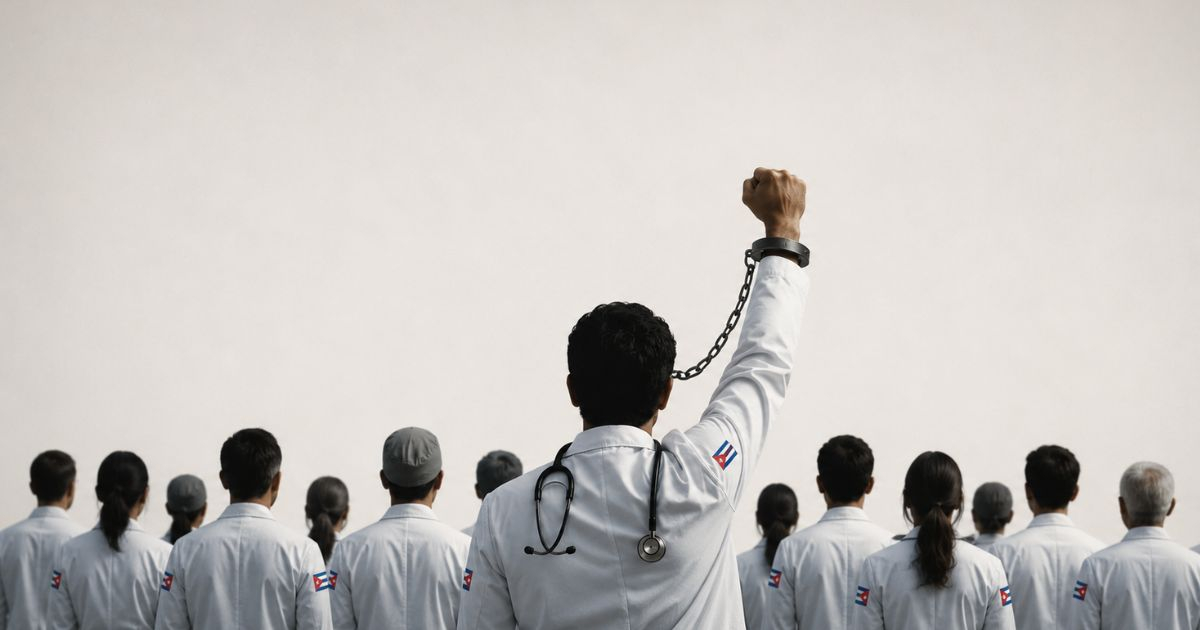
A passionate open letter from a specialist doctor in Santiago de Cuba to the Minister of Public Health has ignited a wave of outrage among healthcare professionals across the island. Many identify with his plight and point out that this issue impacts thousands who are too afraid to speak out.
Dr. Alberto Tejeda Illas has faced three years of passport denials, despite having resigned from his position over a year and a half ago and having no contractual ties with the Ministry of Public Health (MINSAP).
The government's online processing portal automatically rejected his application with the message: "The request cannot be processed, citizen regulated by Vital Category by MINISTRY OF PUBLIC HEALTH: SPECIALIST DOCTOR. Please report to the organization."
Questioning the Legality
In his letter, Tejeda directly challenges the legality of the restrictions: "I face limitations imposed by an employer—the Cuban Public Health system—when I am no longer its employee and have no contractual obligations to the institution."
Despite twice contacting the Ministry without receiving a response, Tejeda has been met with three formal rejections at the provincial level, with no clarity on whether the decisions are made by Santiago de Cuba's Provincial Health Directorate, the Ministry itself, or both.
Impact of New Legislation
Tejeda also references the new Migration Law No. 171/2024, published in the Official Gazette on May 5, 2026, but warns that it fails to address his situation as the authorization remains at the discretion of the relevant officials.
His story sparked a large response from fellow professionals acknowledging their shared experience.
Not an Isolated Incident
"There are many of us doctors facing the same issue. This is not an isolated case," one commenter noted.
Another said, "I resigned years ago and am still regulated. My life is on hold."
A third commenter was even more pointed: "We are not state property. We are professionals and citizens with rights."
Several pointed out that this phenomenon is deterring young people: "Many young people avoid certain specializations for fear of becoming trapped."
Historical Context and Rising Numbers
The roots of these restrictions lie in Decree 306 of 2012, which requires employer approval for the departure of professionals deemed "vital." This was expanded in January 2023 to include medical specialists, dentists, healthcare technicians, and nursing graduates following an internal videoconference where MINSAP's Human Capital Director explicitly requested "discretion."
Dr. Tejeda's case is not the first to become public. In May 2024, surgeon José Manuel Suárez Villalobos from Camagüey, with 28 years of service, denounced similar restrictions, asking, "How long will I be punished for being a specialist?"
The organization Prisoners Defenders documented over 1,402 cases of Cuban health professionals affected by such restrictions in a January 2024 report, compared to just 110 cases in 2019, highlighting a significant and troubling increase.
"We are hundreds or even thousands in the same situation, but few dare to make it public," one doctor summarized in response to Tejeda's letter, capturing the true scale of a practice that the Cuban regime continues to keep under wraps.
Understanding the Impact of Cuban Health Professionals' Restrictions
Why are Cuban doctors facing travel restrictions?
Cuban doctors are subjected to travel restrictions under Decree 306, which requires approval from their employers for them to leave the country. This policy designates certain professionals as "vital," limiting their ability to travel freely.
What impact has this policy had on healthcare workers?
The policy has left many healthcare workers feeling trapped and unable to pursue opportunities abroad. It has also discouraged young professionals from entering certain specializations due to fears of being stuck.
How has the situation changed over recent years?
There has been a notable increase in the number of healthcare professionals facing restrictions. Reports by organizations like Prisoners Defenders indicate a rise from 110 cases in 2019 to over 1,400 cases by 2024.