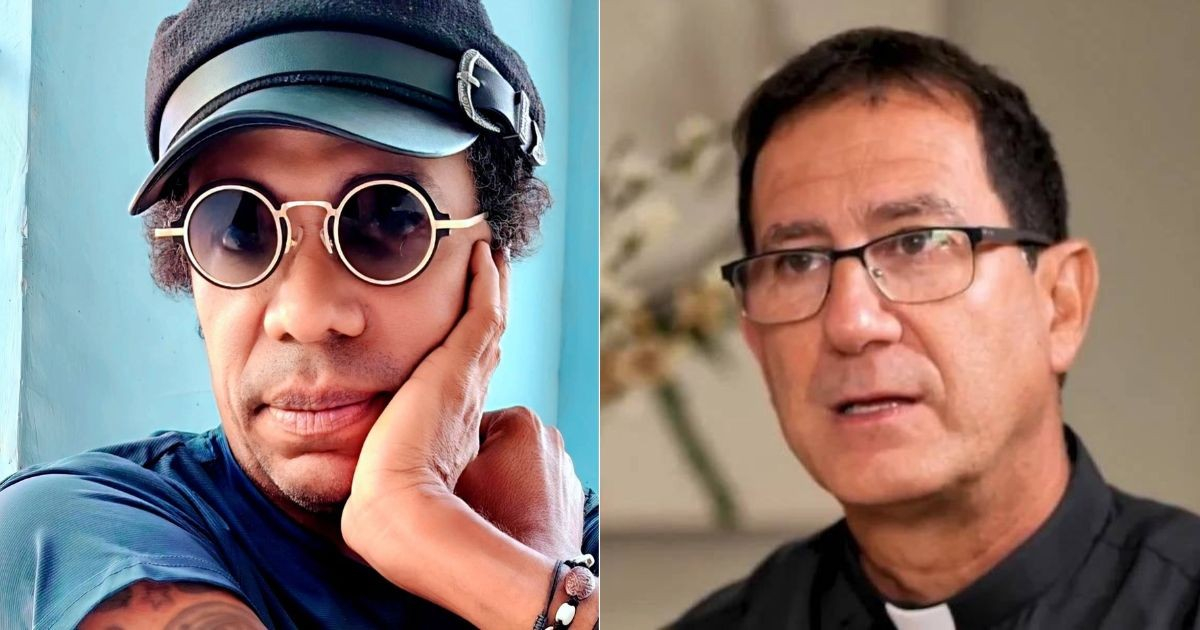
The Cuban troubadour Raúl Torres, renowned for his songs praising Fidel and Raúl Castro and his unwavering support for Cuba's oppressive regime, recently published a public letter on Facebook addressed to Pope Leo XIV. In this missive, he harshly criticizes Father Alberto Reyes Pías, a Catholic priest from Esmeralda, Camagüey, known for his brave stance against the dictatorship in Cuba.
Signed as "A Humble Son of the Lord," Torres's letter is replete with biblical references and ornate language. It's hard to miss the irony: the same man who wrote "Cabalgando con Fidel," "El regreso del amigo" dedicated to Hugo Chávez, and in August 2025, released "Soy por Fidel" for the dictator's 99th birthday, now presents himself to the Pope as a poetic disciple and guardian of the Gospel.
In his letter, Torres accuses Father Reyes Pías of having "set aside the incense to wield the torch," claiming the priest "does not proclaim the Kingdom: he announces revenge." He further accuses Reyes of "fostering death" and claims that "his words do not build bridges: they dig graves for those he claims to defend." He concludes by urging the Pope to let his "apostolic staff strike this rock of intolerance," referring to the Camagüey priest.
The "intolerance" Torres refers to is, in truth, the consistent critique Father Reyes Pías has maintained from his parish about the humanitarian crisis crushing Cuba: enduring blackouts, medicine shortages, hunger, and repression. In October 2025, the priest accused the regime of committing a "silent genocide" due to the lack of pharmaceuticals and widespread hunger. By January 2026, State Security summoned him and another priest in Camagüey, interpreted as an attempt to pressure critical voices within the Church.
Undeterred, Reyes Pías continued to publish his weekly column "I've Been Thinking." On Friday the 12th—one day after Torres's letter—he released a new piece titled "Living in Survival Mode Cannot Be Normal," calling for a "radical change" in Cuba. Weeks earlier, he had expressed that he preferred "a dreadful end" to the status quo of misery and stagnation. In one of his most cited statements, the priest warned: "The dictatorship, made without you, will not change without you."
While Father Reyes Pías risks his freedom to speak the truth, Torres dedicates himself to defending the regime with lyrical warmongering and publishing anti-American pieces in support of the official narrative. In May 2026, he claimed that "in Cuba, those who govern do not enrich themselves," and in September 2025, he maintained that freedom of expression exists in Cuba, citing his own ability to express himself on social media as an example. No one asked if Father Reyes Pías enjoys the same peace of mind.
The letter to the Pope did not go unnoticed on social media. Many users reacted with a mix of ridicule and outrage, highlighting the paradox of a troubadour serving an atheist dictatorship attempting to impart Gospel lessons to a priest who risks his freedom to defend his people.
Torres signs his letter with the phrase, "In Christ, who weeps when Cain awakes." The image is unintentionally revealing: in this narrative, the torchbearer is not the priest denouncing his people's hunger, but the one writing letters to the Pope to silence him.
The Controversy Surrounding Raúl Torres and Father Alberto Reyes
Who is Raúl Torres?
Raúl Torres is a Cuban musician known for his songs exalting Fidel and Raúl Castro and his unwavering support for the Cuban regime.
What is Father Alberto Reyes Pías known for?
Father Alberto Reyes Pías is known for his courageous criticism of the Cuban dictatorship and his advocacy for the Cuban people's rights and freedoms.
What did Raúl Torres accuse Father Alberto Reyes of?
Raúl Torres accused Father Alberto Reyes of inciting revenge and fostering division rather than preaching the Gospel, in a public letter to the Pope.
How did social media react to Torres's letter?
Social media users reacted with derision and indignation, pointing out the irony of a musician loyal to a dictatorial regime lecturing a priest risking his freedom for his beliefs.