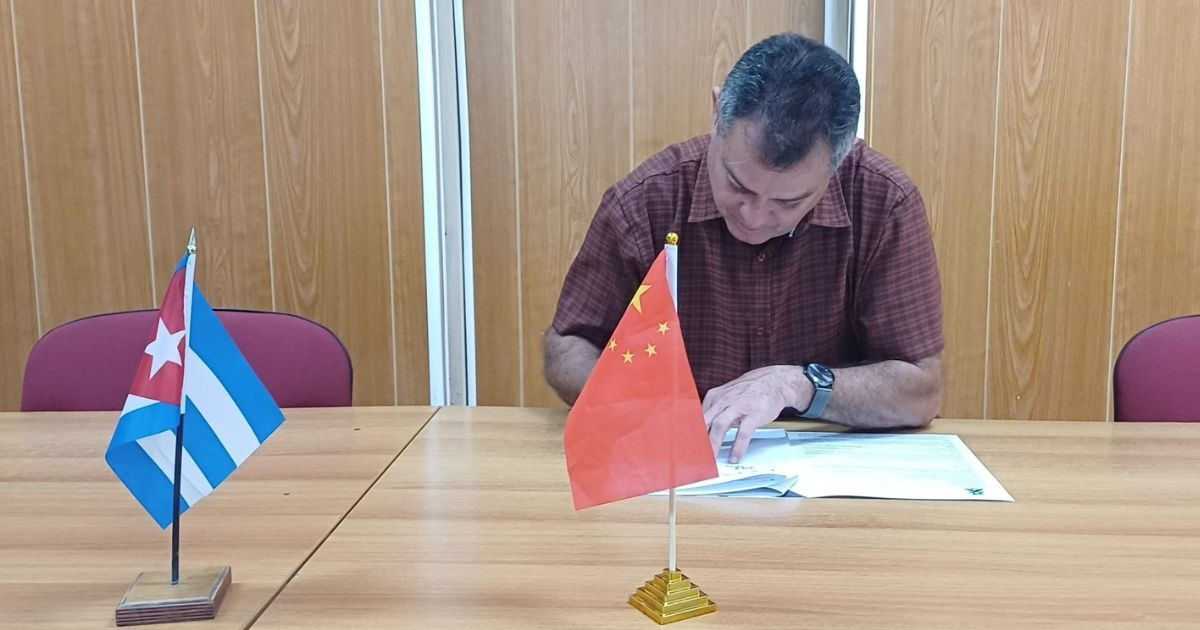
The University of Pinar del Río "Hermanos Saíz Montes de Oca" (UPR) has joined forces with the Chinese tech company Shanghai Loop Artificial Intelligence Technology Co., Ltd. Last Friday, they formalized a comprehensive international cooperation agreement, focusing on enhancing artificial intelligence, academic mobility, and doctoral training in key knowledge areas.
The agreement was signed by Wang Jialiang, founder of Shanghai Loop AI, and Dr.C. Yorki Mayor Hernández, UPR's rector, in a ceremony hailed by the institution as a move that "solidifies bilateral relations between both entities and positions the Pinar del Río academic center on the international academic and technological stage."
A significant component of the accord involves collaborative efforts with the faculties of Forest and Agricultural Sciences, Technical Sciences, Physical Culture, and Early Childhood Education. The emphasis is on improving infrastructure and enhancing the professional development of faculty members.
Key goals include facilitating scholarship access for UPR postgraduate students through Chinese university government offers and arranging research stays in China for Cuban doctoral candidates.
The agreement further encompasses the training and certification of professionals from involved faculties in AI design and application, as well as preparing participants for HSK Level 1 and 2 in Chinese language proficiency.
A tangible commitment within the partnership is the establishment of the "Shanghai OPC Community" in Lingang, Shanghai. This initiative aims to be an auxiliary center for innovation and AI learning, engaging Cuban students actively.
Both parties have pledged to support the mobility, both physical and virtual, of professors and researchers holding Master's or Doctoral degrees. Additionally, they will jointly organize academic events, courses, symposia, and scientific publications.
The UPR highlighted that the agreement aligns with their institutional strategy to bolster internationalization, increase the academic and scientific potential of their faculty, and project their doctoral programs into the global arena, strengthening academic and technological ties between Cuba and China.
Shanghai Loop AI, established in November 2020, specializes in the operation and maintenance of data centers and AI data processing, currently collaborating with Tencent IDC.
This partnership is part of a broader effort by the Cuban regime to advance artificial intelligence as a cornerstone of its "digital transformation" and "technological sovereignty" strategy. The Cuban Artificial Intelligence Consortium, launched in November 2025 with 22 founding members, including the University of Havana, the University of Computer Sciences (UCI), CUJAE, and ETECSA, underscores that UPR is not alone in this endeavor.
Earlier this year, Cuban President Miguel Díaz-Canel visited the University of Havana to discuss AI and called for the accelerated development of a Cuban AI, such as the language model CecilIA, trained with national data.
However, these technological ambitions are met with stark challenges. The energy crisis has led to temporary university closures due to fuel shortages in 2026, limiting access to laboratories and research resources. Meanwhile, unstable connectivity and outdated technology present structural barriers to implementing AI projects in Cuban institutions.
Academic and technological cooperation between Cuba and China is part of a broader bilateral relationship. In January 2026, Xi Jinping approved an aid package of $80 million and 60,000 tons of rice for the island, reinforcing China's position as a key strategic partner for the regime amidst its severe economic crisis.
Key Aspects of the Cuba-China Academic Partnership
What is the main focus of the agreement between UPR and Shanghai Loop AI?
The primary focus is on enhancing artificial intelligence, academic mobility, and doctoral training in strategic knowledge areas.
What are the benefits for UPR students in this partnership?
UPR students can benefit from scholarships offered by Chinese universities and research stays in China, enhancing their academic and professional prospects.
How does this partnership fit into the broader Cuban strategy?
The partnership is part of Cuba's broader strategy to push for a "digital transformation" and "technological sovereignty" by developing artificial intelligence capabilities.
What challenges does Cuba face in implementing AI projects?
Cuba faces challenges such as energy shortages, limited access to research facilities, unstable connectivity, and outdated technology, which hinder AI project implementation.