Officials in Miami-Dade County have initiated a safety campaign to address the potential risks of extreme heat during the 2026 FIFA World Cup matches. They are urging both residents and tourists to take safety measures during the tournament events in the city.
According to a study by World Weather Attribution, 26 out of the 104 scheduled matches could be played under hazardous heat stress conditions for the players, as per the thresholds set by the International Federation of Professional Footballers' Associations.
Five of these games may experience a global wet-bulb temperature of 28 degrees Celsius, a point at which experts suggest postponing matches.
This metric considers temperature, humidity, solar radiation, and wind to determine actual heat stress on the body: an air temperature of 40 degrees with 30% humidity equals about 26 degrees wet-bulb temperature, a level where player performance starts to decline.
“Nearly half of the World Cup matches have at least a 50% chance of heat affecting performance, and 97 of the 104 scheduled games face an increased likelihood of limiting conditions due to climate change,” highlighted World Weather Attribution.
“It's not a coincidence, it's climate change,” stated Simon Still, Executive Secretary of UN Climate Change.
Miami is among the venues with the highest risk of heat stress for the tournament, with temperatures reaching 32 degrees and high humidity potentially raising the heat index to 43 degrees.
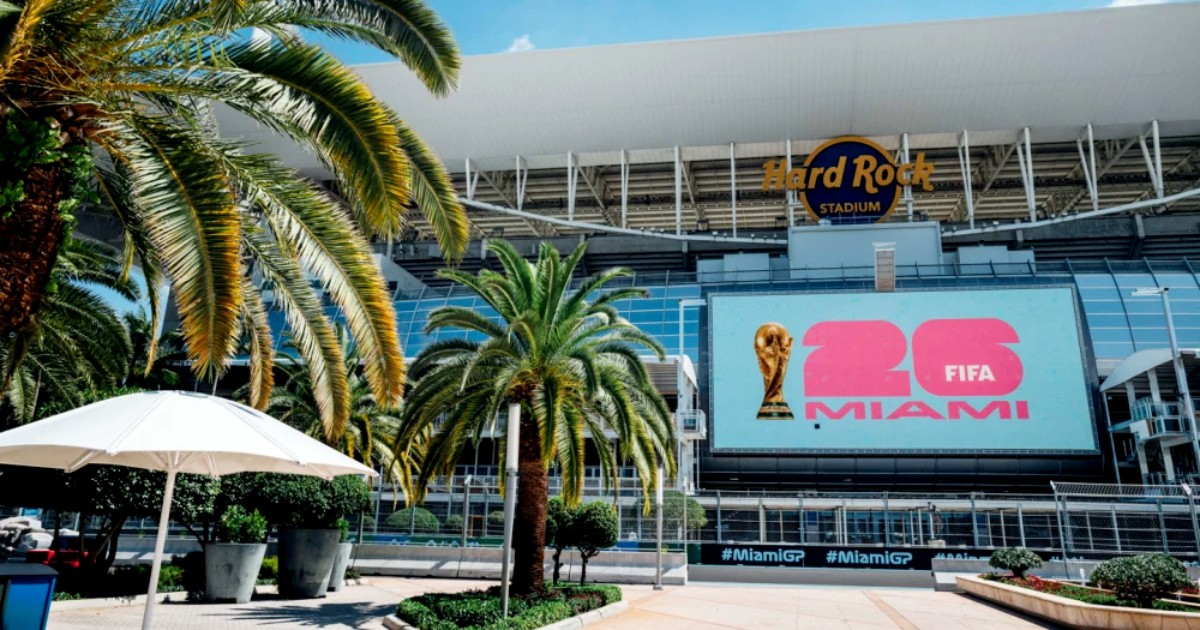
The Hard Rock Stadium, an open-air venue, is set to host seven World Cup matches in 2026, with the first game between Saudi Arabia and Uruguay scheduled for this Monday.
The 2025 Club World Cup already raised red flags: a peer-reviewed study analyzed 57 matches and 1,070 player observations, finding that in 31 games, the wet-bulb temperature exceeded 28 degrees, causing fainting among journalists, fans, and an assistant referee.
In response, the Miami-Dade Environmental Resources Management Department and the Emergency Management Department are collaborating with stadium and Fan Fest organizers to ensure access to cooling areas and free hydration stations.
The county will set up four air-conditioned cooling stations at the Miami Stadium, two water trailers, and eight new cold water stations at transit stops.
Moreover, a network of 60 libraries, parks, and government buildings will serve as cooling centers throughout the tournament, with their locations available on the county's official website.
The FIFA Fan Festival, held at Bayfront Park from last Friday to July 5, can accommodate up to 30,000 daily visitors in an outdoor area of 436,000 square feet, increasing the risk for the general public.
Mayor Daniella Levine Cava launched the "Heat is Not a Game" campaign with messages on social media and transportation centers, emphasizing the importance of staying hydrated, seeking shade, and recognizing heat-related illness symptoms.
FIFA, in turn, has mandated three-minute hydration breaks at the 22nd minute in every half of all matches and reversed an initial ban to allow sealed plastic bottles of up to 590 milliliters per person into the stadiums.
The long-term forecast heightens the concern: by 2050, 14 of the 16 venues for the 2026 World Cup could be unsafe without adaptation measures, according to UN Climate Change.
Understanding Heat Risks During the 2026 World Cup
What measures are being taken to address heat risks at the World Cup?
Miami-Dade County is setting up air-conditioned cooling stations, water trailers, and cold water stations. Libraries, parks, and government buildings will serve as cooling centers, and FIFA has implemented hydration breaks and allowed sealed water bottles in stadiums.
Why is climate change a concern for the 2026 World Cup?
Climate change is increasing the likelihood of hazardous heat conditions during the World Cup matches, affecting player performance and spectator safety. By 2050, most venues may face unsafe conditions without adaptation strategies.