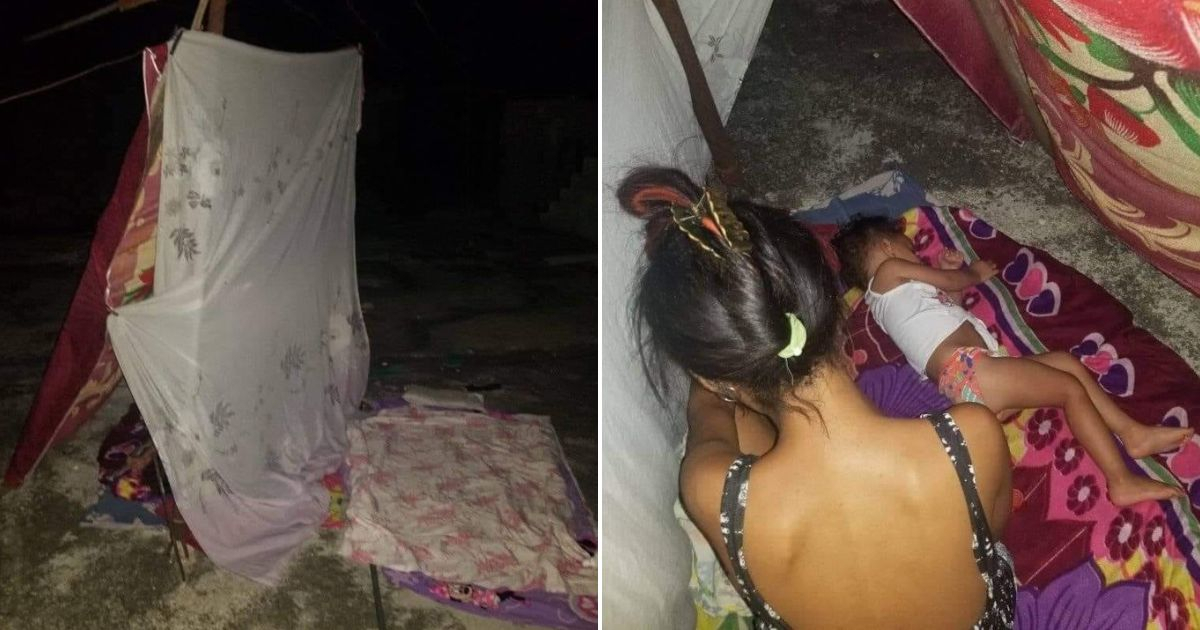
In a moment that encapsulates the daily struggles of countless Cuban families, a young girl watches the fan blades come to a halt during a blackout and innocently asks, "Why?" The adult with her finds themselves at a loss for words.
This poignant scene, featured in the Sunday chronicle of Matanzas' Periódico Girón and penned by journalist Guillermo Carmona Rodríguez, highlights the stark reality facing millions across Cuba.
The child's persistent question, "Why?" follows her gaze as the fan's blades gradually stop spinning. She grips the fan, shaking it in an attempt to restore its motion, despite knowing it might be days before it works again.
The storyteller conjures up whimsical tales to avoid the harsh truth: a greedy fish blocking electrical cables, a mermaid kingdom receiving scarce water donations, a timid unicorn symbolizing a collapsed economy, and boastful buses explaining the lack of transportation.
For the water shortage, a story about "a villain stealing pond water to bottle and sell at 200 pesos" seems fitting. As for the economic crisis, "the price of rice and chicken climbed onto stilts, waving down from above."
Ultimately, Carmona admits he cannot bring himself to tell her the reality: "I don't want to give her the real answer. It's too long and tangled, like a string of forgotten Christmas lights. Its colors might fade under the weight of truth."
The gap between the child and the adult is not just one of age, but also of experience with disaster: "Sometimes, I feel gray and withered; but I am an adult, dead and reborn countless times. She is just piecing together her first life."
Published in the official Communist Party newspaper in Matanzas, the article's candid tone is especially striking.
Carmona has previously depicted the crisis through state media, with reports like "The Little Rest of the Righteous" about enduring a night without electricity and extreme heat, and "The Blackouts, Brother, the Blackouts" in 2022.
This chronicle emerges amid the worst Cuban electrical crisis in decades. In June 2026, the Electric Union reported deficits reaching 2,040 MW at peak times, impacting 68% of the national grid. Researcher Jorge Piñón noted that nearly 60% of the 19 units across eight thermal power plants were out of commission.
The repercussions for children are documented and severe. UNICEF reports show that 9% of children under five suffer from severe nutritional deprivation, and 48.5% of students aged six to 11 lack meals or snacks at school.
In May 2026, the UN warned that over 11,000 children were awaiting surgeries delayed by power outages.
These circumstances led a Cuban mother to share, on June 11, how her daughter cried from hunger as she struggled to ignite wet wood for cooking without electricity.
The Ministry of Education brought the school year to an early close, from June 15 to 30, in response to the energy emergency—a tacit admission that the State cannot ensure even minimal classroom conditions.
Carmona concludes his chronicle without stories or solace: "I don't dare. I can't bear to deceive her like that. She asks 'Why?' again, poking a finger through the fan's guard to spin the blades herself. Unable to find words, I remain silent."
Understanding Cuba's Electrical Crisis and Its Impact
What are the primary causes of Cuba's electrical crisis?
The crisis is largely due to outdated infrastructure, lack of maintenance, and a significant proportion of thermal power plants being out of service, leading to frequent blackouts.
How are children in Cuba affected by the blackouts?
Children face severe consequences, including nutritional deprivation and delays in essential surgeries due to power outages, as well as disrupted education due to school closures.
How has the Cuban government responded to the energy crisis?
The government has shortened the school year to address the energy shortage, but this action highlights its inability to ensure basic services in the education sector.