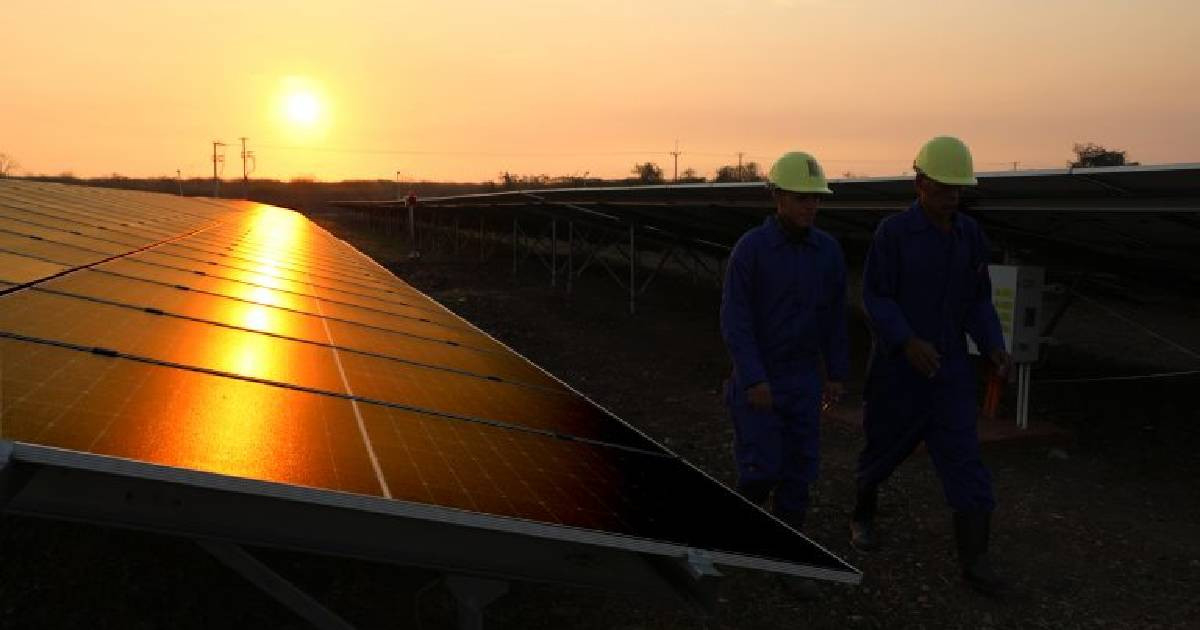
Despite the presence of four major solar photovoltaic parks connected to the National Electric System (SEN), residents in the province of Granma are enduring over 30 consecutive hours without electricity. This irony was addressed by the official newspaper La Demajagua on Saturday, which attempted to justify the situation with technical explanations.
The eastern province boasts solar installations with a capacity of 21.87 megawatts (MW) located in Bayamo, Niquero, Río Cauto, and Manzanillo. These were brought online between 2025 and early 2026.
Additionally, there are two smaller parks with battery storage in Guisa and Yara, part of a 120 MW donation from China. Despite these facilities, circuits in Jiguaní had nearly 49 hours of power outages by June 11, with areas like Media Luna, Yara, and Las Novillas experiencing more than 46 hours without electricity.
Challenges of Solar Energy Integration
The explanation provided is that solar energy is naturally intermittent, requiring a "kick-start" from the grid to activate its inverters, according to the report. When the SEN collapses or its frequency drops below critical thresholds—frequent during peak hours—the solar parks automatically disconnect as a protective measure, ironically when they are needed most.
On June 10, cloud cover and rainfall diminished solar production in Granma, necessitating the synchronization of only two parks to maintain system stability. The following day, the entire province was temporarily severed from the SEN due to an emergency, with only six circuits partially restored.
Systemic Energy Issues
By Sunday, the Electric Union reported just 1,245 MW available at 6:00 am against a demand of 2,650 MW. For the evening peak, the projected shortfall exceeded 1,885 MW, potentially leaving over 60% of the nation without power simultaneously.
The root issue isn't solar but lies with the thermal plants. Energy expert Jorge Piñón from the University of Texas's Energy Institute highlighted that nearly 60% of the generating units across eight plants were offline, warning that the situation is untenable with the current energy management model.
Cuba requires eight 100,000-ton oil tankers monthly to keep its thermal plants running, a supply that is not being met. By June 14, 106 distributed generation plants were inactive due to fuel shortages, resulting in 890 MW unavailable solely for that reason.
Public Outrage and Political Response
Meanwhile, the political response in Granma sparked outrage. On June 11, Yudelkis Ortiz Barceló, the Communist Party's first secretary in the province, took to Facebook to romanticize the image of neighbors cooking tamales on the street during the blackouts, calling it "resilience" and "humanism."
This portrayal starkly contrasted with the residents' experiences. "We have no water, and the little food we have is spoiling due to lack of refrigeration. They are destroying the population," lamented a resident of Conil and Bellavista.
Understanding Granma's Energy Crisis
What is causing the prolonged blackouts in Granma?
The extended power outages are mainly due to the intermittent nature of solar energy and the failure of thermal plants. The solar parks disconnect when the National Electric System's frequency falls, while many thermal plants are offline due to fuel shortages.
How is the Cuban government addressing the energy crisis?
The government's response includes attempts to explain the technical challenges, but the lack of sufficient fuel supplies and outdated infrastructure in thermal plants remain unaddressed, leading to widespread public discontent.