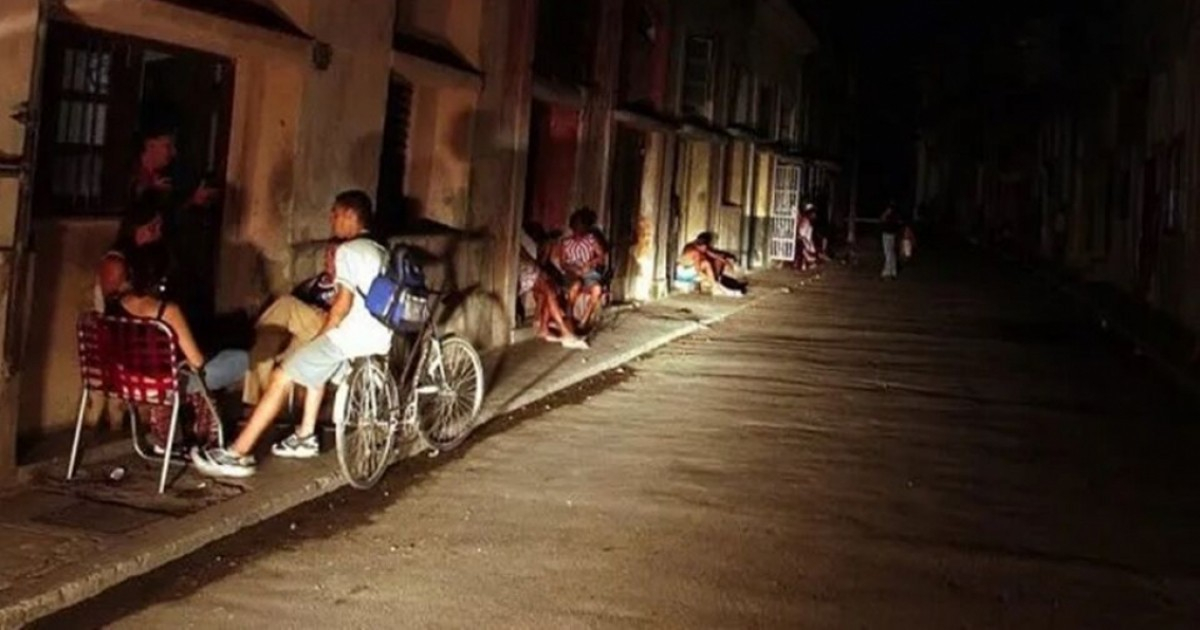
On Sunday, Cuba woke up to yet another day of extensive power outages, with the National Electric System (SEN) operating at less than half the capacity needed to meet the country's energy demands.
The official report from the Unión Eléctrica (UNE) indicated that at 6:00 am, system availability was a mere 1,245 MW against a demand of 2,650 MW, leaving a shortfall of 1,385 MW early in the day.
The situation worsens as the day progresses.
Severe Energy Shortfall Expected
By noon, the power deficit is estimated to reach 1,450 MW, and by the peak evening hours, conditions are expected to deteriorate further. Availability is projected at only 1,215 MW against a demand of 3,100 MW, resulting in a shortfall of 1,885 MW and planned outages affecting 1,915 MW, which would leave more than 60% of the country without electricity simultaneously.
Recurring Power Crisis
Saturday's conditions were equally dire. The UNE confirmed that service was disrupted due to capacity shortages for 24 hours straight, with the highest interruption reaching 1,826 MW at 9:10 pm.
In Havana, the scenario was no different. The Electric Company reported a full-day service interruption, with the maximum disruption at 367 MW by 11:30 pm. Additionally, emergency circuits were shut down, adding 105 MW without restoration.
Multiple Factors Behind the Collapse
Six blocks and emergency circuits - totaling 309 MW - remained out of service with no scheduled restoration time. The reasons for the collapse are numerous and unresolved. Four generating units are currently experiencing active failures at the CTE Máximo Gómez, Ernesto Guevara, Lidio Ramón Pérez, and Antonio Maceo plants.
Meanwhile, three other units are under maintenance at the CTE Mariel, Renté, and Nuevitas plants.
The most telling issue is the fuel shortage: 106 distributed generation plants are halted due to lack of fuel, totaling 890 MW, and unavailable megawatts due to fuel shortages amount to 1,203 MW. Additionally, the Patana de Regla, Patana de Melones, Mariel Fuel Plant, and Moa Fuel Plant are out of service.
The recently inaugurated 54 photovoltaic solar parks provided 2,999 MWh on Saturday, but their contribution is limited to daylight hours and fails to address the nighttime deficit when demand peaks.
Energy expert Jorge Piñón warned last Thursday that nearly 60% of the generator units at the country's eight thermal power plants were out of service, and the situation "cannot be resolved" quickly if the current energy management model persists.
Public Outcry and Humanitarian Impact
Cuban citizens have expressed their frustration through protests. Last Wednesday, residents of Luyanó took to the streets with pots and pans after enduring over 30 hours without electricity or water, and on Sunday, June 7, residents of Regla blocked a street in front of the municipal government, chanting "We want power!"
The humanitarian impact of the crisis is severe. In April, the UN reported over 96,000 surgeries postponed—including 11,000 for children—and nearly half a million students faced shortened school days due to the blackouts, while 32,000 pregnant women are at risk.
May 2026 concluded with 1,311 protests and critical demonstrations recorded in Cuba, the highest figure since the July 11, 2021 protests, and the regime under Miguel Díaz-Canel has yet to propose a credible structural solution plan for a population that, as one Cuban summarized on social media, feels that "here they don't even give you explanations anymore, 50, 80, however many hours without power."
Understanding Cuba's Energy Crisis
What is causing the power outages in Cuba?
The power outages in Cuba are primarily due to a combination of failing infrastructure, maintenance issues, and a significant shortage of fuel for distributed generation plants.
How is the Cuban government responding to the electricity crisis?
So far, the Cuban government has not presented a credible or effective plan to resolve the ongoing electricity crisis, leading to increased public frustration and protests.
What are the humanitarian impacts of the power crisis in Cuba?
The humanitarian impacts include postponed surgeries, shortened school days for students, and increased risks for pregnant women, exacerbating the already challenging living conditions in Cuba.