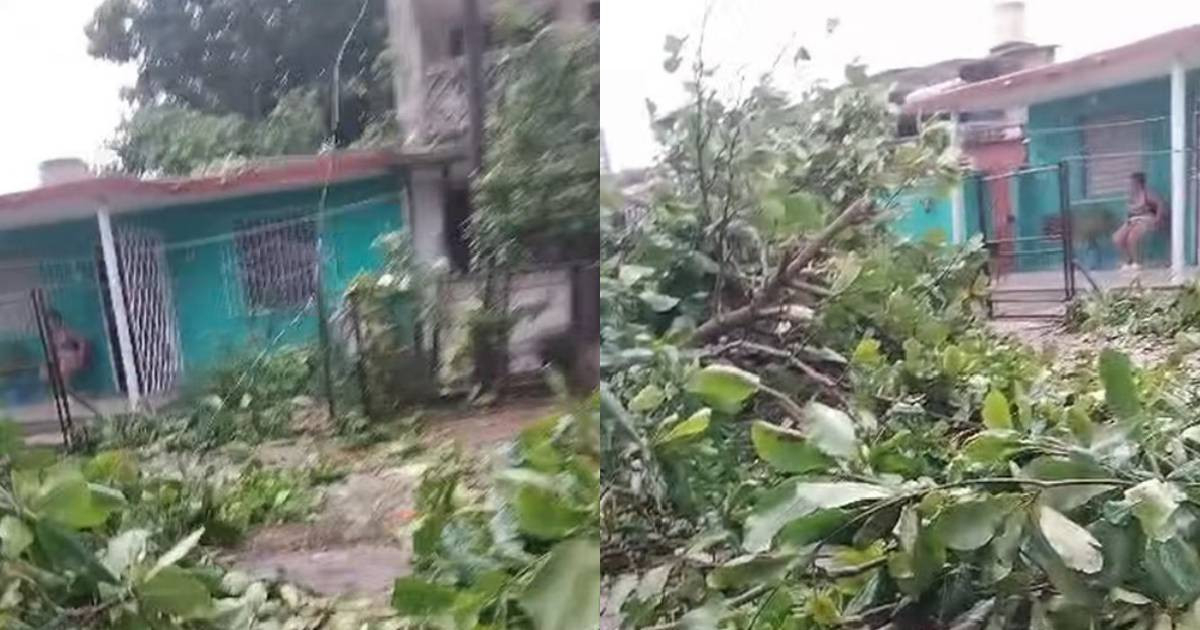
A fierce local storm, bringing heavy rain and powerful winds, swept through several areas of Camagüey city this past Saturday. Hail was reported in the Los Coquitos neighborhood, according to the Camagüey Meteorological Center, which shared the information via Radio Camagüey's Facebook page.
The official entity described the hailstones as "few and roughly the size of a pea," confirming that no damage was reported from the incident.
Additionally, independent journalist José Luis Tan Estrada posted a short video on his Facebook profile showing images of fallen trees in an unspecified area of the Agramontino territory, recorded by an unknown individual.
NASA satellite images captured at 17:36 UTC on Saturday illustrated intense convective activity over the region, with the caption Severe Local Storm overlaid on the area.
The Camagüey government's official forecast for that day predicted partly cloudy skies with showers, rain, and thunderstorms in the afternoon, with rainfall probabilities ranging between 50% and 90%.
This event occurred during Cuba's official rainy season, which begins on May 1st and accounts for approximately 80% of the country's annual precipitation, thus enhancing convective instability.
It is not the first occurrence of such a phenomenon in Camagüey this year. On April 24, a severe storm with large hail struck Ingenio Viejo in the same municipality, lasting just six minutes.
On May 7, a waterspout surprised residents of Nuevitas, also in Camagüey province, with no reported damages.
Other Cuban provinces have experienced similar episodes in recent weeks. On June 3, a severe local storm caused flooding in Bayamo, Granma, with hail and power outages, just 16 days after another event recorded winds exceeding 100 km/h, 81.5 mm of rain in an hour, and damage to 85 homes.
The frequency of these phenomena highlights the vulnerability of Cuban cities to extreme weather events, exacerbated by deteriorating urban drainage systems and precarious infrastructure.
According to Cuba's Institute of Geophysics and Astronomy, these storms arise when troughs at mid and low atmospheric levels promote the development of cumulonimbus clouds with high instability, leading to hail, heavy rain, and gusty winds that can exceed 100 km/h.
Understanding Severe Weather Events in Cuba
What causes severe storms in Camagüey?
Severe storms in Camagüey are caused by atmospheric troughs that promote the development of cumulonimbus clouds with high instability, resulting in hail, heavy rain, and strong winds.
How often do severe storms occur in Cuba?
Severe storms can occur frequently during Cuba's rainy season, which runs from May to October, accounting for about 80% of the country's annual rainfall.
What are the impacts of these storms on infrastructure?
These storms often exacerbate the existing vulnerabilities of Cuban cities, such as faulty drainage systems and weak infrastructure, leading to flooding and damage to properties.