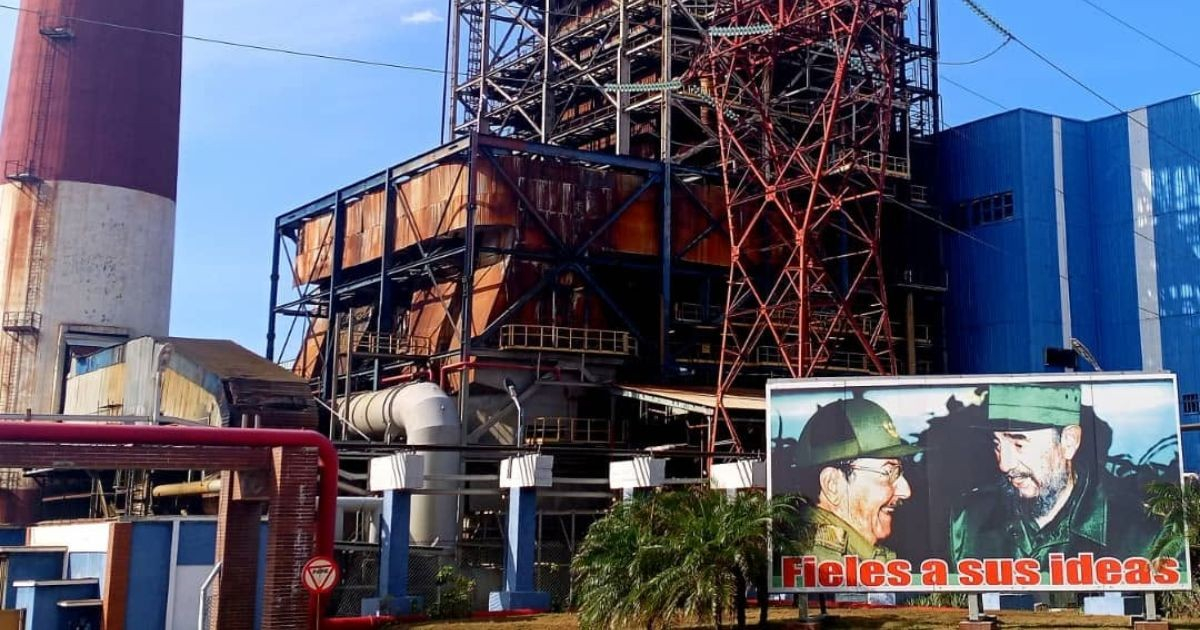
Matanzas journalist Yirmara Torres Hernández took to Facebook on Friday to share a devastating account of the power outages her community endured throughout the week: a staggering 67 hours without electricity from Saturday to Tuesday, followed by another 46 hours from Tuesday to Thursday, and an additional 26 hours at the time of her writing.
The catalyst for this post was the reactivation of the Antonio Guiteras thermoelectric plant into the National Electric System, as announced by the Electric Union (UNE) last Friday, after its 14th shutdown of the year due to boiler leaks that occurred on June 6.
Continued Struggles Despite Plant Reactivation
Torres Hernández questioned the real benefit for Matanzas in hosting the country's largest capacity plant. "Having the Guiteras, what good does it do for Matanzas? To take our water away?" she asked, highlighting the irony of its presence.
She further expressed her frustration: "What I see is that because of it, we have the longest and most exasperating blackouts in all of Cuba." She also mentioned another grievance: "And since it has leaks in the boiler, it siphons off water from much of the town."
Widespread Impact and Community Reactions
The return of the Guiteras plant did not ease the situation. On Saturday, UNE reported a meager availability of only 1,200 MW, with demand at 2,580 MW and 1,385 MW affected. Moreover, 106 distributed generation plants remained offline due to fuel shortages, leading to an absence of 890 MW.
The journalist's account sparked a flood of testimonials from residents across the province. A Colón resident reported 54 hours without electricity; a neighbor in Cárdenas faced 37 hours; in Carlos Rojas, outages exceeded 48 hours with merely an hour and a half of power once restored. One resident noted that in six days, her circuit only had five hours of service.
Many commentators reached a similar conclusion: the energy generated by the Guiteras plant does not benefit Matanzas. "The Guiteras is situated in Matanzas, but it's not for the people of Matanzas," wrote a neighbor from Torres's circuit. Another user was more direct: "Everyone knows where the energy generated by the Guiteras ends up. The government doesn't even bother to hide it anymore. Yesterday, as soon as it started, the deficit in that area dropped to almost zero." Other reflections considered that the whole country suffers from the same dire conditions, indicating a systemic issue rather than a local one.
Matanzas: The Epicenter of Energy Crisis
Matanzas, the second highest electricity-demanding province in Cuba with an average of 238 MW, has been officially recognized as the most affected by power cuts. The provincial electric company's deputy technical director admitted this on television.
The power crisis is compounded by a severe water crisis, as over 80% of Matanzas' water supply system relies on electricity. Torres has highlighted how water is also wasted in the province due to leaks caused by poor handling by hydrology workers.
The repercussions of the blackouts are severe: spoiled food, inability to pump water to elevated tanks, and increased dengue risk due to mosquito proliferation. "Food spoils, it's impossible to pump water to the tank, and cooking with charcoal is an ordeal in these rainy, humid days," summarized an online user.
Since 2024, Torres Hernández, former director of the Cuban Journalists Union (UPEC) in Matanzas, has been documenting the energy crisis and other local issues. In March 2026, she described the blackouts as "psychological torture." By June 2026, residents from various parts of the province had reported power cuts of 55, 70, and even 85 consecutive hours, making Matanzas the most visible epicenter of Cuba's energy collapse.
Frequently Asked Questions about Matanzas Power Outages
What triggered the recent power outages in Matanzas?
The power outages were exacerbated by the reactivation of the Antonio Guiteras thermoelectric plant, which had been shut down earlier due to boiler leaks.
How have the power outages affected Matanzas residents?
Residents have faced prolonged periods without electricity, leading to spoiled food, water supply issues, and increased health risks due to mosquito proliferation.
Is the energy generated by the Guiteras plant benefiting Matanzas?
Many residents believe the energy generated does not benefit Matanzas, as it appears to be diverted to other areas, leaving them with extended blackouts.