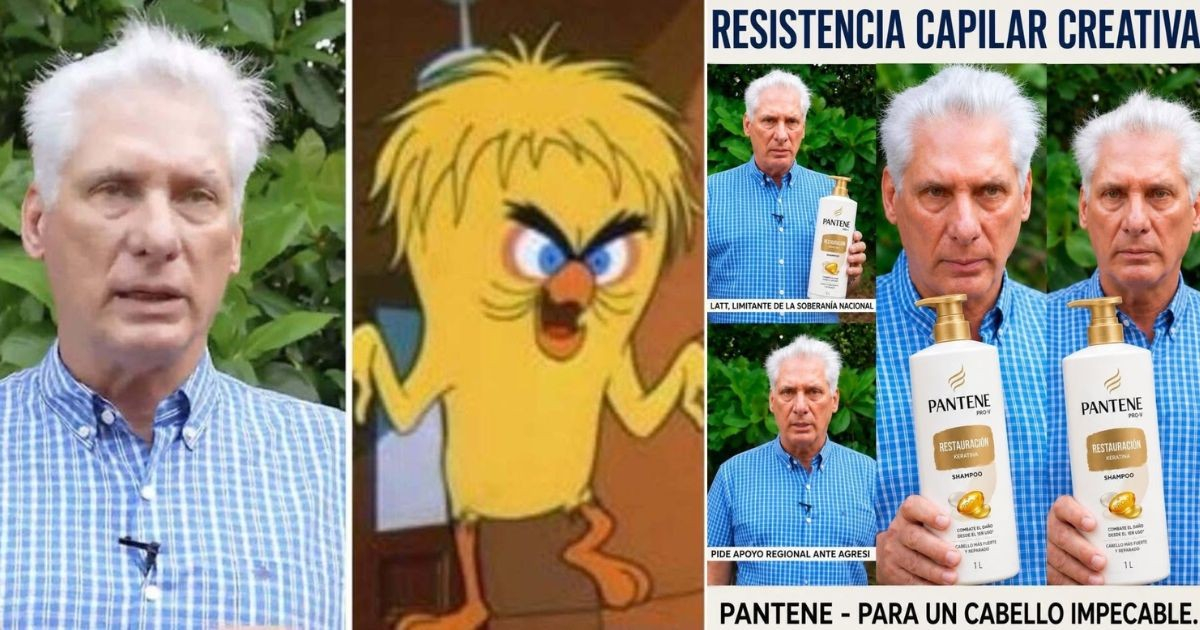
On Friday, Cuban President Miguel Díaz-Canel took to national television to discuss economic reforms, but his appearance quickly became the talk of the internet for an unexpected reason: a flood of memes centered on his wild, white hair.
During his guest spot on the national TV show Revista Buenos Días, the president appeared in a short-sleeved, blue-and-white checkered shirt, with a lapel microphone and a tropical green backdrop. As he gestured with both hands and spoke about his delayed plans to rescue Cuba's economy, it was his unruly hair that stole the spotlight.
The broadcast from June 12 quickly went viral. From within Cuba and abroad, Cubans unleashed their creativity: collages, fake ads, animated character comparisons, and witty wordplays proliferated at a pace that no power outage could hinder.
One of the standout memes was a spoof advertisement for Pantene Pro-V titled "Creative Hair Resistance," cleverly merging political rhetoric from the regime with the shampoo's slogan: "Fights damage from the first use." The irony was razor-sharp.
Another meme played on the phrase "Look, I get goosebumps," referencing a woman still moved by Cuba's political rhetoric, alongside an image of someone with spiked-up hair, directly nodding to the president's appearance. A third collage likened Díaz-Canel to a ruffled yellow cartoon character—a grumpy chick—and the "man in yellow" from the TV series From. The resemblance, according to netizens, was undeniable.
Facebook users joined the fray. "Even Sedal didn't dare to go this far," one person quipped. "He washed his hair with caustic soda soap," speculated another, noting how shampoo has been missing from Cuban stores for months. "He hasn't gotten his shampoo yet," another remarked. Someone suggested he "needs a bit of everything," referencing a popular song. A more philosophical comment read, "Karma exists." One critic deadpanned, "His only talent is being a comedian."
Economic Announcements Overshadowed by Hair
Ironically, Díaz-Canel's TV appearance was meant to unveil a long-overdue and inadequate set of economic reforms, including municipal and business autonomy, a nod to foreign and diaspora investments, and a plan to unblock small and medium-sized enterprises. These measures, according to him, are inspired by China and Vietnam's models and evaluated using artificial intelligence. "In every aspect of Cuban life, in every family detail, in every economic facet, there are extremely complex situations," acknowledged the president, a statement few would contest.
The backdrop to this appearance is anything but humorous: in May and June, Cuba faced power shortages exceeding 2,000 MW, leaving over 65% of the country without electricity simultaneously. Díaz-Canel himself admitted that only one oil shipment had arrived on the island in the past five months. By the end of May, more than 2.7 million Cubans were grappling with a lack of potable water, a crisis directly tied to the energy shortages.
This isn't the first time Díaz-Canel has been fodder for Cuban humor. In 2020, his hand-drawn TV graphics sparked the popular hashtag #CaneloArtAttack. In 2022, a seaside photo and his English pronunciation fueled a wave of ridicule. Earlier this year, his noticeable physical decline triggered another round of ironic commentary. Despite lacking electricity, water, and shampoo, Cubans retain their humor and are weary of plans and countermeasures that don't lead to real change. "The meme hour has arrived," one internet user aptly summarized.
Understanding the Memes Around Díaz-Canel
Why did Díaz-Canel's appearance go viral?
Díaz-Canel's appearance went viral primarily due to his disheveled hair, which sparked a wave of memes and humorous commentary on social media.
What were some of the popular memes?
Popular memes included a spoof Pantene ad, comparisons to animated characters, and playful phrases regarding his hair, all highlighting the irony and humor regarding his appearance.
What economic reforms did Díaz-Canel announce?
Díaz-Canel announced reforms such as municipal and business autonomy, opening up to foreign investment, and measures to unblock small and medium-sized enterprises, inspired by China and Vietnam.