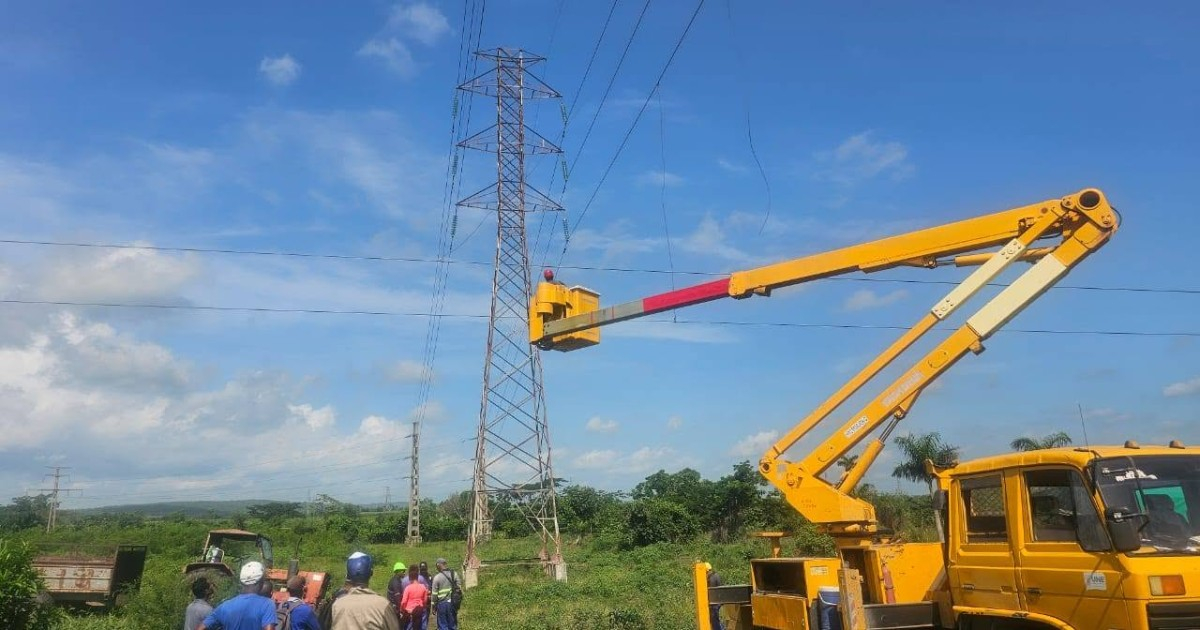
The Electric Company of Guantánamo announced on Friday that linemen teams from both Santiago de Cuba and Guantánamo are working tirelessly on the 110 kV lines that supply the province. They aim to begin technical tests and synchronize with the National Electric Grid by early afternoon to start restoring electricity service.
The entire province was plunged into darkness on Thursday, June 11, at approximately 5:20 p.m., when an automatic disconnection, known as a "trip," occurred on the 110 kV line linking Santiago de Cuba with Guantánamo. This left the entire province without power, yet the official notice failed to clarify the cause of the fault.
By the time the announcement was made, many residents had endured over 24 hours without electricity. A resident from the Reparto Obrero neighborhood reported a continuous blackout lasting 29 hours, while another noted that the 5385 San Luis–Palma Soriano line in Santiago de Cuba had been without power for 33 hours.
The company assured that power restoration would be gradual, focusing on circuits with the longest outages and essential facilities, as the system allows.
Public Outrage and Criticism
The frustration among Guantánamo's residents became evident in the comments on the company's announcement.
"They've been fixing this for over 24 hours, yet they don't explain what happened, and there's no emergency plan; it's easier to leave us without power for days," an online user lamented.
Another user questioned, "Is there no emergency fuel to activate distributed energy? Are the solar parks not operational either?"
The anger also touched on the regime's priorities. "In the peace and order of blackouts, officials come first, and then the common people," one user sarcastically remarked.
Another pointed out the food spoilage issue: "The little food we can buy at exorbitant prices is going to waste, and nobody cares."
Structural Vulnerabilities and Crisis Context
Guantánamo is particularly vulnerable due to its reliance on a single high-voltage line for connection to the National Electric Grid via Santiago de Cuba, making any failure on this line result in a province-wide blackout.
Only Baracoa and Maisí retained power during the outage, supplied through Moa.
The structural decay exacerbates the situation. On June 7, the Electric Union acknowledged that eight transformers in the province are damaged—three in Baracoa, two in Maisí, two in El Salvador, and one in Manuel Tames—without available equipment for repairs.
This blackout occurs during the peak of the 2026 Cuban electric crisis. On Friday, the national power deficit reached 1,720 MW, with an estimated demand of 3,000 MW against a mere 1,310 MW availability, and 106 distributed generation plants out of commission due to fuel shortages.
On Thursday night, the power shortfall exceeded 2,000 MW, with a record high for the year set on May 14 at 2,174 MW. Since June 3, protests and pot-banging demonstrations have erupted in Havana and Santiago de Cuba in response to the prolonged power and water shortages.
Understanding Power Outages in Guantánamo
What caused the power outage in Guantánamo?
The blackout was caused by an automatic disconnection, or "trip," on the 110 kV line connecting Santiago de Cuba to Guantánamo, though the specific cause of this fault has not been disclosed by the authorities.
How long have residents been without electricity?
Many residents have experienced over 24 hours without power, with reports of some areas being in the dark for up to 33 hours.
Why is Guantánamo particularly vulnerable to blackouts?
Guantánamo relies on a single high-voltage line for electricity, making it susceptible to complete blackouts if that line fails. The region's structural issues further compound this vulnerability.