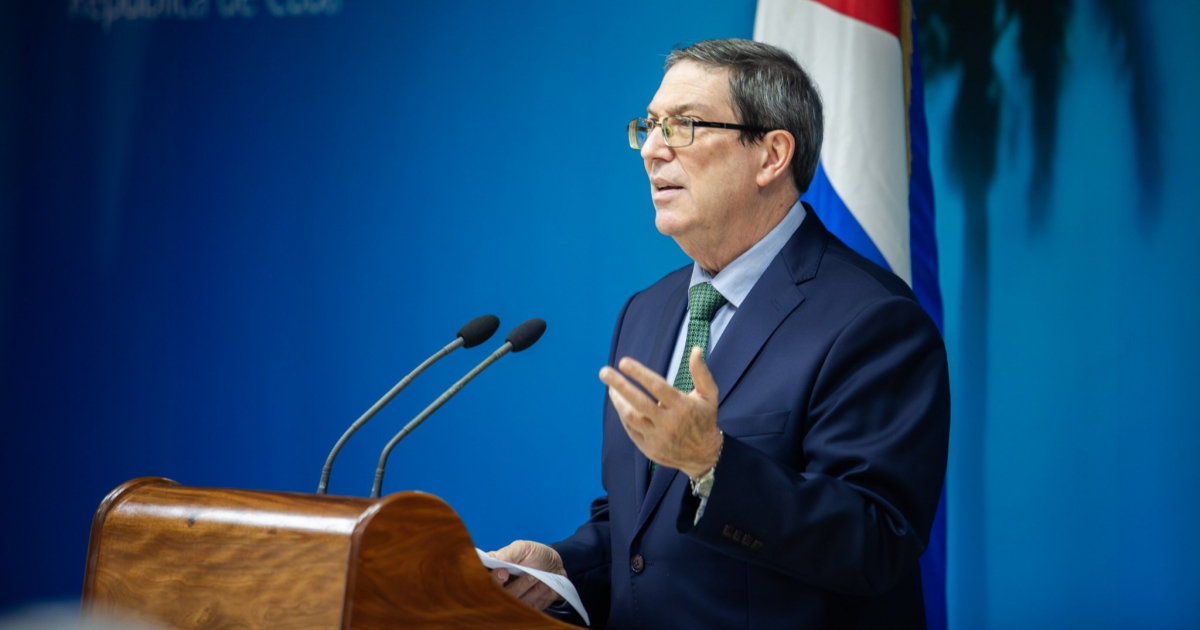
Cuban Foreign Minister Bruno Rodríguez Parrilla took to X this Friday, accusing the U.S. oil embargo of causing two major issues affecting the Cuban populace: delays in distributing 15,000 tons of rice donated by China to each province and the inability to distribute nearly 50% of the medicines produced on the island in recent months.
In his post on X, Rodríguez stated that the "U.S. oil blockade directly impacts the supply of food and medicine in Cuba," adding that "the entire population is punished, without exception, with the declared intention of provoking social unrest."
Regarding the rice, the foreign minister explained that the 15,000 tons donated by the Party, Government, and people of China "could not be immediately transported to each province due to disruptions related to cargo transportation."
On the issue of medicines, he mentioned that "the lack of fuel prevents nearly half of the medicines produced in Cuba in recent months from being distributed throughout the country."
Rodríguez concluded his message with a categorical statement: "The energy siege is real. Anyone who says otherwise is lying."
The rice donation mentioned by the foreign minister is part of a larger commitment: China pledged a total of 60,000 tons of rice to Cuba in 2026, distributed in four shipments of 15,000 tons each.
The first shipment, consisting of 15,600 tons, arrived at the Port of Havana on March 20 aboard the vessel Loyalty Hong. Distribution was gradual and varied across provinces: Mayabeque began receiving four pounds per consumer starting April 4; Camagüey, five pounds from April 15; and Las Tunas along with other provinces from April 25. A second donation of 15,000 tons was announced on May 23.
The underlying energy crisis affecting both issues is structural. Cuba requires between 90,000 and 110,000 barrels of oil daily but only produces around 40,000 internally.
At various points in 2026, the country received just one of the eight monthly fuel ships it needs, leading to power outages exceeding twenty hours a day in March and May, impacting over half of the country.
In the pharmaceutical sector, BioCubaFarma and the Ministry of Public Health acknowledged in March that Cuba must internally produce 62% of the 403 products in the national basic list, and the lack of a single component can halt the production of a drug. The struggle to find medications in Cuba has become a constant ordeal for millions of families.
The Trump administration signed an executive order on January 29 imposing secondary restrictions on countries exporting oil to Cuba, further exacerbating the supply issues.
The U.S. has historically argued that the embargo includes exceptions for medical and humanitarian products, citing nearly $900 million in approved medical exports to Cuba in 2023 alone.
On May 15, the UN warned that the humanitarian crisis in Cuba is worsening due to shortages of electricity, fuel, and medicines, noting that the fuel shortage even limits ambulance operations. The organization mobilized over $32 million in aid and transported 48 containers with supplies to eastern Cuban provinces.
Understanding Cuba's Energy and Medicine Crisis
What is causing the delay in distributing Chinese rice in Cuba?
The delay is primarily attributed to disruptions in cargo transportation, which have been exacerbated by the U.S. oil embargo.
How is the U.S. oil embargo affecting medicine distribution in Cuba?
The embargo has led to a significant fuel shortage in Cuba, which in turn hampers the ability to distribute nearly 50% of the medicines produced on the island.
What measures has the UN taken to address the crisis in Cuba?
The UN has mobilized over $32 million in aid and transported 48 containers with supplies to eastern Cuban provinces to alleviate the crisis.