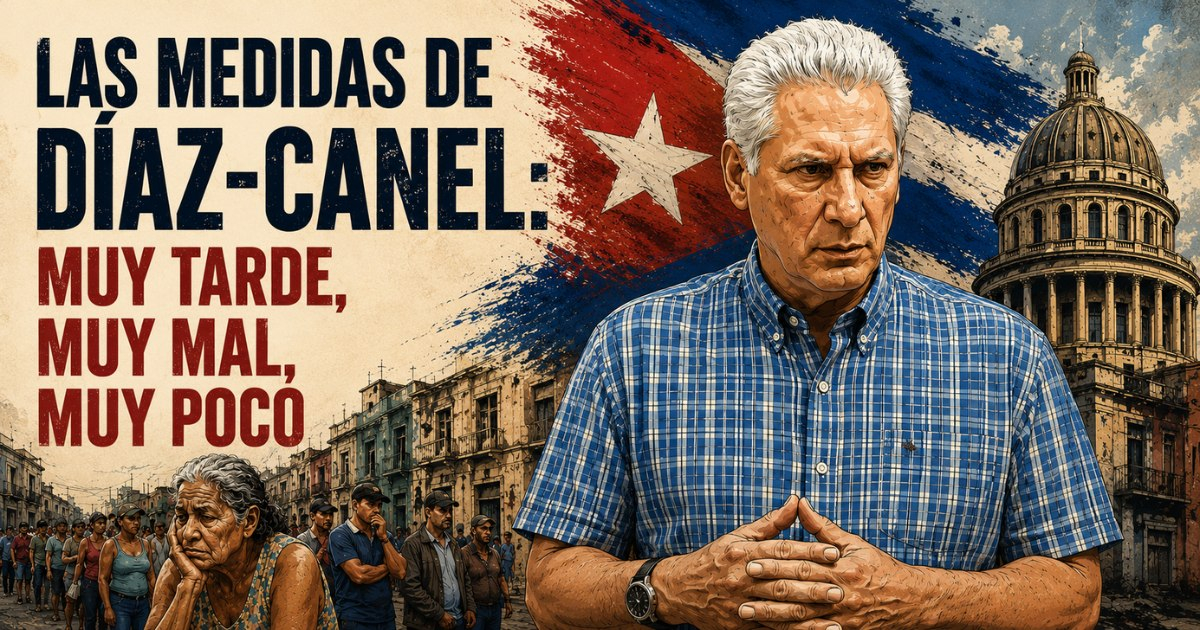
On Friday, June 12, Díaz-Canel addressed the state-run media with a set of "economic reforms," suggesting a willingness from the regime to embrace change. "The country cannot continue operating the same way," he declared. While his assessment of the situation is accurate, the proposed measures fall short of being a solution. They resemble yet another temporary relief offered to a patient in dire need of surgery.
The timing speaks volumes. These announcements come not from a place of reflective calm or strategic vision for the nation's future, but rather as a hasty response to recent events. Just days after U.S. Senator Marco Rubio enforced new sanctions against Cuba's state oil company CUPET, and mere hours following statements from the U.S. Secretary of Defense at Guantanamo Naval Base, the changes were rolled out. This isn't reform—it's a reaction.
The Persistent Cycle of the Regime
For 65 years, the Cuban regime has followed a predictable pattern: severe crisis, promise of openness, minimal controlled concession, brief respite, and eventual closure. This cycle was evident during the "Special Period" of the 1990s, Raúl Castro's 2010 reforms, the Obama-era "opening," and again in 2021 with the half-hearted "Tarea Ordenamiento" that led to crippling inflation, as substantial reforms were never implemented.
Once more, the regime is offering a small opening, just enough to avoid collapse, not to foster growth.
What Was Announced and Its Implications
The announced package consists of seven key points, each warranting careful scrutiny as the details left out by Díaz-Canel are crucial.
In tourism, the government speaks of allowing "new actors" to manage the hotel industry. This move is driven by the withdrawal of major foreign hotel chains—such as Meliá and Iberostar—from Cuba, due to U.S. sanctions. The state needs operators for its vacant hotels, which is more a management issue masquerading as reform.
State enterprises are promised "autonomy" to directly engage in export and import activities, retain part of their foreign earnings, and partner with others. While this appears as decentralization on paper, in practice, any autonomy is limited by the ruling Party, unchanged by any decree.
The elimination of state-run import companies, which are mandatory intermediaries in foreign trade, is an implicit acknowledgment of their inefficiency. However, without a clear legal framework for private trade, this change merely shifts the bottleneck elsewhere.
Farmers have been promised direct access to supplies, cash-backed accounts, and participation in the foreign exchange market. Despite Cuba being a fertile island, it imports around 80% of its food. Implementing these measures would be both urgent and necessary. However, the land market remains closed; without stable long-term property or leasing rights, no one invests in agriculture.
In real estate, Díaz-Canel mentioned "new modalities" and "new actors" without offering any specifics, making this the vaguest announcement of all.
Cubans living abroad are to be afforded "the same conditions" for investment as island residents. The issue, however, is that these conditions do not yet exist in any legal form.
The reduction of ministries from 27 to 20 is the most concrete measure announced, yet it holds little significance for the average citizen.
What's Left Unsaid
The most telling aspect of Díaz-Canel's declarations is not what was announced, but what was omitted.
No measures address the monopoly held by the military conglomerate GAESA over foreign currency, tourism, imports, and distribution. Any "new actor" entering the Cuban market will face this formidable barrier. True competition is impossible when the referee is also the player with the most advantages.
There is no unified, stable exchange rate allowing businesses to perform accurate calculations. There's no access to private credit, no reliable property registry. Under these conditions, serious investors stay away, and Cuban entrepreneurs understand that what the state gives today can be taken back tomorrow by decree, with no legal recourse or compensation.
No stable or predictable regulatory framework exists, and economic statistics are unreliable, leaving everyone—inside and outside the island—in the dark about the country's true state. Additionally, there's no mention of legal security. There's no binding international arbitration, independent tribunal for disputes between investors and the state, or compensation mechanism in case of expropriation or unilateral contract cancellation. Cuba's history in these areas is long, and today's package doesn't address any of it. Any liberalizing decree without resolving these issues remains literally "in the air," subject to the political whims of the moment.
The regime also hasn't lifted the de facto financial restrictions on foreign company accounts, nor has it provided a timeline for normalizing dividend repatriation. The absence of a transparent exchange regime, with multiple coexisting rates amid high inflation, prevents anyone from calculating at what rate they can convert their earnings or if they can take them out of the country.
The plight of emigrant investors underscores the gap between rhetoric and reality. Díaz-Canel announced that Cubans abroad would have "the same conditions" as those on the island for investment. However, the regulatory changes necessary to make this possible—including migratory modifications for a hypothetical "resident investor" category—have not appeared in the Official Gazette. Without publication in the Gazette, legal validity is absent. This announcement lacks legal backing, and no one has explained what would happen to an emigrant's assets if they were to enter into political conflict with the regime or lose their migration status.
The Underlying Issue
The Cuban economy isn't broken by accident or solely due to the U.S. embargo. It's broken by design: the predictable outcome of six decades of a system that prioritizes political control over wealth creation. True reform isn't about tweaking a few regulations; it's about dismantling the power structure.
Díaz-Canel and the Communist Party are not ready to do that—not yet. Not because they can't envision it, but because it would mean relinquishing the control upon which their entire hegemony relies. That's why every reform comes with a shut-off valve: the state gives, and the state can take away. Always.
For Cubans, who've endured years without stable electricity, without medicines, without prospects, these measures are too little, too late. As always.
Understanding the Economic Reforms in Cuba
What are the main components of Díaz-Canel's economic reforms?
The reforms include allowing new operators in tourism, granting state enterprises some autonomy in trade, eliminating mandatory state import companies, promising farmers better market access, proposing vague real estate changes, offering investment opportunities to Cubans abroad, and reducing the number of ministries.
Why are these reforms considered insufficient?
The reforms are viewed as insufficient because they don't address the underlying issues like the monopoly of GAESA, lack of a unified exchange rate, absence of private credit, legal uncertainties, and the state's ability to retract what it gives without compensation. These factors hinder true economic progress.