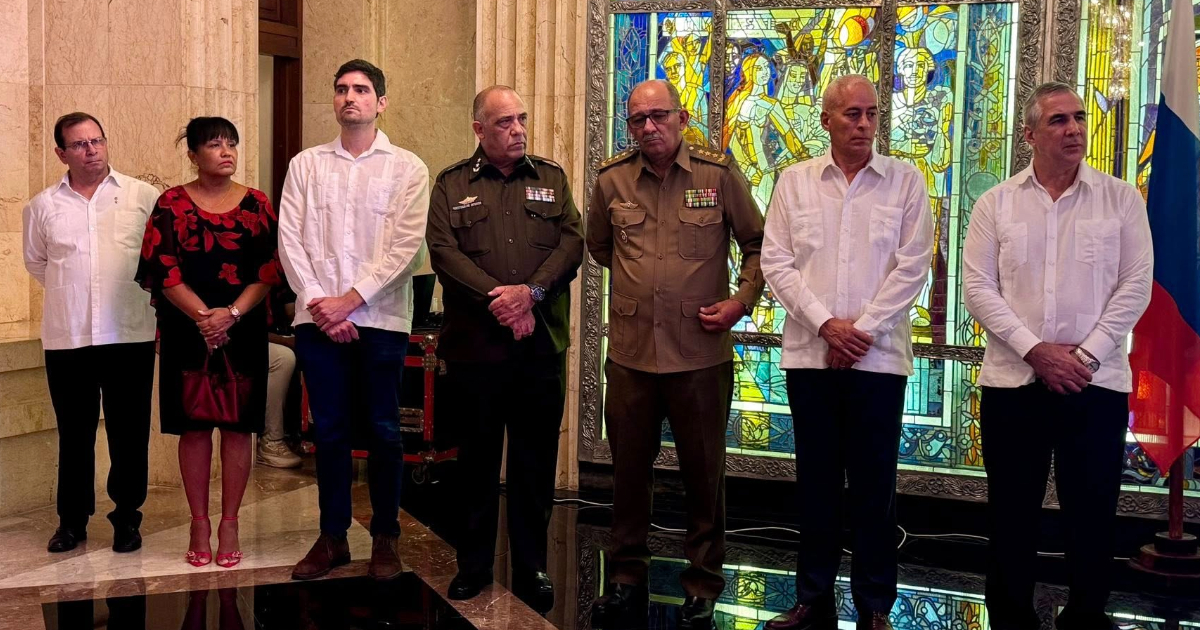
This past Thursday, the Russian Embassy in Cuba held a formal gathering to commemorate Russia's National Day at its premises in Havana. The event saw the presence of high-level Cuban officials from institutions targeted by U.S. sanctions, a move that can be seen as a unified stance against the maximum pressure strategy employed by the Trump administration.
Among the distinguished attendees were Vice Prime Minister Eduardo Martínez Díaz; First Deputy Minister and Chief of the General Staff of the Revolutionary Armed Forces (FAR), Roberto Legrá Sotolongo; First Deputy Minister of the Interior, Brigadier General Jesús Manuel Burón Tabit; and the President of the Cuban Institute for Friendship with the Peoples (ICAP), Fernando González Llort, a Hero of the Republic and former spy convicted in the U.S. as part of the Wasp Network.
Significance of the Attendance Amid Sanctions
The participation of these officials carries significant weight given the context of ongoing sanctions. The Ministry of the Interior (MININT), which includes Burón Tabit, was sanctioned by the U.S. on May 18. Similarly, the Ministry of the Revolutionary Armed Forces (MINFAR) and ICAP were both designated by OFAC on June 4, just days before this diplomatic reception.
Russian Ambassador Victor Koronelli led the event, delivering a speech that openly supported the Cuban regime. "Faced with daily threats of armed invasion, the tightening of the criminal economic, commercial, and financial blockade, and now the energy siege and media attacks, the people of the largest of the Antilles show incredible resilience," he declared, invoking the legacy of Fidel Castro.
Moscow's Continued Support for Cuba
Koronelli assured Moscow's unwavering support, stating, "Cuba has been and remains our strategic partner and one of our key allies in Latin America and the Caribbean. We will continue to support our friends in defending the sovereignty of the Republic, providing political and diplomatic help, as well as any material support possible."
The presence of Legrá Sotolongo was particularly noteworthy. On May 29, the FAR's Chief of Staff met with General Francis L. Donovan, Commander of the U.S. Southern Command, at the Guantanamo Naval Base, an encounter described as unprecedented in recent history. Less than two weeks later, Legrá Sotolongo appeared at the Russian embassy alongside officials from institutions sanctioned by Washington.
Deepening Bilateral Relations
Fernando González Llort, who has led ICAP since 2017, oversees an organization founded in 1960 that various sources describe as an external influence platform linked to Cuban intelligence. The reception is part of a steadily intensifying bilateral relationship. In March 2025, Russia and Cuba signed a military cooperation agreement that President Putin ratified in October that year.
By May 2026, the two nations were negotiating new areas of collaboration, with Foreign Minister Sergey Lavrov promising "political, diplomatic, and material support" to Havana. This occurs as the Trump administration enforces the most intensive sanctions offensive against Cuba in decades, with over 240 new designations since January 2026.
Koronelli concluded his address by announcing that Russia and Cuba would jointly celebrate the centennial of Fidel Castro's birth on August 13.
Understanding the Russian-Cuban Relationship Amid U.S. Sanctions
Why did Russian and Cuban officials meet at the Russian Embassy in Havana?
The meeting was part of a formal reception on Russia's National Day, highlighting a show of solidarity between Russia and Cuban officials from sanctioned institutions against U.S. pressures.
What is the significance of the sanctions mentioned in the article?
The sanctions target Cuban institutions and officials, reflecting the U.S. strategy to apply maximum pressure on Cuba. The presence of these officials at the embassy signifies a defiant response to these measures.
What role does Fernando González Llort play in Cuban-Russian relations?
Fernando González Llort leads ICAP, an organization involved in fostering Cuba's influence abroad, and plays a part in strengthening ties with Russia, as evidenced by his presence at bilateral events.