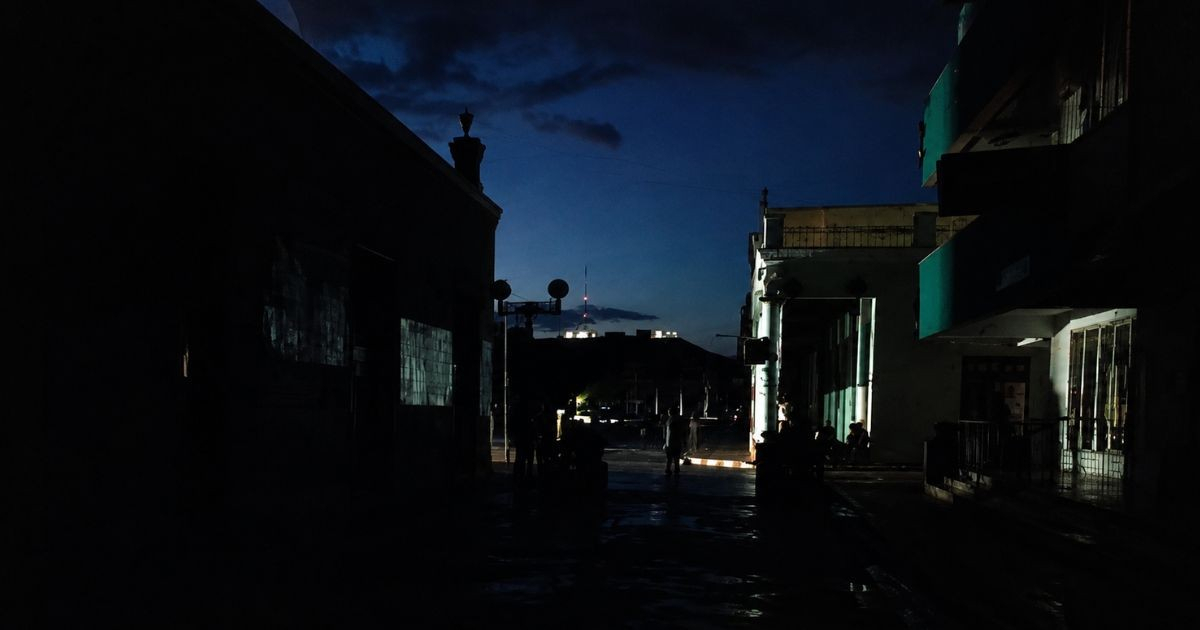
The Holguín Power Company has admitted that residential circuits in the province receive about three hours of electricity for every 39 or slightly more than 40 hours of power outages. This service scheme was explained by Rubert Reynaldo González, the company's general director, during an appearance on Telecristal, with a summary shared on the company's social media platforms.
Holguín ranks as the second-largest province in Cuba in terms of electricity customers, serving 383,180 users and facing a peak demand of 240 MW. However, the current operational capacity is limited to just 70 MW, which is less than 30% of the required power.
Of the available 70 MW, 26 MW are allocated to essential services, and around 20 MW are dedicated to the nickel industry, leaving only 14 MW to cover a residential demand of 190 MW. This shortfall has led the company to implement a "queue" system instead of traditional blackout schedules. "Because of the low availability, traditional blackout blocks cannot be planned; instead, a 'queue' system is used where circuits receive approximately 3 hours of service for every 39 or slightly more than 40 hours of outage," González stated, without emotion.
There are 18 prioritized circuits that serve 4.04% of customers, ensuring the operation of critical services such as strategic hospitals, the eight main water pumping systems, tourism, the airport, and the Felton Thermoelectric Plant.
The company also highlighted a worsening issue: when power is restored after extended outages, the simultaneous reconnection of devices and the mass charging of batteries, ecoflows, and electric scooters result in overloads that damage transformers.
"The capacity of the three national workshops is insufficient to meet the repair demand, with some cases in the province experiencing over a month of interruption due to a lack of spare equipment," the company noted.
In times of heightened risk to the National Electric System, the company is compelled to shut down even water pumping circuits to provide the scheduled three hours of service for residential circuits on rotation.
This announcement follows a deleted Telegram post by the Holguín Power Company on June 2, which acknowledged the three hours of daily electricity and the prioritization of tourism, sparking a wave of criticism.
The document, captured before deletion, revealed that the National Load Dispatch assigned Holguín 60 MW: 35 MW for vital services, three MW for the Guardalavaca tourist hub, and only 22 MW for residential and commercial rotation.
Such conditions are not new. Since March 2026, the company has been operating under plans that promised just three hours of electricity per shift. By April, outages extended to 18 hours daily, and by the end of May, blackouts exceeded 24 consecutive hours.
The crisis affects all of eastern Cuba. Lester Salvador Cedeño, director of the electrical dispatch in Santiago de Cuba, admitted on May 31 that outages exceed 20 hours daily: "We often can't even reach two hours of service."
Nationally, a record deficit of 2,174 MW was recorded on May 14, with only 976 MW available against a demand of 3,150 MW. On June 10, Cuba was generating less than 1,000 MW, only a third of what is needed to meet national demand.
Understanding Holguín's Power Crisis
What is the current power service scheme in Holguín?
Holguín's power service scheme provides approximately three hours of electricity for every 39 to 40 hours of power outages.
How is the power allocated in Holguín?
Of the 70 MW available, 26 MW are used for essential services, 20 MW for the nickel industry, and only 14 MW are left for residential needs, which require 190 MW.
Why are there frequent overloads when power is restored?
Overloads occur because of the simultaneous reconnection of devices and mass charging of batteries, ecoflows, and electric scooters, which damage transformers.
What are the challenges faced by the repair workshops?
The national workshops lack sufficient capacity to handle the repair demand, resulting in prolonged power interruptions due to a shortage of spare parts.