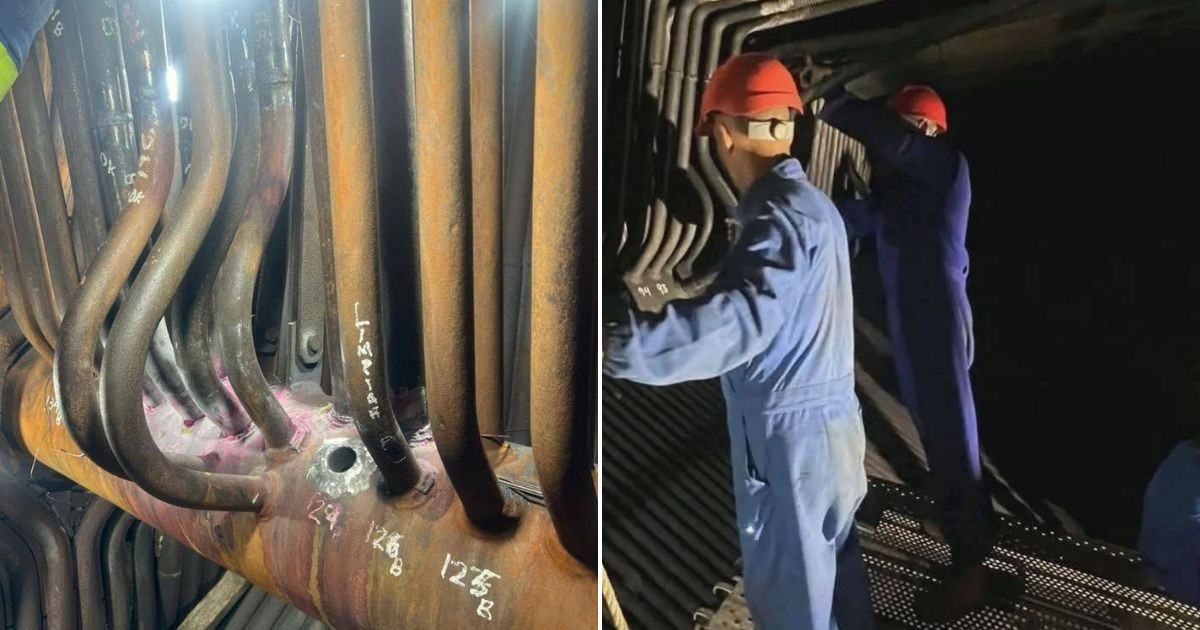
Officials at the Antonio Guiteras thermoelectric plant in Matanzas have declared that they plan to restart the unit tonight, as reported by the government-aligned journalist, José Miguel Solís.
According to Elmer García Romero, the technical deputy director of the facility, a six-hour hydraulic test has been completed. The next steps involve finalizing a welding task and conducting radiological control of a detected leak in the boiler before they can ignite and synchronize with the National Electric System.
García emphasized that this time, inspections were not only intensified on the economizer, which has been responsible for recent shutdowns, but also on numerous heat exchange surfaces throughout the plant.
Nevertheless, the Cuban populace, used to hearing promises that outlast the unit's operational time, remains skeptical of these so-called "miraculous repairs."
Plant experts have pointed out that the delay is due to the need for scientific precision and foresight to prevent further breakdowns, referring to the plant's notorious history of frequent malfunctions.
Solís himself acknowledged in his report that "Guiteras won't be online for the peak demand period, despite many wishing it would be," though he described the challenges overcome as something that "surpasses the wildest imagination."
This announcement follows the 14th shutdown of the Guiteras from the National Electric System this year, which occurred on Friday, June 6, due to new leaks in the boiler, just three days after syncing on June 3.
Throughout 2026, the pattern repeats: promised start-ups swiftly followed by fresh failures within days, fostering growing skepticism among the public about the plant's capability to remain operational consistently.
As the largest generating unit in Cuba, with a capacity of around 300 MW, Guiteras' chronic instability exacerbates an already dire electrical crisis, considered the worst in the country's recent history.
This Thursday, the electrical deficit exceeded 2,000 MW, with protests erupting as Cubans banged pots and pans in Havana.
On June 10, the Electric Union predicted a deficit of 2,010 MW for the night, with demand at 3,000 MW and availability at a mere 990 MW, while Cuba produces less than a third of its required electricity.
That same day, 106 distributed generation plants were out of service due to fuel shortages, adding another 890 MW to the deficit.
In provinces like Granma, blackouts have stretched between 45 and 48 hours consecutively, illustrating the structural collapse of an electrical system devastated by decades of underinvestment and mismanagement under the dictatorship.
Solís concluded his report with a phrase encapsulating the uncertainty surrounding each new attempt: "If it stays online for much longer, it will be a success and congratulations will pour in, but if it fails, they will face the satisfaction of sacrifice and likely human ingratitude."
Understanding Cuba's Power Crisis
What is causing frequent power outages in Cuba?
Frequent power outages in Cuba are primarily due to the chronic instability of the country's largest power plant, Guiteras, and a general lack of investment and poor management in the electric infrastructure.
How is the Guiteras plant affecting Cuba's power supply?
The Guiteras plant's frequent shutdowns significantly contribute to the electrical crisis by reducing the available power supply, thereby increasing the overall deficit.
What measures are being taken to address the power crisis in Cuba?
Efforts are focused on scientific precision and foresight to prevent further breakdowns at key power plants like Guiteras, though skepticism remains high among the population.