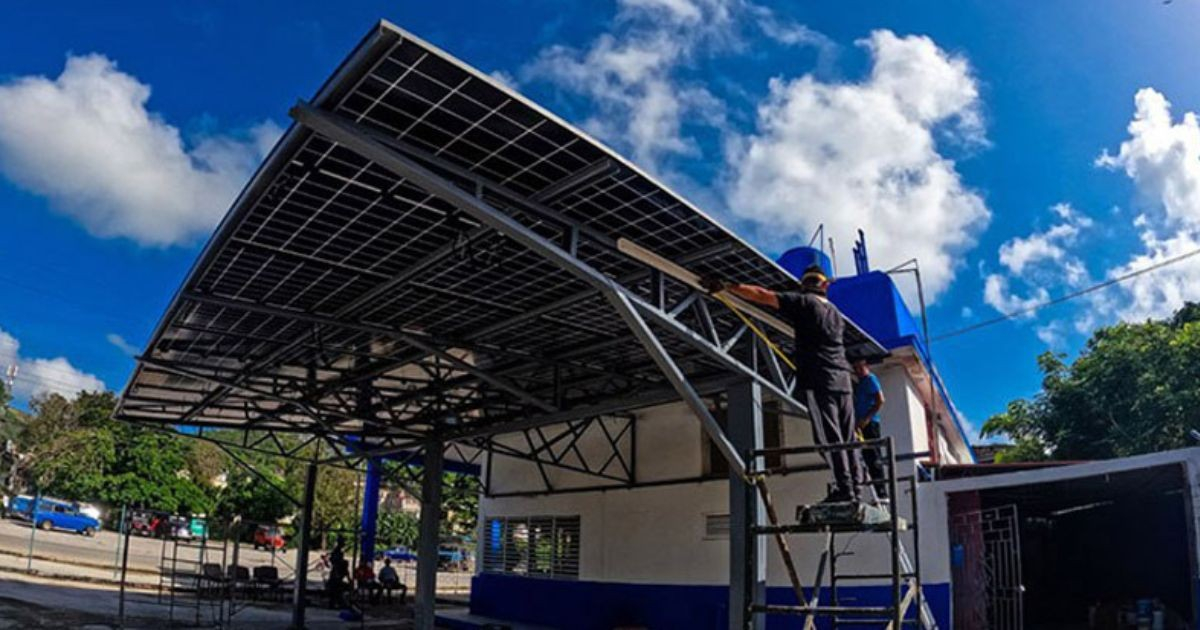
Holguín's inaugural solar charging station has wrapped up its civil construction phase and is gearing up to begin operations.
The initiative is spearheaded by the private enterprise Frenas Conmigo. Álvaro Grass González, the sole proprietor and founder, revealed that the initial phase involved preparing the building and installing solar panels in the Alcides Pino neighborhood of Holguín's main municipality, at a site previously used as a fuel service center.
This first stage of the facility will host 32 kW in inverters and 60 kW in batteries.
Once the technological setup is complete, the solar station will provide charging services for electric tricycles, bicitaxis, and scooters, operating around the clock.
Community Support and Future Expansion
In addition to offering electric vehicle charging services, the center will provide free services to the community, including charging stations for mobile phones, rechargeable lamps, and dedicated areas for cooking.
Grass González noted that the facility will also feature a specialized store selling high-demand electrical supplies that are hard to find in the informal market, such as switches, cables, insulating tape, and outlets.
A planned second phase will expand capacity to 60 kW in inverters and 150 kW in batteries, enabling the station to cater to electric cars as well.
Addressing Holguín's Energy Crisis
This project is particularly significant amid the energy crisis plaguing Holguín, one of Cuba's hardest-hit provinces. The area is currently limited to an electric supply of just 70 MW against a demand of 225 MW, with power outages exceeding 24 consecutive hours.
The Lidio Ramón Pérez thermoelectric plant in Felton, a critical source for eastern Cuba's electricity, has experienced frequent breakdowns and was entirely disconnected from the National Electrical System in February 2026, resulting in a total blackout in Holguín, Granma, Santiago de Cuba, and Guantánamo.
This solar charging station will be the first in eastern Cuba operated by a private microenterprise, signaling a milestone in the private sector's shift toward renewable energy on the island.
Expansion of Solar Charging Stations Across Cuba
Independent solar charging stations, known as "solineras," have been emerging across the nation since the first was unveiled in Santa Clara on April 5. It was constructed in just nine days by the Local Development Project Gomate and the private company Eléctrica Total.
Following Santa Clara, Matanzas has planned nine solar charging points, and Havana has announced one in the heart of Vedado at the intersection of 23 and J streets.
Juan López, a commercial technician with Frenas Conmigo, had previously highlighted the project's social impact by stating, "It will greatly benefit nearby communities and those traveling in electric vehicles who need to charge them, especially now that the energy situation has become nearly critical."
Founded in 2022, Frenas Conmigo has been recognized as a National Vanguard Collective by the Cuban Workers' Central for its provincial leadership in brake and clutch system repair.
Frequently Asked Questions About Holguín's Solar Charging Station
What services will Holguín's solar charging station offer?
The station will offer charging services for electric tricycles, bicitaxis, and scooters. It will also provide free community services such as charging mobile phones and rechargeable lamps, along with cooking facilities.
How does Holguín's energy crisis affect the region?
Holguín faces an acute energy crisis with a supply of only 70 MW against a demand of 225 MW, leading to prolonged power outages. The region's main power plant has suffered frequent failures, exacerbating the situation.
What future plans are there for the solar charging station?
The station plans to expand its capacity to accommodate electric cars by increasing its inverter capacity to 60 kW and battery capacity to 150 kW in a future phase.