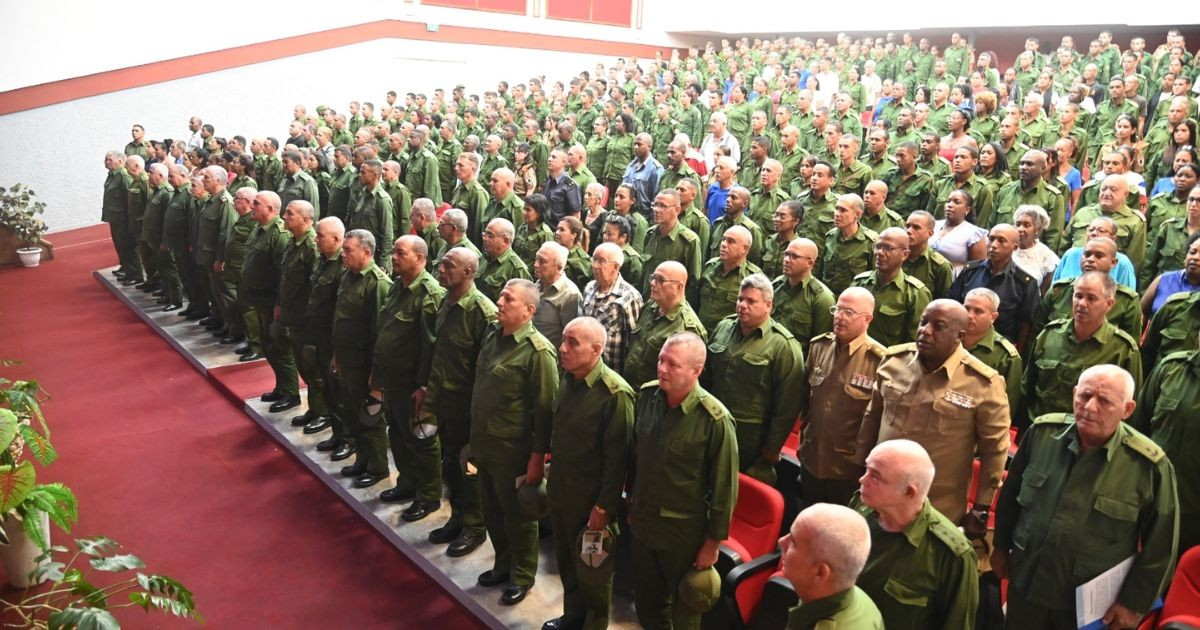
On Thursday, Miguel Díaz-Canel led a high-profile military ceremony in Havana celebrating the 65th anniversary of the Western Army. The event was attended by the Minister of the Revolutionary Armed Forces (FAR), Corps General Álvaro López Miera, and included a formal congratulatory message from Raúl Castro, who is currently retired.
The ceremony gathered hundreds of uniformed personnel in a capital auditorium where awards and medals were distributed, and several officers received promotions to higher ranks.
Honoring the Founders of the Western Army
During the event, a tribute was paid to Commander of the Revolution Guillermo García Frías, recognized as the founding leader of the Western Army, an organization established in 1961 to protect the provinces of Havana, Matanzas, and Pinar del Río.
Commitment to Defense Amid Rising Tensions
General of Division Ernest Feijóo Eiró, the head of the Western Army, reaffirmed the commitment of his troops to remain "steadfast in our combat positions" in the face of what he described as a "serious threat of aggression against the Homeland."
"We will confront any plans that aim to undermine our resolve to be free and independent," declared the senior military leader.
Escalating Crisis with the United States
The event takes place at a time of heightened tension between Cuba and the United States, the most intense in decades.
Just a day earlier, U.S. Secretary of War Pete Hegseth visited Guantánamo Naval Base and issued direct warnings to the regime, referencing the so-called "Donroe Doctrine," an updated version of the Monroe Doctrine to "reassert control over the hemisphere."
On the same Thursday, from Central Command in Tampa, Hegseth confirmed that an operation to capture or eliminate Díaz-Canel "remains an option on the table."
"All options are on the table. The President expects us to act with firmness and determination in our response," Hegseth stated.
The Cuban regime responded to these statements by calling them "completely misguided."
The crisis has been escalating since May 2026, when Axios reported that Cuba had acquired over 300 military drones from Russia and Iran since 2023, with potential plans to use them against Guantánamo and targets in Florida.
In response, Washington deployed the USS Nimitz aircraft carrier to the Caribbean on May 20 and tasked the Southern Command with developing military action scenarios against the island.
Defensive Mobilization Under Díaz-Canel
Since April, Díaz-Canel has maintained a rhetoric of defensive mobilization grounded in the "War of All the People" doctrine, warning that American aggression would lead to a "bloodbath with incalculable consequences."
In this context, the joint presence of Díaz-Canel and López Miera at the Western Army event, supported by Raúl Castro's message, serves as a deliberate signal of unity between the regime's civilian and military leadership in the face of pressure from Washington.
Key Aspects of Cuba-U.S. Tensions
What is the significance of the Western Army's anniversary event in Havana?
The event marked the 65th anniversary of the Western Army and was significant for showcasing the unity between Cuba's military and civilian leadership amid rising tensions with the United States.
What are the key tensions between Cuba and the United States?
The tensions have escalated due to Cuba's acquisition of military drones from Russia and Iran and the U.S.'s military maneuvers in the Caribbean, including threats against Díaz-Canel.
How has Díaz-Canel responded to the U.S. threats?
Díaz-Canel has emphasized a defensive stance, warning that any American aggression would lead to severe consequences and maintaining a rhetoric of national defense.