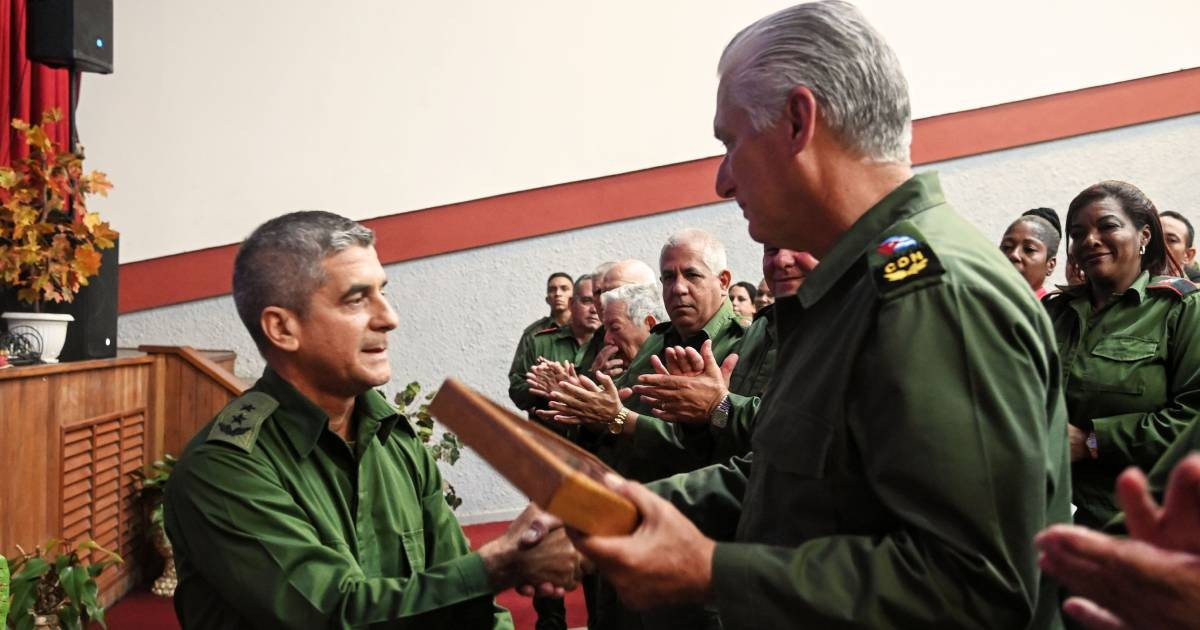
The head of Cuba's Western Army, Major General Ernest Feijóo Eiró, declared on Thursday that the forces under his command will remain "resolute in our combat positions" in response to what he called a "serious threat of aggression to the Homeland." His speech, delivered amidst escalating tensions between Havana and Washington, emphasized Cuba's readiness to defend itself.
The remarks were made during the 65th-anniversary ceremony of the Western Army, attended by Miguel Díaz-Canel and the Minister of the Revolutionary Armed Forces (FAR), Army Corps General Álvaro López Miera, as reported by the Cuban Presidency on social media.
"We will confront any plans that aim to undermine our resolve to remain free and independent," Feijóo Eiró asserted to officers and troops of one of the country's principal military structures.
Although the event was officially to commemorate the founding of the Western Army, the statements by the military leader reflected the current political and military standoff between the United States and Cuba.
Historical Context and Recent Developments
The ceremony also featured a congratulatory message from Army General Raúl Castro, alongside tributes to Commander of the Revolution Guillermo García Frías, regarded as the founding leader of this military unit. Medals and recognitions were awarded to outstanding officers and combatants, with several military personnel receiving promotions to higher ranks.
Established in June 1961 by Fidel Castro, the Western Army's mission is to protect the western region of Cuba, home to strategic sites like the Mariel port, crucial military bases, and the nation's capital.
Escalating Tensions with the United States
Feijóo Eiró's statements arrive at a particularly sensitive juncture in Cuba-U.S. relations. Just a day prior, U.S. Secretary of War Pete Hegseth suggested from Tampa that a potential operation to capture or eliminate Miguel Díaz-Canel "remains an option on the table," further inflaming the dialogue between Washington and Havana.
During a visit to the Guantanamo Naval Base, Hegseth introduced the "Donroe Doctrine," a modern take on the Monroe Doctrine, warning Cuba against developing or acquiring military capabilities that could threaten U.S. installations.
This visit also included a reminder of the capture of Nicolás Maduro in Venezuela, illustrating the operational capability of the United States to act against governments perceived as hostile.
Tensions have been mounting in recent months. Reports in May suggested Cuba's acquisition of over 300 military drones from Russia and Iran since 2023, claims later denied by Moscow.
In response, the Trump administration dispatched the USS Nimitz aircraft carrier to the Caribbean, a move seen by analysts as a show of strength in the region.
Cuba's Military Preparations
Simultaneously, the Cuban government has intensified its military preparedness rhetoric. Early this year, it declared 2026 as the "Year of Defense Preparation" and has been conducting regular training under the "War of All the People" doctrine.
In late May, the Western Army released images of military exercises in the Mariel area, featuring coastal rocket unit maneuvers and combat diving forces.
Díaz-Canel, in recent weeks, has amplified his rhetoric. In May, he warned that a potential U.S. military aggression would result in "a bloodbath of incalculable consequences," asserting that Washington is evaluating various scenarios to increase pressure on Cuba.
In this context, the message conveyed during the Western Army's anniversary reinforces the official narrative of preparation and resistance promoted by Cuban authorities in the face of what they perceive as an escalating external threat.
The military structure will officially celebrate its 65th anniversary on June 14, a date considered a milestone in the nation's defensive organization by the FAR.
Insights into Cuba-U.S. Military Tensions
What recent events have heightened U.S.-Cuba tensions?
Recent tensions have been fueled by U.S. Secretary of War Pete Hegseth's remarks about a potential operation against Miguel Díaz-Canel and reports of Cuba acquiring military drones from Russia and Iran.
How is Cuba responding to perceived threats from the U.S.?
Cuba has declared 2026 as the "Year of Defense Preparation," conducting regular military training and exercises, and reinforcing its rhetoric of resistance against external threats.